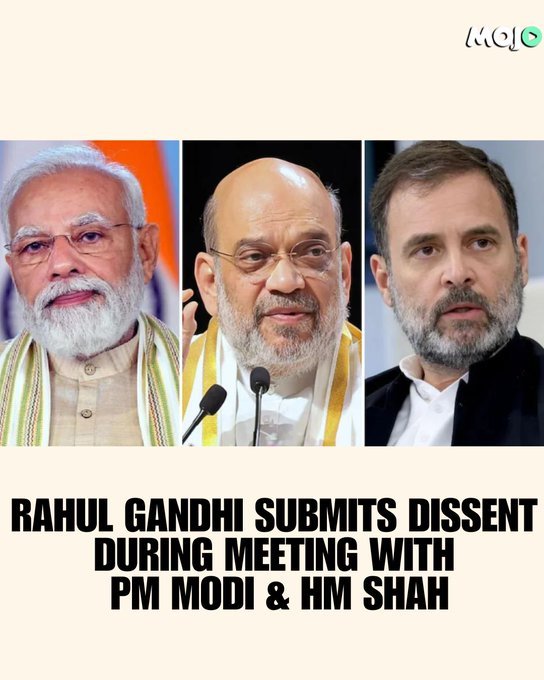
Rahul Gandhi submitted a formal note of dissent challenging some government-backed candidates for the transparency watchdogs, arguing the need to safeguard institutional independence amid a massive RTI backlog.
BY PC Bureau
December 10, 2025: NEW DELHI: In a significant display of bipartisan engagement amid ongoing parliamentary tensions, Leader of the Opposition (LoP) in the Lok Sabha Rahul Gandhi held a 90-minute closed-door meeting on December 10, 2025, with Prime Minister Narendra Modi and Union Home Minister Amit Shah in the Prime Minister’s chamber at Parliament House.
The high-level panel—constituted under the Right to Information (RTI) Act, 2005, and the Central Vigilance Commission (CVC) Act—focused on filling critical vacancies in India’s apex transparency institutions: the Central Information Commission (CIC) and the Central Vigilance Commission (CVC).
Discussions centered on the appointment of a new Chief Information Commissioner (CIC), a post vacant since the retirement of Heeralal Samariya on September 13, 2025, and the selection of eight Information Commissioners (ICs). The CIC is currently functioning with only two serving members: Anandi Ramalingam and Vinod Kumar Tiwari. The panel also deliberated on filling a Vigilance Commissioner position within the CVC.
READ: ₹55-Cr Tirupati Scam: Polyester Shawls Sold as Pure Silk
READ: Delhi HC Questions Centre Over Soaring Airfares Amid IndiGo Crisis
With more than 30,838 RTI appeals and complaints pending, timely appointments are considered crucial to safeguarding citizens’ right to information.
BREAKING NEWS 🚨
Rahul Gandhi dissents against PM Modi and Amit Shah on selections of central panel chiefs.
LoP Rahul Gandhi today submitted a formal note of dissent during a high level meeting between PM Modi and Amit Shah to finalise the appointments of key transparency… pic.twitter.com/Stmqzzn6XT
— Ravinder Kapur. (@RavinderKapur2) December 10, 2025
According to media reports, broad consensus was reached on several names, but Gandhi submitted a formal note of dissent on certain government-proposed candidates. Congress members described the dissent as a principled stand to protect institutional independence, echoing Gandhi’s earlier remarks about the 2:1 voting imbalance that favors the executive in such panels.
A senior Congress leader, speaking to a media outlet, said Gandhi rejected “every single name floated by the government,” emphasising the need for diverse representation. The dissent has been formally recorded and final appointments—once cleared by the President—are expected in the coming days.
The meeting follows multiple Supreme Court directives, including a July 2025 petition by RTI activist Anjali Bhardwaj, seeking urgent filling of CIC vacancies to prevent erosion of the RTI framework. Established in 2005, the CIC adjudicates grievances arising from non-compliance with RTI requests and has quasi-judicial powers similar to a civil court.
Berlin Visit Sparks Bipartisan Barbs
The CIC-CVC meeting coincided with mounting political rhetoric over Rahul Gandhi’s upcoming visit to Berlin, Germany, from December 15–20, 2025—overlapping with the extended Winter Session of the Lok Sabha, now scheduled until December 19.
BJP leaders seized on the timing to accuse Gandhi of neglecting parliamentary duties. One BJP spokesperson posted on social media, calling Gandhi “Videsh Nayak” (Foreign Hero) and “Leader of Paryatan” (Tourism Leader), pointing to previous occasions where Gandhi was abroad during key political events.
Several other BJP MPs joined in the criticism on social platforms, questioning Gandhi’s commitment to opposition responsibilities.
Congress responded sharply. Priyanka Gandhi Vadra countered on social media:
“PM Modi spends half his working time outside the country—how many foreign trips has he made this year alone? Hypocrisy at its peak.”
She cited the Prime Minister’s 2025 international engagements, including G20-related events and bilateral summits, to argue that the criticism was politically motivated.
Congress spokespersons dismissed the attacks as “desperate distractions,” noting that Gandhi had strongly questioned the government during the December 9 Lok Sabha debate on electoral reforms and alleged Election Commission bias.
Rahul Gandhi’s Berlin Agenda: Diaspora Outreach & Diplomacy
Despite the controversy, preparations for Gandhi’s Germany trip continue. The Indian Overseas Congress (IOC) is framing it as a major diaspora outreach initiative.
Gandhi will be accompanied by senior advisors Sam Pitroda and Dr. Arathi Krishna. He is scheduled to headline a major pan-European IOC summit in Berlin on December 17, hosted by IOC Austria President Ausaf Khan. The event is expected to draw 500–700 attendees representing more than 20 European countries.
According to media reports, Gandhi will hold discussions on:
- India-Germany trade (which reached €21 billion in 2024)
- Green energy partnerships
- Migration and visa challenges for NRIs
- Concerns about democratic institutions
He is also expected to meet lawmakers from Germany’s Bundestag, including members from the Social Democratic Party (SPD) and the Greens.
IOC leaders say the agenda includes strengthening Congress’s organisational footprint overseas and addressing long-standing diaspora issues such as consular access and visa delays.
Within the BJP, however, critics are portraying the visit as part of a so-called “India defamation campaign,” an allegation Congress has rejected as baseless.