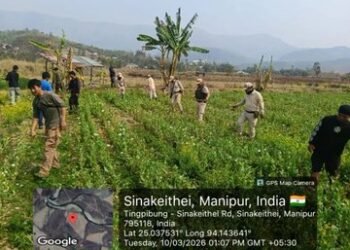
The NGT’s Eastern Zone Bench has ordered an immediate halt to construction on the German–Tiger road project in Manipur’s hill districts, citing prima facie environmental violations and the absence of mandatory statutory clearances.
BY PC Bureau
December 28, 2025: In a significant development amid Manipur’s prolonged ethnic unrest, the National Green Tribunal (NGT), Eastern Zone Bench in Kolkata, has ordered an immediate halt to all construction activities on the controversial German–Tiger road project cutting through the state’s hill regions.
The road was conceived as an alternative connectivity route between the hill districts of Churachandpur and Kangpokpi, as the conventional road link between the two districts passes through Imphal, which has remained inaccessible for many Kuki residents due to safety concerns following the ethnic clashes that erupted on May 3, 2023.
The NGT passed an interim order on December 23, 2025 during the fifth hearing of Original Application No. 144/2025/EZ, filed on August 20, 2025, by Khuraijam Athouba , spokesperson of the Coordinating Committee on Manipur Integrity (COCOMI). Invoking the precautionary principle under Section 20 of the NGT Act, the tribunal cited prima facie evidence of serious environmental violations, including the absence of mandatory statutory clearances and the risk of irreversible damage to fragile hill ecosystems.
Commonly referred to as the “Tiger Road,” or “German Road,” the project traverses forested and hilly terrain across several districts—Churachandpur, Kangpokpi, Noney, and Ukhrul. The road drew widespread attention after images and videos circulated on social media showing alleged inauguration events involving local leaders, including the Saikul MLA, and gates bearing the name “Tiger Road.”
In its petition and subsequent public statements, COCOMI alleged that the road was being developed without any public disclosure or approval of legally required clearances. Information reportedly obtained from the Directorate of Environment and Climate Change, the Forest Department, and the Rural Engineering Department indicated the absence of an environmental impact assessment (EIA), forest clearance, no-objection certificates, or other statutory permissions. The tribunal also noted that the Manipur government failed to submit a preliminary status report despite being granted multiple extensions, further justifying immediate judicial intervention.
Beyond environmental violations, COCOMI flagged broader concerns linked to Manipur’s deteriorating security and governance landscape. The organisation pointed to widespread allegations circulating in public discourse and media that the road was being used as a clandestine corridor for illicit activities, including drug trafficking, illegal arms movement, and the influx of undocumented migrants. COCOMI clarified that these remain unverified allegations and stressed the need for independent investigation and judicial scrutiny rather than presumptive conclusions.

Welcoming the NGT’s interim directive as a “victory for environmental rule of law,” COCOMI said the order would prevent further misuse of potentially illegal infrastructure in ecologically vulnerable hill areas. The tribunal has directed the Chief Secretary of Manipur to instruct District Magistrates and Superintendents of Police in the affected districts to ensure strict enforcement of the construction ban. The matter is scheduled for further hearing on February 2, 2026.
In response to the order, COCOMI called for a comprehensive and transparent inquiry into the project, including its approvals, funding sources, construction oversight, and actual usage. The organisation also demanded public disclosure of all relevant administrative, environmental, and financial records. It further urged a scientific assessment of environmental damage already caused, followed by appropriate remedial and restoration measures.
Reaffirming its commitment to constitutional and legal remedies, COCOMI expressed confidence in India’s judicial institutions to ensure accountability, protect fragile ecosystems, and contribute to long-term peace and stability in Manipur. The case highlights the complex intersection of environmental protection, governance transparency, and ethnic sensitivities in one of India’s most troubled regions, with potential implications for infrastructure projects across ecologically fragile zones nationwide.