The largest event so far—a magnitude 4.3 quake on March 1—was felt in several Nevada communities but caused no injuries or major damage. Seismic networks continue to track the ongoing swarm.
BY PC Bureau
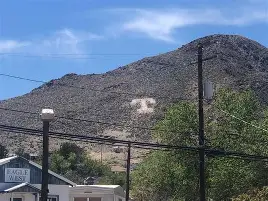
A swarm of more than 100 earthquakes has shaken a remote region of central Nevada in recent days, with epicenters located within roughly 80 kilometers (about 50 miles) of the highly restricted Tonopah Test Range, a U.S. military installation long associated with nuclear weapons research and testing.
The seismic activity, which began in late February 2026 and intensified into early March, has drawn widespread attention amid heightened global geopolitical tensions, including ongoing conflicts involving the United States in the Middle East. Some online speculation has linked the tremors to possible underground nuclear testing, though experts and official sources say the events are consistent with natural geological processes.
According to data from the U.S. Geological Survey (USGS) and the Nevada Seismological Laboratory, between 100 and 120 shallow earthquakes have been recorded through early March. Magnitudes have ranged from as low as 1.0 to a peak of 4.3. The strongest quake struck on March 1, 2026, at approximately 16:37 UTC (8:37 a.m. local time), centered about 77–80 kilometers (48 miles) northeast of the town of Tonopah at a shallow depth of roughly 11–12 kilometers.
Smaller events have continued, including a magnitude 4.0 tremor near Warm Springs, east of Tonopah, as recently as March 3. In one 24-hour period, more than 40 tremors were detected, with dozens exceeding magnitude 2.5 in recent days. The earthquakes have been felt by residents as far away as Carson City (about 290 kilometers west) and Las Vegas (around 280 kilometers south), though no injuries or significant structural damage have been reported.
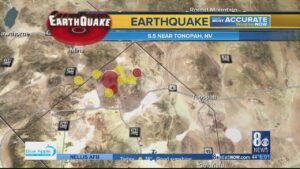
Seismologists say the swarm appears to be occurring along a previously lesser-known fault line stretching along the southern edge of the Monitor and Antelope ranges. Such earthquake swarms—sequences of tremors without a single dominant mainshock—are not uncommon in Nevada, a seismically active state due to its position in the Basin and Range Province, where the Earth’s crust is slowly extending.
The Tonopah Test Range, sometimes nicknamed “Area 52” in popular media because of its proximity to the more famous Area 51, is part of the vast Nevada Test and Training Range (NTTR) north of Las Vegas. Historically, the broader Nevada Test Site—now called the Nevada National Security Site—hosted hundreds of underground nuclear explosions during the Cold War until a testing moratorium in the early 1990s.
READ: Centre moves Delhi LG Saxena to Ladakh in major governors’ reshuffle
READ: US Grants 30-Day Waiver Allowing India to Import Russian Oil
While Tonopah itself has been associated with weapons delivery system testing, stockpile stewardship, and other classified military activities rather than active detonations in recent decades, its secretive nature has long fueled conspiracy theories.
Seismologists emphasize that the characteristics of the swarm—including shallow depths, a gradual buildup, and the absence of explosive signatures—are consistent with tectonic activity rather than human-induced events such as nuclear explosions. No official statements from the U.S. military or the Department of Energy have indicated any connection to weapons testing.
The timing of the seismic activity has nevertheless sparked discussion online and in some media outlets, particularly in the context of recent U.S. and allied military actions abroad. Some international commentary has drawn parallels with seismic activity elsewhere during periods of geopolitical tension, though experts caution against linking natural earthquakes to military operations without evidence.
As of March 6, 2026, the swarm remains ongoing but appears to be stabilizing. Monitoring continues through the USGS and regional seismic networks. Residents in sparsely populated central Nevada are advised to remain prepared for aftershocks, though the risk of major damage from these moderate events remains low.