Linking the controversy to the Emergency era and what he called “Congress’ mindset,” Modi said the 150th anniversary of Vande Mataram was an opportunity to “restore the song’s original glory,” accusing the opposition of diluting it for political appeasement.
BY PC Bureau
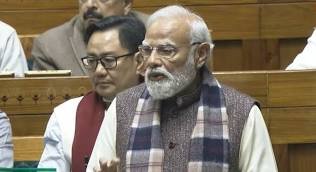
December 8, 2025: Prime Minister Narendra Modi on Monday launched a sharp political attack on the Congress during a Lok Sabha discussion commemorating 150 years of Vande Mataram, alleging that Jawaharlal Nehru endorsed Muhammad Ali Jinnah’s objections to the national song.
Speaking during the special discussion, the Prime Minister said both leaders had opposed the song on the grounds that its references to Hindu goddesses could “irritate Muslims”.
“When Vande Mataram celebrated its 100th anniversary, the country was entangled in the Emergency… the Constitution was strangled,” PM Modi said, linking the song’s commemorative milestones to what he called the Congress’ “suppression of national pride”.
Calling the song a “source of freedom” during India’s independence struggle, the Prime Minister said the 150-year mark was an “opportunity to restore its full glory”.
He also referenced recent national commemorations — the 75th anniversary of the Constitution, the 150th birth anniversaries of Sardar Patel and Birsa Munda, and the 350th martyrdom of Guru Teg Bahadur — saying the celebration of Vande Mataram fits into that continuum of national remembrance.
VIDEO | Debate over Vande Mataram: Speaking in Lok Sabha, PM Modi (@narendramodi) says, “A few days back, Vande Mataram completed 150 years. During British times, it was the fashion to demean India. Then Bankim Chandra Chatterjee presented Vande Mataram through his work, and he… pic.twitter.com/VqZ9YQOWnw
— Press Trust of India (@PTI_News) December 8, 2025
The Political Flashpoint: 1937 Congress Decision
The BJP has been attacking the Congress over its 1937 Working Committee resolution, which prescribed that only the first two stanzas of Vande Mataram be sung at national gatherings.
These two stanzas do not contain references to Hindu deities.
The remaining verses invoke Durga, Kamala/Lakshmi, and Saraswati, portraying them as feminine embodiments of the motherland — imagery that some Muslim leaders at the time objected to as “exclusionary”.
The Congress resolution stated:
“Taking all things into consideration, therefore, the Committee recommends that whenever Vande Mataram is sung at national gatherings, only the first two stanzas should be sung.”
It also noted that individuals remained free to sing the full song elsewhere.
However, the BJP has framed this historical decision as evidence of what it calls the Congress’ “communal appeasement”.
PM Modi said the removal of the stanzas “sowed the seeds of the nation’s division”, drawing a direct connection to the Partition.
“In 1937, a portion of Vande Mataram was severed… it was torn apart,” he said earlier in November. “Today’s generation must understand why.”
READ: Hyderabad Plans Trump Avenue, Google Street, Microsoft Road
READ: ‘Mehbooba’ Turns to Mayhem as Deadly Fire Engulfed Goa’s Nightclub
BJP Cites Nehru’s Letters To Netaji Subhas Chandra Bose
The latest round of controversy was triggered by BJP spokesperson C.R. Kesavan, who posted extracts from Nehru’s 1937 correspondence with Netaji Subhas Bose on X.
Kesavan claimed Nehru “agreed with Jinnah-like objections”, asserting that the Congress leader described references to the goddess as “absurd” and acknowledged that “people who are communistically inclined have been affected by it”.
However, the letters indicate a more nuanced position.
Nehru wrote that interpreting the song strictly as goddess worship was “absurd”, arguing that the lyrics were “thoroughly harmless and nobody can take exception”.
At the same time, he acknowledged that some verses were “out of keeping with modern notions of nationalism”, adding:
“…we cannot pander to communalists’ feelings but must meet real grievances where they exist.”
Kesavan accused Nehru of “deliberately” removing the stanzas about Ma Durga from national functions, a charge the Congress has not officially responded to following the renewed political storm.
Why The Song Remains Contentious
At the core of the dispute are the six original stanzas written by Bankim Chandra Chatterjee in 1875, with verses celebrating the motherland through references to Hindu deities — a form of literary symbolism common in 19th-century nationalist writing.
For the BJP, these verses represent India’s cultural identity.
For many in the opposition, the historical debate reflects a complex negotiation between nationalism, religious sensitivity, and inclusive political strategy in pre-independence India.
As Parliament commemorates 150 years of Vande Mataram, the song remains not just a cultural symbol but a political battleground — shaping yet another round of BJP-Congress confrontation ahead of a charged national political season.