Visuals circulating on social media show significant damage to the SP’s escort vehicle as authorities work to contain the volatile situation along NH‑202. The incident follows alleged abductions and retaliatory detentions between Tangkhul Naga and Kuki communities, underlining persistent friction in the hill districts.
BY PC Bureau
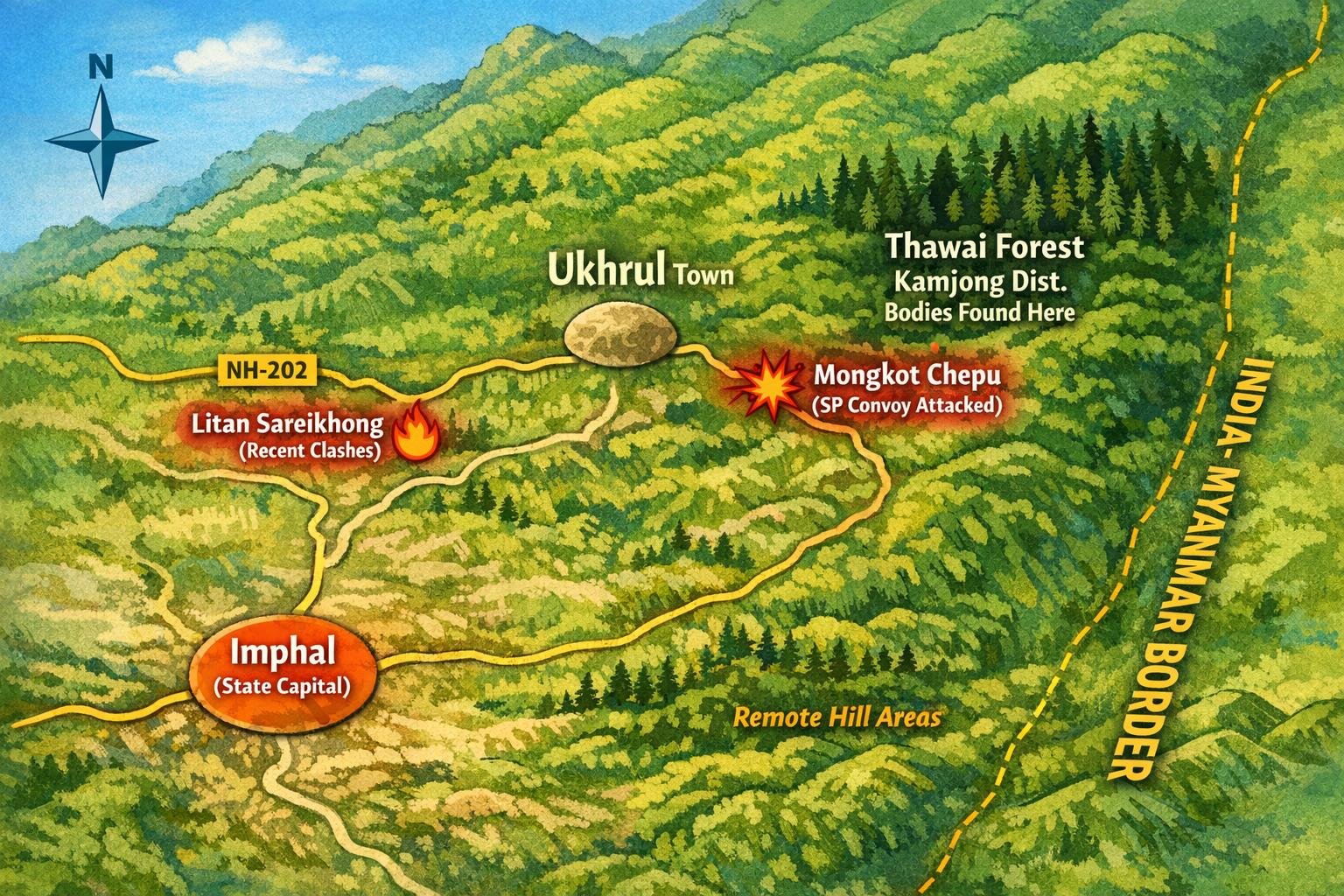
March 12, 2026 : Tensions in Ukhrul district escalated sharply on Thursday when a mob reportedly vandalised the escort vehicle of the Superintendent of Police (SP), Ukhrul, near Mongkot Chepu along the Imphal–Ukhrul road (NH‑202). The attack occurred as the SP’s convoy was en route to Imphal, shortly after the recovery of two bodies from a forested area linked to an earlier firing incident.
Local reports and visuals circulating on social media showed the police vehicle damaged, with smashed windows and windshield. Authorities have not confirmed any injuries to the SP or accompanying personnel, though the atmosphere in the area remained tense and volatile.
#BREAKING Tensions escalate in Ukhrul as a Kuki mob targets the SP’s escort vehicle at Mongkot Chepu, en route to Imphal, following the recovery of two dead bodies missing since Wednesday’s Thawai forest firing incident. More details awaited! pic.twitter.com/6gfqr5NBGN
— Poknapham / The People’s Chronicle (@PoknaphamNews) March 12, 2026
The vandalism follows the grim discovery of the bodies of two men from the Kuki community, identified as Thengin Baite (40) of Thawai Kuki village and Thangboimang Khongsai (35) of Shangkai village, found in a forest near Thawai in neighbouring Kamjong district. The men were reportedly abducted by suspected Tangkhul volunteers. In apparent retaliation, armed Kuki groups allegedly detained around 20 Tangkhul individuals, including women, children, and elderly persons, who were later released unharmed.
At the time of reporting, authorities had not announced any arrests or issued a detailed official statement regarding the SP escort incident.
Authorities appealed for calm, and the Ukhrul police had earlier urged the public to refrain from spreading unverified information as law-and-order challenges persisted. Parts of the district have witnessed recurring clashes in recent weeks, including arson, firing, and internet suspensions following earlier flare-ups in areas such as Litan Sareikhong in February. Security forces were reported to be monitoring developments along NH‑202, a strategic highway linking Ukhrul to the state capital, Imphal.
READ: Horror in Manipur: Tortured Bodies of Abducted Kuki Men Found in Forest
The violence in Ukhrul is part of a long-standing pattern of ethnic tensions between the Tangkhul Naga and Kuki communities in Manipur’s hill districts. The roots of the conflict trace back to the mid-20th century, after India’s independence, when different tribal groups contested land rights and territorial influence. Disputes intensified as the Nagas, seeking broader political autonomy and territorial integration with neighbouring Naga areas, clashed with Kukis residing in overlapping regions. Throughout the 1950s and 1960s, these tensions led to recurring clashes and displacements. Violence resurfaced strongly in the 1990s, particularly between 1992 and 1998, causing hundreds of deaths, thousands of houses to be burnt, and tens of thousands displaced.
After a relative lull in large-scale violence, disputes have reignited periodically. In early February 2026, clashes in Litan Sareikhong village saw several houses burned, firing incidents reported, and prohibitory orders imposed. Security forces were deployed and internet services suspended in parts of the hill districts. Local organisations such as Tangkhul Naga Long have accused opposing groups of encroachment and demographic pressures, advocating for recognition of ancestral land rights, further deepening mistrust between communities. Both Tangkhul Naga and Kuki groups maintain distinct ethnic identities with historical claims to land and local governance, and mobilisation often involves village defence units or volunteer groups responding to grievances. Localised incidents—ranging from disputes over roadblocks and firearm confiscations to retaliatory attacks—feed broader cycles of confrontation and insecurity.
The latest incident along NH‑202 reflects the fragile peace in Manipur’s hill districts, where long-standing ethnic, territorial, and identity-based disputes continue to spark violence. With retaliatory actions reported on both sides, the situation remains fluid, prompting continued monitoring by security forces and repeated appeals for calm by authorities. Residents and travellers have been advised to exercise caution in affected areas.