The haunting image of empty seats filled with children’s photographs aboard Iran’s “Minab 168” flight has cast a long shadow over the talks in Islamabad.
BY PC Bureau
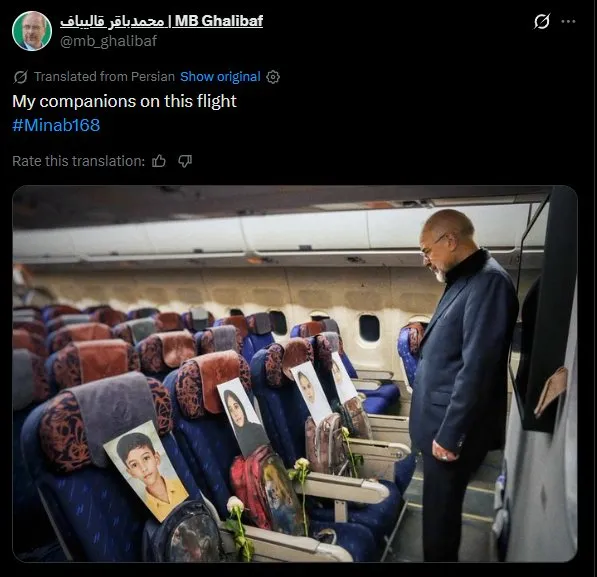
April 11, 2026: As high-stakes US–Iran ceasefire talks opened in Islamabad on Saturday, the Iranian delegation delivered a powerful and deeply symbolic message even before reaching the negotiating table. Images from their aircraft showed empty seats filled with photographs of smiling children, blood-stained school bags, tiny shoes, and white flowers—poignant reminders of victims of the devastating Minab school strike.
The aircraft itself was named “Minab 168”, a tribute to at least 168 people—most of them young girls aged 7 to 12—killed when a US missile struck the Shajareh Tayyebeh Elementary School in Minab on February 28, 2026, the opening day of the brief but intense US–Iran conflict.
Iranian Parliament Speaker Mohammad Bagher Ghalibaf, who led the delegation alongside Foreign Minister Abbas Araghchi, shared images from inside the aircraft, writing: “My companions on this flight, Minab 168.” Other visuals showed delegation members standing beside the belongings of the young victims placed reverently across the cabin.
READ: Crucial Hours Ahead as US, Iran Sit Down for Make-or-Break Talks
The Minab Strike: A Defining Tragedy
The attack on the girls’ school in Minab’s Shahrak-e Al-Mahdi neighbourhood remains one of the most emotionally charged and disputed incidents of the conflict. Iranian authorities, along with international human rights groups including Amnesty International, have described it as a precision-guided US strike that caused the school building to collapse on students, teachers, and parents present at the time.
Casualty estimates range from 168 to over 170, with more than 100 children among the dead and dozens injured.
Washington has maintained that the intended target was a nearby facility linked to the Islamic Revolutionary Guard Corps, suggesting the school was hit due to faulty intelligence or collateral damage in the early hours of the war. Tehran, however, has called the strike “deliberate” and a violation of international humanitarian law, citing the school’s location within a civilian area. The incident sparked global outrage, mass funerals, and ongoing calls for an independent investigation.
Images from a plane carrying Iran’s delegation to US-Iran talks in Islamabad show seats filled with photos and belongings of victims of the Minab school strike.
The aircraft, “Minab 168,” honours the 168 killed, mostly children. pic.twitter.com/1RdeOWnUrA
— Al Jazeera English (@AJEnglish) April 11, 2026
By naming the aircraft after the tragedy and carrying victims’ belongings onboard, Iran appears intent on keeping the human cost—especially that borne by children—at the center of the diplomatic process.
Setting the Tone for Talks
The Iranian delegation, comprising around 70 members including senior negotiators, military advisers, and economic experts, arrived in Islamabad late Friday and was received with full state protocol by Pakistani authorities, including Army Chief Asim Munir.
Analysts view the symbolism as a calculated move to reinforce Iran’s negotiating stance—highlighting civilian suffering, pressing demands for sanctions relief, security guarantees, and accountability, while countering any perception of weakness following the ceasefire.
On the US side, Vice President JD Vance is leading the delegation alongside Steve Witkoff and Jared Kushner. Vance struck a cautiously optimistic tone ahead of the talks, stating that Washington is ready to engage if Tehran negotiates in good faith, while warning against insincerity. President Donald Trump has described Iran’s proposals as a possible starting point but continues to apply public pressure.
Prime Minister Shehbaz Sharif has termed the talks “make or break,” underscoring Pakistan’s role as a neutral facilitator that helped secure the initial truce.
High Stakes, Uncertain Outcome
The agenda in Islamabad is ambitious: consolidating the ceasefire, easing sanctions, addressing nuclear concerns, and exploring broader regional de-escalation. While accountability for wartime casualties is not formally listed, the symbolism of “Minab 168” suggests it will remain an unspoken but powerful undercurrent.
The atmosphere remains tense. Success could open the door to wider regional stability, while failure risks renewed conflict with significant global economic consequences.
As negotiations unfold behind closed doors, the empty seats aboard “Minab 168” serve as a haunting reminder that beyond geopolitics and strategy, the stakes are measured in human lives—and the cost of failure could be devastating.