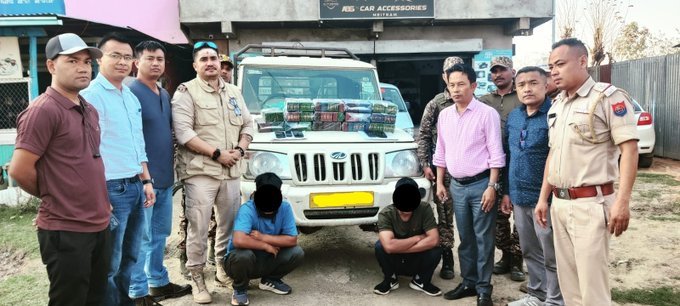
The arrest of two Rongmei Naga civilians with 1.7 kg of heroin in Bishnupur highlights the scale and persistence of Manipur’s drug crisis, with enforcement agencies continuing to intercept significant quantities despite ongoing crackdowns.
BY PC Bureau
March 27, 2026 — The arrest of two Naga civilians in Bishnupur district with a significant quantity of heroin has once again brought Manipur’s entrenched drug problem into focus, while also raising questions about the increasingly politicized narratives surrounding it.
According to Manipur Police, security forces on March 26 apprehended two men—Kasimthai Rongmei (32) from Luangchung Part-I in Noney district and Gaikhuluanlung Ruangmei (46) from Khongshang—during an operation in the Meitram area under Nambol police station. Authorities recovered approximately 1.7 kilograms of suspected heroin No. 4 concealed in 150 soap cases, along with a four-wheeler and five mobile phones.
The seizure is notable not only for its scale but also for the identities of those arrested. Both individuals belong to the Rongmei Naga community, adding to a growing list of drug-related arrests in the state involving individuals from multiple ethnic groups.
On 26.03.2026, security forces arrested 02 (two) individuals from Meitram area under Nambol-PS, Bishnupur district:
i.Kasimthai Rongmei (32) of Luangchung part-I, Noney district, and
ii.Gaikhuluanlung Ruangmei (46) of Khongshang, Noney district.From their possession,… pic.twitter.com/xpKH4ZbHgv
— Manipur Police (@manipur_police) March 26, 2026
A Pattern That Challenges Simplistic Narratives
In recent years, sections of political discourse and public commentary have frequently framed the drug trade in Manipur through the lens of “narco-terrorism,” often disproportionately associating it with Kuki-Zo communities inhabiting the hill districts. This narrative has gained traction amid broader ethnic tensions, particularly following the outbreak of violence in 2023.
However, law enforcement data and repeated arrests tell a more complex story.
Cases involving individuals from Naga and Meitei communities—such as the latest Bishnupur arrest—complicate attempts to attribute the drug trade to any single ethnic group. Over the past year, multiple seizures across valley and hill districts have involved actors from diverse backgrounds, suggesting that the narcotics economy in Manipur operates through interconnected networks rather than ethnically isolated ones.
Geography, Not Identity
Experts and former law enforcement officials point out that Manipur’s position along the “Golden Triangle”—a major Southeast Asian drug-producing region—makes it inherently vulnerable to trafficking networks that cut across ethnic and territorial boundaries.
“The drug trade here is opportunistic and network-driven,” said a senior security analyst familiar with counter-narcotics operations in the Northeast. “It exploits geography, weak enforcement pockets, and conflict zones. Reducing it to a single community not only distorts reality but also weakens enforcement strategy.”
The latest seizure in Bishnupur—a valley district dominated by Meitei populations—underscores this point. It highlights how transit, storage, and distribution nodes are spread across regions, often far removed from cultivation zones in the hills.
READ: Poppy War: Kuki Volunteers Torch Naga Poppy Fields in Ukhrul
Politics of Blame and Its Consequences
The persistence of a one-sided “narco-terror” narrative has had tangible social and political consequences. Kuki organizations have repeatedly rejected such characterizations, arguing that they stigmatize entire communities and are used to justify selective enforcement and political targeting.
At the same time, Naga and Meitei civil society groups have also faced uncomfortable questions as arrests within their own communities surface periodically, challenging earlier assumptions about the exclusivity of involvement.
Analysts warn that framing the drug crisis through an ethnic lens risks deepening mistrust in an already polarized state.
“When enforcement is seen as biased, communities withdraw cooperation,” the security analyst noted. “That ultimately benefits trafficking networks.”
A Systemic Crisis
Manipur’s drug problem remains severe. Authorities have reported the destruction of thousands of acres of illegal poppy cultivation in recent years, alongside frequent seizures of heroin, methamphetamine tablets, and precursor chemicals.
Yet eradication drives and arrests have not significantly disrupted the underlying economy, which is sustained by:
- cross-border smuggling routes
- local cultivation in remote hill areas
- and distribution networks spanning both hills and valley
The Bishnupur arrest fits into this larger pattern—one that points to a diffuse, resilient system rather than a community-specific enterprise.
The latest case serves as a reminder that Manipur’s drug crisis cannot be effectively addressed through narratives that assign collective blame. Instead, experts argue for:
- intelligence-driven, network-focused policing
- cross-community cooperation
- and depoliticized enforcement
Without such a shift, the risk remains that the fight against narcotics will be overshadowed by competing ethnic narratives—allowing the trade itself to persist largely intact.