The silence of the SoO leadership — at a moment when a senior political figure closely associated with the broader Kuki-Zo political ecosystem has joined the Manipur government — is rapidly becoming as consequential as the political development itself, raising serious questions about internal coordination, strategic clarity, and collective political direction.
The Deafening Silence of Manipur’s SoO Leadership
By PC Bureau
As condemnation poured in from across the Kuki-Zo political and civil society spectrum over Nemcha Kipgen’s induction as Manipur’s Deputy Chief Minister, one absence stood out with striking clarity: the silence of the armed groups operating under the Suspension of Operations (SoO) framework — particularly the United People’s Front (UPF).
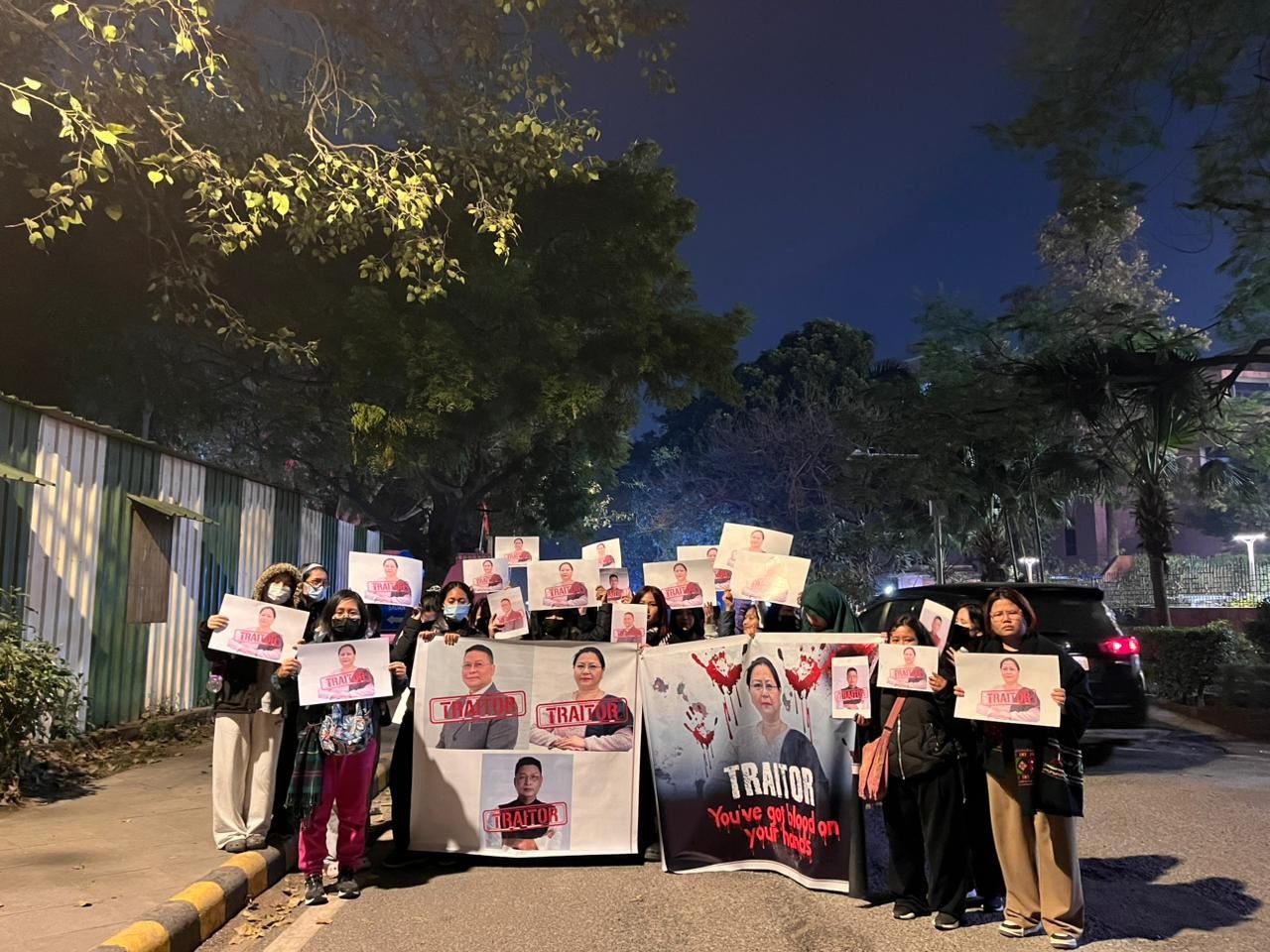
From village councils and student bodies to women’s organisations, church forums, and grassroots platforms — and most notably the apex Kuki-Zo Council (KZC) — nearly every major civil society institution issued sharp denunciations of Kipgen and two other Kuki-Zo MLAs who joined the new BJP-led government. Protest posters flooded hill districts and diaspora networks alike, while social media platforms turned into arenas of anger, grief, and political disillusionment.
Yet amid this swelling chorus, the leadership of the SoO groups — who occupy a uniquely powerful position in the Kuki-Zo political ecosystem — have remained conspicuously silent.
This silence has triggered widespread unease and debate within the community, particularly because Deputy Chief Minister Nemcha Kipgen is the wife of Semthang Kipgen, a senior leader of the Kuki National Front (KNF), one of the principal SoO constituent groups.
UPF, KNO and the Architecture of Power
The growing controversy has sharpened attention on the silence of the United People’s Front (UPF) — the umbrella political platform representing a cluster of Kuki-Zo armed groups operating under the SoO agreement with the Government of India.
The Kuki National Front (KNF), led by Semthang Kipgen, is a constituent of the UPF. Alongside the UPF, another umbrella organisation — the Kuki National Organisation (KNO) — jointly represents nearly 14–15 armed groups currently under the SoO framework.
Together, the UPF and KNO form the principal negotiating interlocutors with the Ministry of Home Affairs, spearheading political talks for a separate administrative arrangement or Union Territory with legislature for the Kuki-Zo people.
READ: Centre’s Nemcha Gambit Deepens Manipur’s Dangerous Divide
Against this backdrop, the continued silence of the UPF leadership — even as civil society groups, apex tribal bodies, and grassroots organisations have openly condemned the political defection — is rapidly becoming as consequential as the defection itself.
Across WhatsApp groups of community elders, church leaders, youth activists, women organisers, and opinion-makers, one question now dominates: Where do the SoO groups stand?
Power, Leverage, and Political Centrality
The SoO framework encompasses a coalition of armed Kuki-Zo groups operating under a ceasefire arrangement with the Government of India. Over the years, these organisations have acquired substantial political leverage — not only due to their armed presence, but also because of their central role in negotiations with the Centre.
Today, SoO groups function as the principal representatives of Kuki-Zo political aspirations in high-stakes constitutional talks. Their leadership has effectively become the political fulcrum around which negotiations, strategy, and mobilisation revolve.
Beyond negotiations, their influence extends deep into the electoral and organisational life of the hill districts. Political observers, civil society leaders, and past electoral outcomes suggest that the positions taken by these groups often shape political alignments, candidate selection, and campaign dynamics.
This dual role — as negotiating interlocutors and influential grassroots actors — has made the SoO leadership one of the most powerful collective forces in contemporary Kuki-Zo politics.
It is precisely this centrality that renders their silence so politically consequential.
A Community Searching for Signals
In moments of political crisis, the SoO leadership has historically issued statements, clarifications, or strategic positions to guide public discourse. Their interventions often functioned as stabilising signals — providing clarity, restraint, and tactical direction.
This time, however, no such signal has emerged.
As condemnation of Nemcha Kipgen intensified — with protests, public denunciations, and widespread social media mobilisation — the absence of any response from the SoO leadership has created a political vacuum, now filled with speculation, anxiety, and mistrust.
Some within the community interpret the silence as tactical caution, aimed at preventing further escalation. Others see it as strategic ambiguity, designed to preserve political flexibility. Still others view it as an unsettling sign of internal strain or strategic recalibration.
What remains undeniable is that the silence itself has become a political statement.
Why This Moment Cuts Deep

This intersection of family ties, armed leadership, and constitutional politics has magnified the sense of contradiction many in the community now feel.
For a movement built on collective discipline, unity, and strategic coherence, the optics of this divergence have proven deeply unsettling. Activists argue that the credibility of any negotiation process depends not only on external leverage, but also on internal alignment and moral authority.
In this context, Nemcha Kipgen’s induction into the Manipur government — even as SoO groups continue to negotiate for political separation — has exposed a visible tension between parallel political tracks.
Strategic Ambiguity or Structural Strain?
The silence of the SoO leadership has reopened deeper debates about the long-term architecture of Kuki-Zo political mobilisation.
Can negotiation and electoral participation proceed on divergent paths without weakening the movement’s cohesion? Who ultimately defines the collective political will of a displaced and traumatised population? And how sustainable is a dual-track strategy that risks sending contradictory signals?
These questions now dominate internal discussions, as civil society organisations openly urge the SoO leadership to clarify their position.
For many, the silence feels less like restraint and more like a rupture — not only between political elites and grassroots sentiment, but between parallel centres of power operating within the same political struggle.
A Silence Heavy With Consequence
In volatile political landscapes, silence can be as powerful as speech. In Manipur’s fragile hill districts, it carries particular weight.
Whether the SoO leadership eventually breaks its silence or maintains strategic ambiguity, the moment has already altered political expectations. The community’s demand is not merely for condemnation or endorsement, but for clarity — clarity that can restore trust, coherence, and collective direction.
Until then, the quiet from one of the most powerful actors in Kuki-Zo politics continues to echo louder than any protest slogan or poster campaign — shaping uncertainty, deepening anxiety, and redefining the contours of a movement at one of its most fragile junctures.