The Kangpokpi District IDP Welfare Committee says a detailed memorandum outlining urgent demands — from security outposts to housing aid — could not be submitted as “no official channel was opened.”
BY PC Bureau
December 12: President Droupadi Murmu’s two-day visit to Manipur — her first since the state plunged into ethnic conflict 19 months ago — has stirred fresh discontent among Kuki Internally Displaced Persons (IDPs), who say they were “completely excluded” from the President’s engagements despite being among the worst-affected communities.
While the President on Wednesday met valley-based IDPs in Imphal, inaugurated development projects and reviewed rehabilitation work, displaced Kuki families in Kangpokpi and neighbouring hill districts say they were neither granted an audience nor provided any route to submit their memorandum outlining urgent security and resettlement needs.
For the Kuki IDPs, many of whom fled burning homes on May 3, 2023, the visit was seen as a rare opportunity for direct communication with what they describe as the “highest moral authority of the Republic.” Instead, they say the “door was shut even before we could knock.”
LIVE: President Droupadi Murmu’s address at a Public Function at Senapati, Manipur https://t.co/vwrEJVByle
— President of India (@rashtrapatibhvn) December 12, 2025
Memorandum Ready, But ‘No Route’ to the President
The Kangpokpi District Internally Displaced Persons Welfare Committee (KDIDP/WC), representing several thousand displaced families living in relief camps for nearly 31 months, said they had prepared a detailed memorandum well in advance of the President’s arrival.
Committee members allege they were told informally that there was no channel — either through the district administration or through the security apparatus — to relay the document to the President.
“We had a respectful, fact-based document ready. Yet every door was closed to us,”
said a committee spokesperson, calling the episode “a painful continuation of the discrimination we have faced since May 2023.”
Senapati welcomes a new chapter of growth and opportunity as the Hon’ble President of India, Smt. Droupadi Murmu, inaugurates and lays the foundation for major development projects across the district.
From a state-of-the-art Model Residential School and a new Girls’ Hostel at… pic.twitter.com/HljQ0upS16
— Government of Manipur (@govt_of_manipur) December 12, 2025
President Murmu, who arrived in Imphal on Wednesday, visited Senapati district on Thursday morning. Senapati shares its southern border with Kangpokpi — the worst-hit district, sheltering over 25,000 Kuki-Zo IDPs in makeshift camps. Despite this proximity, the KDIDP/WC says no meeting was arranged with them, and no mechanism was provided to deliver their five-page memorandum.
“We waited from early morning along the route she was expected to take towards Senapati, but heavy security stopped us more than two kilometres away. Not a single representative was allowed to approach,” said Paominlen Haokip, Chairman of the committee.
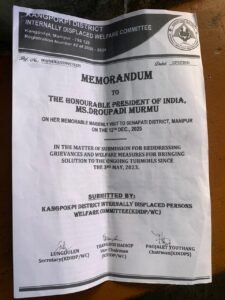
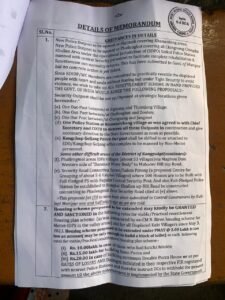
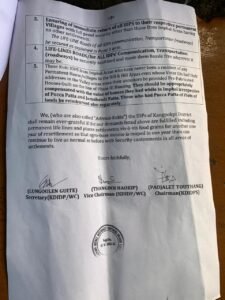
A copy of the memorandum reviewed by this newspaper lists 12 urgent demands, including:
- Immediate establishment of new police outposts and a full-fledged station in strategic areas to ensure safe return of displaced families.
- Enhancement of PMAY housing assistance from the current ₹3 lakh to between ₹10–20 lakh, citing complete destruction of homes and high construction costs in hill terrain.
- Permanent settlement for Kuki residents of Imphal who never owned property in the valley but have ancestral land in the hills.
- Designation of key routes as “life-line roads” with round-the-clock security to allow movement of essential goods.
- Separate compensation for those who owned only plots of land in destroyed neighbourhoods.
The memorandum states that if core demands are addressed within a year, displaced families are prepared to be resettled with “food grains for another one year” until agricultural incomes stabilise. Failure to act, it warns, will leave thousands living indefinitely under “security cantonments.”
“The President met displaced people in Imphal and is visiting Senapati today. Kangpokpi is right next door and is the worst-affected district, yet we were not allowed to even submit a piece of paper,”
said Thangboi Haokip, Vice-Chairman of the committee.
“This does not feel like an oversight. It feels like a message that our suffering does not matter.”
What has intensified the sense of alienation among IDP families is that the President visited a district adjoining theirs, but no symbolic or substantive interaction was planned with Kuki-Zo IDPs.
“We are right here. Our camps are right here. Yet she is not meeting us — not even for five minutes,” said a relief camp volunteer in Kangpokpi.
With over 50,000 Kuki-Zo residents still displaced from their homes in Imphal valley and surrounding regions, community leaders say the absence of even brief outreach sends “a troubling signal” about the State’s rehabilitation priorities.
A Community Still Living in Limbo
The memorandum paints a stark picture of life in the camps:
Security Gaps
IDPs say they cannot return to their villages unless central forces establish secure outposts at Aigijang, Thomjang, Phailengkot, Kamuching and other sensitive locations. A fully functional police station at Kamuching is a key demand.
Rebuilding With Insufficient Aid
Families argue that the current ₹3 lakh PMAY housing compensation is grossly inadequate. They propose ₹10 lakh for kutcha, ₹15 lakh for semi-pucca, and ₹20 lakh for pucca homes based on estimated rebuilding costs.
READ: Indian Artefacts Among 600 Items Stolen in UK Museum Heist
READ: KOHUR Terms Prez Murmu Manipur Visit as ‘Symbolic Violence’
Compensation for Valley Losses
Thousands who lived in Imphal valley before the conflict lost homes, shops and ancestral land. The memorandum calls for proper assessment and compensation, and provision of pre-fabricated housing for those with no homes to return to.
Food Security
With livelihoods destroyed and agricultural activity disrupted, IDPs request guaranteed food grains for at least one more year.
A Visible Divide in the President’s Outreach
For many Kuki IDPs, the contrast is stark: the President met displaced Meitei residents in Imphal but not a single hill-based IDP cluster in Kangpokpi.
Relief workers say the omission has left the community “confused, distressed and deeply disappointed.”
“We hoped she would heal the divide,” said a local civil society leader,
“but today the divide has only become more visible.”