Addressing supporters, Rahman described Bangladesh as being “liberated twice” — in 1971 and again in 2024 — framing the recent uprising as a renewal of democratic aspirations.
BY PC Bureau
December 25, 2024: Bangladesh’s opposition politics entered a decisive new phase on December 25, 2025, as Bangladesh Nationalist Party (BNP) Acting Chairman Tarique Rahman returned to Dhaka after nearly 17 years abroad, energising supporters and reshaping the political landscape ahead of parliamentary elections scheduled for February 2026.
The 60-year-old leader, long seen as the political heir to former Prime Minister Khaleda Zia, arrived at Hazrat Shahjalal International Airport around noon on a Biman Bangladesh Airlines flight from London. He was accompanied by his wife, Dr Zubaida Rahman, his daughter Barrister Zaima Rahman, and close aides. Despite security restrictions at the airport, thousands of BNP supporters gathered to welcome him, alongside senior party leaders.
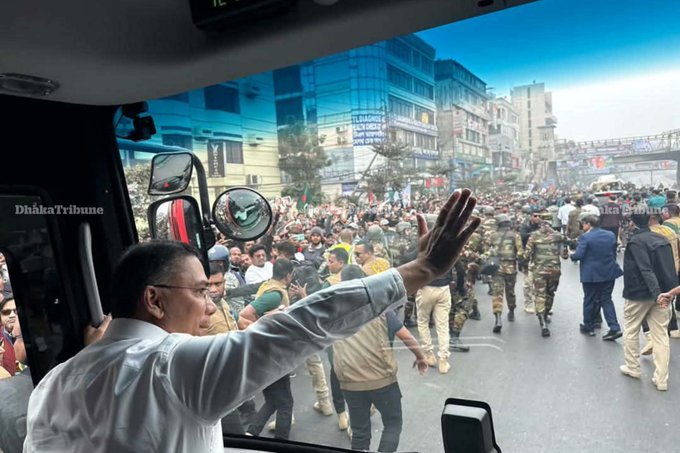
From the airport, Rahman travelled in a bulletproof bus painted in the national colours, greeting crowds that lined the streets en route to a massive reception rally at Purbachal’s 300 Feet Road, also known as the July 36 Expressway. The BNP mobilised supporters from across the country, with party leaders claiming an unprecedented turnout running into hundreds of thousands, and some estimates reaching several million. Slogans, party flags, and red-and-green banners dominated the route, turning the procession into a show of political strength.
Addressing supporters from the rally stage, Rahman delivered his first in-person speech on Bangladeshi soil since 2008. Framing recent history in sweeping terms, he declared, “We liberated Bangladesh in 1971. We liberated it again in 2024,” linking the country’s independence war with the student-led July–August 2024 uprising that brought down Sheikh Hasina’s Awami League government. The statement drew prolonged applause, reinforcing the BNP’s narrative of the uprising as a second liberation that restored democratic aspirations.
READ: India’s Progress Not Built by One Family, Says PM Modi
Rahman called for the creation of an inclusive Bangladesh, urging participation from all communities, ethnic groups, and citizens. Unity, equality, and fair representation, he said, would form the core of the BNP’s political vision as the country navigates a fragile post-Hasina transition marked by unrest and institutional reform.
Paying tribute to the martyrs of the 1971 Liberation War, the anti-autocracy movement, and the 2024 uprising, Rahman said their sacrifices must translate into lasting democratic change. He also mourned BNP leader Sharif Osman Hadi, assassinated earlier in the week, describing him as a believer in democracy who gave his life for the cause. “He gave his life believing in democracy,” Rahman said, pledging to restore democratic institutions, the rule of law, and economic rights.
Tarique’s return marks a historic moment for democracy.
After years away, his homecoming symbolizes resilience, renewed hope, and a reawakening of Bangladesh’s democratic journey.#TariqueRahman #BangladeshFirst pic.twitter.com/oTOlAuWdJm
— Yusuf Khan (@KhanYusuf98) December 25, 2025
Invoking American civil rights leader Martin Luther King Jr., Rahman outlined what he called a practical roadmap for the country. “Martin Luther King said, ‘I have a dream.’ Standing on the soil of Bangladesh today, I say: I have a plan for my country,” he told the crowd. That plan, he said, focused on peace, discipline, political stability, and security—particularly for women and children—along with freedom from fear, corruption, and authoritarian rule.
Speaking emotionally about his mother, Rahman referred to Khaleda Zia’s deteriorating health. The former prime minister, now 80, has been undergoing treatment for multiple ailments at Evercare Hospital since November 2024. Rahman expressed gratitude for being able to return home and be by her side. Following the rally, he visited her at the hospital before proceeding to his residence in Gulshan.
VIDEO | Dhaka: Bangladesh: Bangladesh Nationalist Party (BNP) Acting Chairman Tarique Rahman returns to Bangladesh after 17 years and is greeted by massive crowds in Dhaka.
Addressing the gathering, he says, “I offer my heartfelt thanks to the Almighty. Our beloved motherland… pic.twitter.com/TeaiY3Hbdj
— Press Trust of India (@PTI_News) December 25, 2025
Rahman’s return follows a series of court rulings after the 2024 uprising that cleared him of major cases, including corruption, money laundering, and allegations linked to the 2004 grenade attack—cases the BNP has long described as politically motivated. Acting as BNP chairman since 2018, he is now expected to formally assume full leadership of the party and lead it into the 2026 elections, with several surveys placing the BNP ahead of its rivals.
The scale of the homecoming underscored the BNP’s political resurgence, with Rahman positioning the party as the custodian of democratic renewal. Yet his return also comes amid continued instability, sporadic violence, and intense debate over reforms under the interim government. As Bangladesh heads toward a crucial election, Tarique Rahman’s re-emergence sets the stage for a high-stakes contest that could redefine the country’s political future.