Shangkai Village Authority calls the eviction demand “baseless” and warns that peace must not be misinterpreted as weakness.
BY PC Bureau
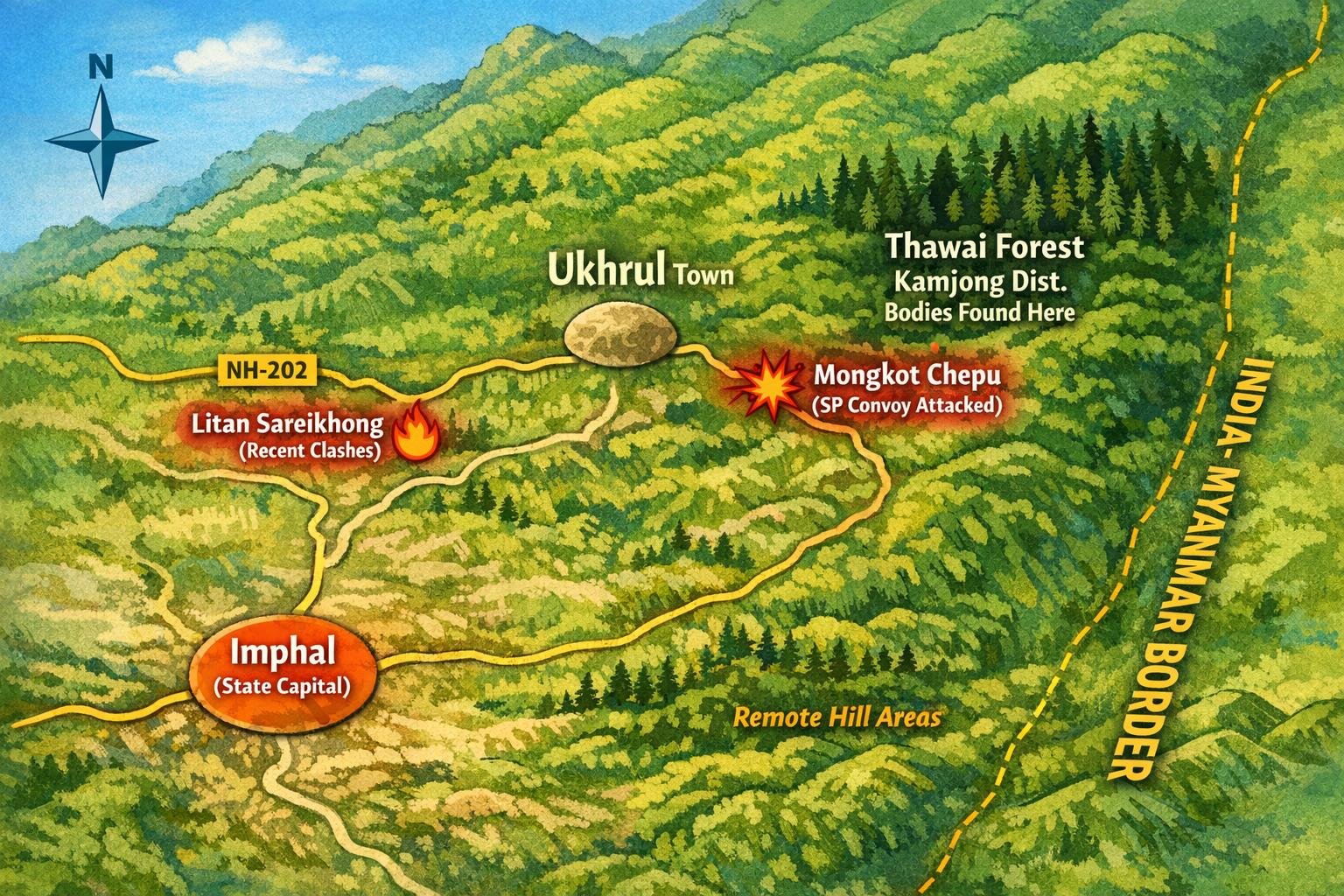
March 13, 2026: In Manipur’s volatile Ukhrul district, tensions are rising sharply as Kuki-Zo groups have rebuffed the ultimatum issued by the Naga youth organization Khanuithot Khon (Voice of the Naga Youth), which demanded the immediate eviction of Kuki-Zo residents from Shangkai village. Far from yielding, the Kuki-Zo community has vowed to “dig in their heels,” prepared to confront what they describe as ongoing harassment and aggression from Naga militants.
With the ultimatum hanging over the village, fears of renewed violence loom large, escalating the risk of direct confrontation between the two communities. This resolve persists even in the shadow of the brutal killings of two Kuki-Zo men just two days earlier, underscoring a deepening determination to defend ancestral claims and demand accountability amid accusations of systemic bias.
The ultimatum, released on March 12, accuses Shangkai’s Kuki-Zo inhabitants of being “unlawful and barbarous tenants” on sacred Naga land, labeling them as guests who have overstayed their welcome through acts of violence and provocation. It cites recent incidents, including the brief detention of 21 Tangkhul Naga civilians on March 11, as evidence of Kuki-Zo aggression and warns that failure to vacate would prompt “necessary measures” for their removal.
Khanuithot Khon frames the demand as a reclamation of Tangkhul ancestral territory, invoking historical and customary rights. However, this narrative has galvanized, rather than intimidated, the Kuki-Zo community, exposing fractures in the fragile ethnic equilibrium of Manipur’s Naga-dominated Ukhrul district.
READ: Kuki-Zo Groups Renew Demand for UT After Brutal Killings in Ukhrul
At the forefront of the resistance is the Shangkai Village Authority, which issued a scathing rebuttal, dismissing the ultimatum as “baseless,” rooted in “deliberate distortion of historical truth” and an “irresponsible attempt to intimidate a peaceful community.” The authority rejected claims that Shangkai is merely a Kuki settlement on Tangkhul land, asserting that it stands on land rightfully owned by Kuki landowners under established customary law.
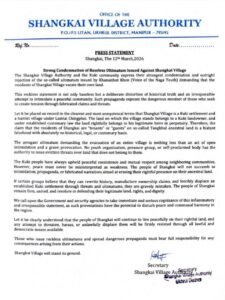
“The claim that the residents of Shangkai are ‘tenants’ or ‘guests’ on so-called Tangkhul ancestral land is a blatant falsehood with absolutely no historical, legal, or customary basis,” the statement read. It warned that such provocations could erode communal harmony and called on government and security agencies to intervene. While emphasizing peaceful coexistence, the authority declared, “peace must never be misinterpreted as weakness,” pledging to resist threats through all lawful and democratic means and holding the issuers fully responsible for ensuing consequences.
KSO Ukhrul demands answers for the abduction, torture, and killing of two Kuki villagers from Thowai on 11 March.
Why the silence on murdered Kukis while outrage was raised only for Tangkhul hostages? Justice cannot be selective.@HMOIndia @PMOIndia pic.twitter.com/RRXtBBts7s
— Min งึลมินธัง (@ngulmint) March 13, 2026
This defiant stance echoed broader sentiments within the Kuki-Zo community, which views the ultimatum as part of a pattern of harassment and violence. The killings of Thengin Baite (42, from Thawai Kuki village) and Thangboimang Khongsai (35, from Shangkai village) on March 11—abducted, tortured, blindfolded, bound, and executed—have only hardened this resolve. Discovered the next day near the Mapithel hill range, the murders are widely attributed by Kuki-Zo groups to suspected Tangkhul militants, possibly linked to NSCN-IM cadres.
Rather than cowing the community, the acts have fueled accusations of targeted ethnic cleansing, drawing parallels to historical grievances such as the 1993 Joupi massacre, in which over 100 Kukis were killed by Naga militants.
The Kuki Students’ Organisation (KSO) Ukhrul has been vocal, questioning perceived biases in official responses and security deployments. “Why was the Chief Minister’s concern seemingly restricted to the safe release of Tangkhul hostages, with no mention of the two Kuki villagers brutally murdered?” the KSO asked. It accused Ukhrul police and security forces of prioritizing Tangkhul protection while ignoring or facilitating atrocities against Kukis. The group also challenged the Tangkhul Naga Long (TNL) over its two-hour ultimatum for the release of 21 Naga civilians, asking if such directives indirectly sanction violence against Kukis.
The KSO warned that failure to address these concerns would hold stakeholders “directly responsible for all consequences,” signaling readiness for escalation if impartiality is not demonstrated. Civil society organizations aligned with the Kuki-Zo have amplified this defiance. The Kuki CSO Working Committee, Ukhrul, condemned the killings as “brutal and inhumane,” criticizing authorities for prioritizing the Naga hostages’ release while making minimal efforts to locate abducted Kuki men.
Broader Kuki bodies, including the Committee on Tribal Unity (COTU) and Kuki Inpi Manipur, have issued 48-hour ultimatums for arrests, threatening further action if ignored.
Analysts say the standoff exposes the precarious state of inter-ethnic relations in Manipur, where land disputes and historical animosities—exacerbated by armed groups—threaten fragile ceasefires. With prohibitory orders, internet suspensions, and intensified patrols in place, authorities focus on de-escalation. Yet without addressing root causes—equitable land rights, impartial policing, and demilitarization—the unrest could reignite the multi-front ethnic strife that has plagued Manipur since 2023. Kuki-Zo leaders warn that justice delayed may compel communities to protect themselves, a scenario no stakeholder can afford.