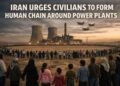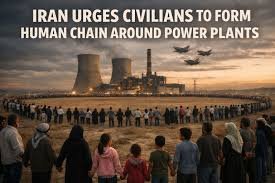
The civilian mobilisation by Iranians, seen at key sites like the Kazerun power plant, is aimed at protecting critical infrastructure from potential US airstrikes.
BY PC Bureau
April 7, 2026 — In a dramatic display of civilian defiance, thousands of Iranians have formed human chains around key power plants across the country, vowing to protect critical infrastructure from threatened US strikes as the deadline set by Donald Trump approaches.
Iranian state media, including Tasnim News Agency, reported large gatherings at multiple facilities, with particularly visible mobilisations at the Kazerun Combined Cycle Power Plant in Fars province. Officials described the move as a grassroots response to what they termed “US threats,” aimed at demonstrating national unity in the face of possible military action.
The Kazerun facility, a major natural gas-fired power plant near the city of Kazerun, plays a key role in supplying electricity to large parts of southern Iran. Visuals broadcast by state outlets showed crowds linking arms at the plant’s entrance, with people of all ages standing together in a symbolic act of resistance.
🚨WATCH: Iranians form human shield around their power plants pic.twitter.com/j2G8dEgIRD
— Spencer Hakimian (@SpencerHakimian) April 7, 2026
Similar demonstrations have been reported in other regions, including Ilam province. Iranian officials had earlier urged citizens—including students, athletes, and artists—to gather at key infrastructure sites and “stand hand in hand.” President Masoud Pezeshkian was quoted by state media as saying millions had volunteered to act as human shields if strikes occur.
The mobilisation comes as rhetoric from Washington intensifies. Trump earlier warned that “a whole civilization will die tonight” if Iran fails to reopen the Strait of Hormuz by his 8 p.m. EST deadline. He has repeatedly threatened to target power plants, bridges, and other infrastructure, framing the move as a response to Iran’s blockade of the vital shipping route.
READ: “Whole Civilisation Will Die Tonight”: Trumps Warns Iran
Analysts say the human-chain strategy is both symbolic and strategic—placing civilians at potential target sites could raise the political and humanitarian cost of any strike, while projecting defiance to the international community. Iranian media has widely broadcast the scenes, portraying them as spontaneous expressions of patriotism.
The crisis escalated after Iran restricted movement through the Strait of Hormuz in response to earlier US-Israeli military actions. The disruption has already rattled global energy markets and heightened fears of a broader regional conflict.
As the deadline draws closer, the presence of civilians at critical infrastructure sites underscores the potential human cost of escalation. Any strike on power facilities could trigger widespread blackouts, affecting hospitals, water systems, and essential services—raising serious humanitarian concerns under international law.
No official response has yet been issued by the White House or the Pentagon regarding the civilian mobilisations, though US forces in the Gulf remain on high alert.
With tensions at a peak, the world is watching closely to see whether these human chains act as a deterrent—or become part of a dangerous escalation that could reshape the region.