BY PC Bureau
March 2, 2026: Satellite imagery has indicated possible damage to a key United States ballistic missile early warning radar system in Qatar following an Iranian strike late last week, raising questions about the vulnerability of critical US defence infrastructure in the Gulf.
Images captured by Planet Labs and circulated by open-source analysts show scorched ground, debris and signs of firefighting activity at a radar installation near Al-Khor, north of Al Udeid Air Base. The facility houses the US Space Force’s AN/FPS-132, an upgraded early warning radar valued at roughly $1.1 billion and regarded as one of the most important long-range missile tracking systems operated by the United States in the region.
The strike is believed to have occurred on or around February 28 amid escalating hostilities between Washington and Tehran. Iran’s Islamic Revolutionary Guard Corps (IRGC) claimed responsibility, describing the attack as a “precision missile strike” carried out under Operation “True Promise 4”. Tehran said the operation was retaliation for joint US-Israeli strikes on Iranian military and nuclear facilities.
While Iranian officials characterised the strike as missile-based, several defence analysts and open-source intelligence trackers have suggested that the damage may have been caused by a one-way attack drone, possibly a Shahed-type unmanned aerial vehicle, that penetrated air defences during a broader barrage of missiles and drones. The exact munition used has not been independently confirmed.
BREAKING: Satellite imagery shows an Iranian ballistic missile struck the AN/FPS-132 phased array radar at Al Udeid Air Base in Qatar.
If the damage is as severe as the imagery suggests, Iran just destroyed a $1.1 billion piece of equipment that took years to build and cannot be… pic.twitter.com/fsblmHMncP
— Shanaka Anslem Perera ⚡ (@shanaka86) March 4, 2026
READ: Over 21,300 Flights Cancelled Worldwide as Gulf Conflict Deepens
READ: Hezbollah Fires Rockets at Israeli Troops in Northern Israel
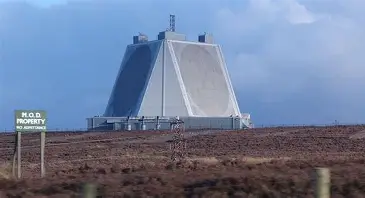
The AN/FPS-132 (Block 5) system forms a central pillar of the US missile defence architecture in the Middle East. With an operational range of approximately 5,000 kilometres, it is designed to detect and track ballistic missiles shortly after launch, providing early warning data to US and allied forces across the Gulf. The Qatar-based variant features three electronically steered phased-array faces, enabling full 360-degree coverage without the need for mechanical rotation.
The radar feeds high-fidelity tracking and trajectory data to interceptor systems such as Terminal High Altitude Area Defense (THAAD) and MIM-104 Patriot batteries, allowing commanders to calculate potential impact points and determine interception windows. In addition to its missile warning role, the system supports space surveillance functions by tracking satellites and orbital debris.
Military analysts describe the installation as a strategic-level sensor rather than a point-defence system, meaning its primary function is to generate the initial detection picture that underpins the broader regional “kill chain”. Any degradation of its capabilities could compress reaction times for missile defence operations and reduce sensor depth for United States Central Command (CENTCOM), which coordinates US military operations across the region.
It remains unclear whether the radar has been fully disabled or only partially damaged. Satellite imagery appears to show impact-related scarring near at least one radar face, but US officials have not released a detailed public assessment of the system’s operational status. It is also not known whether backup or overlapping sensor systems have compensated for any temporary loss of capability.
The radar’s location near Al-Khor complements the nearby Al Udeid Air Base, which serves as a major hub for US air operations and command-and-control functions in the Middle East. The proximity of the strike to such a high-value strategic site underscores the escalating nature of the confrontation between Iran and the United States.
If confirmed as a significant impairment, the attack would mark one of the most consequential strikes on US military infrastructure in the Gulf in recent years. Beyond physical damage, targeting an early warning sensor carries strategic signalling value, demonstrating the ability to threaten the surveillance backbone that supports regional missile defence.
Further official confirmation is expected in the coming days as assessments continue.