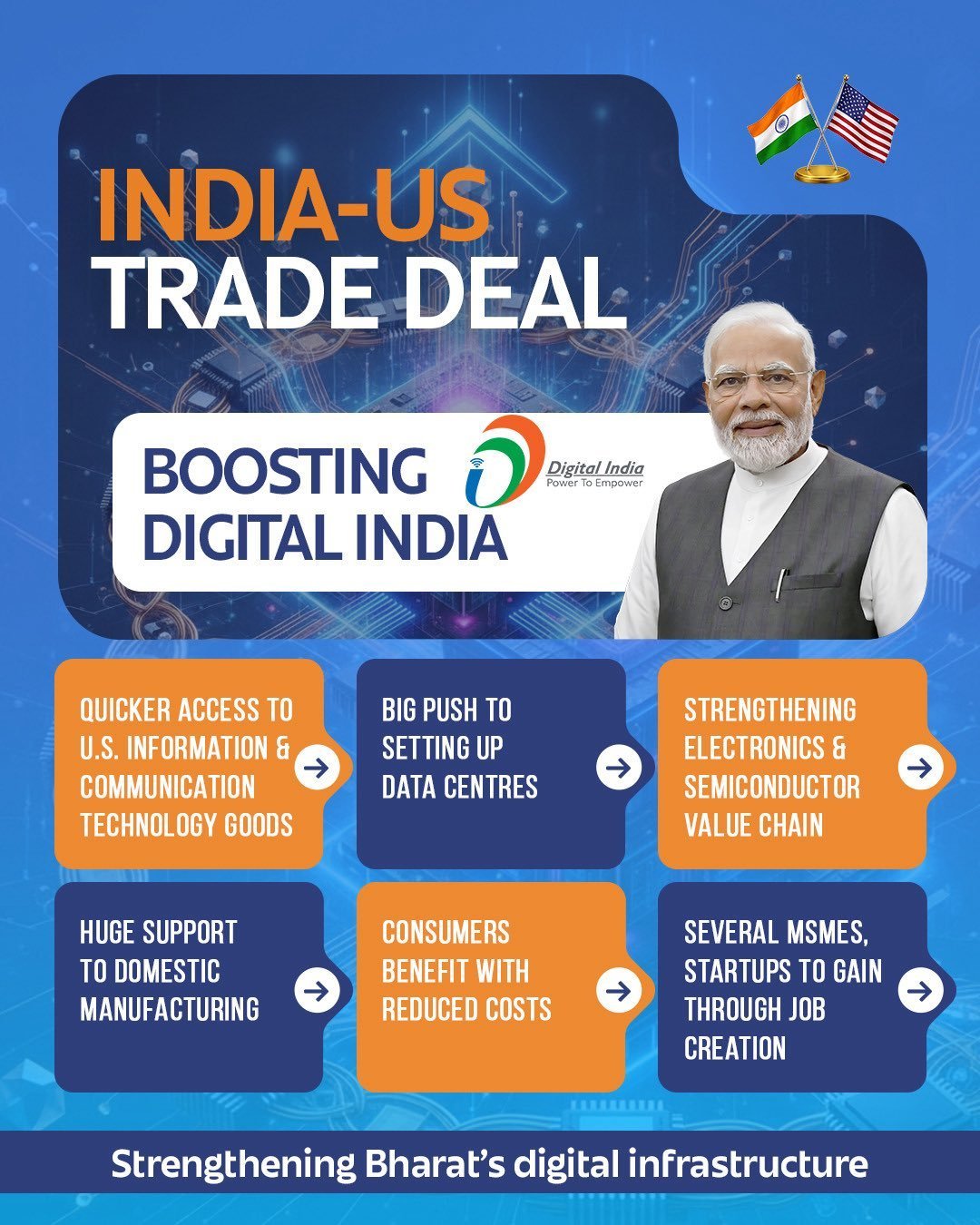
In a major economic breakthrough, Washington and New Delhi agreed on an interim trade framework that cuts tariffs, expands U.S. energy exports to India, and safeguards sensitive farm sectors, signaling a deeper strategic alignment between the two democracies.
BY PC Bureau
New Delhi – February 7, 2026 — In a major development strengthening bilateral economic ties amid global geopolitical shifts, the United States and India released a detailed joint statement on February 6, 2026, outlining a framework for an Interim Agreement on reciprocal and mutually beneficial trade. The announcement follows weeks of high-stakes negotiations and public claims by President Donald J. Trump, building on talks launched by Trump and Prime Minister Narendra Modi in February 2025 for a full Bilateral Trade Agreement (BTA).
The framework is hailed as a “historic milestone” that promotes balanced trade, resilient supply chains, and deeper cooperation in technology, digital trade, and economic security. Both sides pledged prompt implementation, with a formal Interim Agreement expected soon and the broader BTA potentially finalized by March 2026.
Tariff Reciprocity at the Core
Under the deal:
The U.S. will impose a reciprocal 18% tariff on key Indian exports, including textiles and apparel, leather and footwear, plastics and rubber, organic chemicals, home décor, artisanal products, and certain machinery (per amended Executive Order 14257).
Subject to finalization, the U.S. will remove tariffs on additional Indian goods such as generic pharmaceuticals, gems and diamonds, and aircraft parts.
National security-related tariffs on certain Indian aircraft parts (linked to prior proclamations on aluminum, steel, and copper) will be lifted, with preferential treatment for automotive parts.
In return, India will eliminate or reduce tariffs on all U.S. industrial goods and a range of American agricultural and food products, including dried distillers’ grains (DDGs), red sorghum for animal feed, tree nuts, fresh and processed fruits, soybean oil, wine, spirits, and others.
Both nations commit to preferential market access in mutual sectors, rules of origin to prevent third-party benefits, and addressing non-tariff barriers (NTBs), with a six-month review for U.S. standards in medical devices, ICT goods, and food and agriculture.
A safeguard clause protects either side if tariffs change unilaterally.
Under the decisive leadership of PM @NarendraModi ji, India has reached a framework for an Interim Agreement with the US. This will open a $30 trillion market for Indian exporters, especially MSMEs, farmers and fishermen. The increase in exports will create lakhs of new job… pic.twitter.com/xYSjxML6kt
— Piyush Goyal (@PiyushGoyal) February 7, 2026
Russian Oil: U.S. Claims Victory, India Emphasizes Diversification
A flashpoint in the negotiations has been India’s energy imports from Russia. President Trump tied tariff relief to this issue, signing an executive order on February 6, 2026, to rescind an additional 25% punitive tariff (imposed in August 2025 over discounted Russian crude purchases, which Washington viewed as indirectly funding Russia’s actions in Ukraine).
The order explicitly states that “India has committed to stop directly or indirectly importing Russian Federation oil” and will boost U.S. energy purchases, plus expand defense cooperation over the next decade.
Trump highlighted this in announcements, framing the deal as pressuring Moscow while securing American energy exports.
India’s $500 billion purchase intention over five years — covering U.S. energy products, aircraft and parts, precious metals, technology (including GPUs for data centers), and coking coal — supports this shift, with expanded tech trade and joint cooperation.
READ: India Lift Sixth U19 World Cup Title After Crushing England
READ: Echoes of May 3, 2023 as Mass Protests Sweep Manipur’s Hill Districts
However, Indian officials have been more measured. The joint statement focuses on U.S. energy purchases and diversification without mentioning a full Russian oil halt. The Ministry of External Affairs reiterated that energy security for 1.4 billion people is paramount, with sourcing decisions based on “objective market conditions and evolving international dynamics.”
Reports indicate India’s Russian crude volumes have declined due to sanctions and pricing, but a complete stop remains unlikely in the short term given economic advantages.
This divergence underscores U.S. geopolitical priorities versus India’s pragmatic approach to energy security.
Agriculture: Targeted Openings, Ironclad Protections for Farmers
The agriculture sector drew intense scrutiny, with India securing strong safeguards for domestic sensitivities. India will ease barriers on non-competing U.S. items like animal feed (DDGs, red sorghum), nuts, fruits, soybean oil, wine, and spirits, plus resolve long-standing NTBs in U.S. food and agricultural exports.
Commerce and Industry Minister Piyush Goyal emphasized full protection for sensitive areas: “Farmers safe, country developed… dairy, fruits, vegetables, spices, and other grains have been protected.”
No concessions apply to staples such as maize, wheat, rice, soya, poultry, milk, cheese, ethanol, tobacco, certain vegetables (including frozen potatoes, peas, beans, legumes, roots and tubers), meat, and powdered spices like fenugreek, cassia, and mustard.
Finance Minister Nirmala Sitharaman added that the framework safeguards agriculture and animal husbandry, strengthening farmer incomes while helping MSMEs integrate globally.
Goyal noted benefits for Indian exporters (including farmers and fishermen) in the “$30 trillion” U.S. market, creating “lakhs of new job opportunities for women and youth.”
This selective liberalization avoids import shocks to rural livelihoods and food security, countering opposition claims of a “one-sided” deal.
Broader Vision and Reactions
The framework advances digital trade rules, supply-chain resilience against third-party non-market policies, investment reviews, and export controls.
External Affairs Minister S. Jaishankar praised it for boosting exporters and strengthening “Make in India.”
Prime Minister Modi welcomed the “growing depth, trust, and dynamism” in bilateral ties.
The deal eases months of tensions, positioning both nations for deeper strategic alignment.
As implementation begins, analysts see it as a pragmatic win-win — tariff relief for India, energy and security gains for the U.S. — while leaving room for further talks on unresolved frictions like full energy diversification.
┌──────────────────────────────────────────────────────────────────────────────────────┐
│                  KEY POINTS: US-INDIA INTERIM TRADE FRAMEWORK (2026)                 │
├──────────────────────────────────────────────────────────────────────────────────────┤
│ • Historic milestone toward full Bilateral Trade Agreement (BTA)                     │
│   Launched Feb 2025 by Trump & Modi; stepping stone for balanced, reciprocal trade  │
│                                                                                      │
│ • US Tariffs on Indian Goods: 18% reciprocal rate applied (textiles, apparel,       │
│   leather/footwear, plastics/rubber, chemicals, home décor, artisanal, machinery)   │
│   → Removals planned post-finalization: generic pharma, gems/diamonds, aircraft parts│
│   → Lifts national security tariffs on select Indian aircraft/parts & auto quotas   │
│                                                                                      │
│ • India's Concessions: Eliminate/reduce tariffs on ALL US industrial goods + wide   │
│   range of US agri/food (DDGs, red sorghum feed, tree nuts, fruits, soybean oil,    │
│   wine/spirits + more); address NTBs in US medical devices, ICT, food/agri exports  │
│                                                                                      │
│ • Agriculture Protections (India side): Sensitive sectors fully safeguarded         │
│   → No openings for maize, wheat, rice, soya, poultry, milk/cheese, ethanol,        │
│     tobacco, frozen vegetables (incl. potatoes), meat, spices, staples, grains      │
│   → Focus on non-competing US feed/processed items; protects farmer incomes         │
│                                                                                      │
│ • Energy & Russian Oil Dynamics:                                                    │
│   → India intends $500B US purchases over 5 years (energy, aircraft, tech/GPUs,     │
│     precious metals, coking coal)                                                   │
│   → Trump claims India committed to stop direct/indirect Russian oil imports;       │
│     removed 25% punitive tariff (Aug 2025) tied to this                             │
│   → India emphasizes energy security priority + market-based diversification;       │
│     no explicit full halt in joint statement                                        │
│                                                                                      │
│ • Other Commitments:                                                                │
│   → Preferential market access in mutual sectors                                    │
│   → Rules of origin to benefit US & India primarily                                 │
│   → Address digital trade barriers; robust rules in BTA                             │
│   → Supply chain resilience, counter non-market policies, investment/export controls│
│   → Standards/conformity discussions; 6-month NTB reviews                           │
│   → Safeguard clause if tariffs change                                              │
│                                                                                      │
│ • Indian Benefits Highlighted: Opens ~$30T US market; boosts MSMEs, farmers,        │
│   fishermen, exporters; creates lakhs of jobs (esp. women/youth); advances Make in  │
│ India, digital/AI leadership