



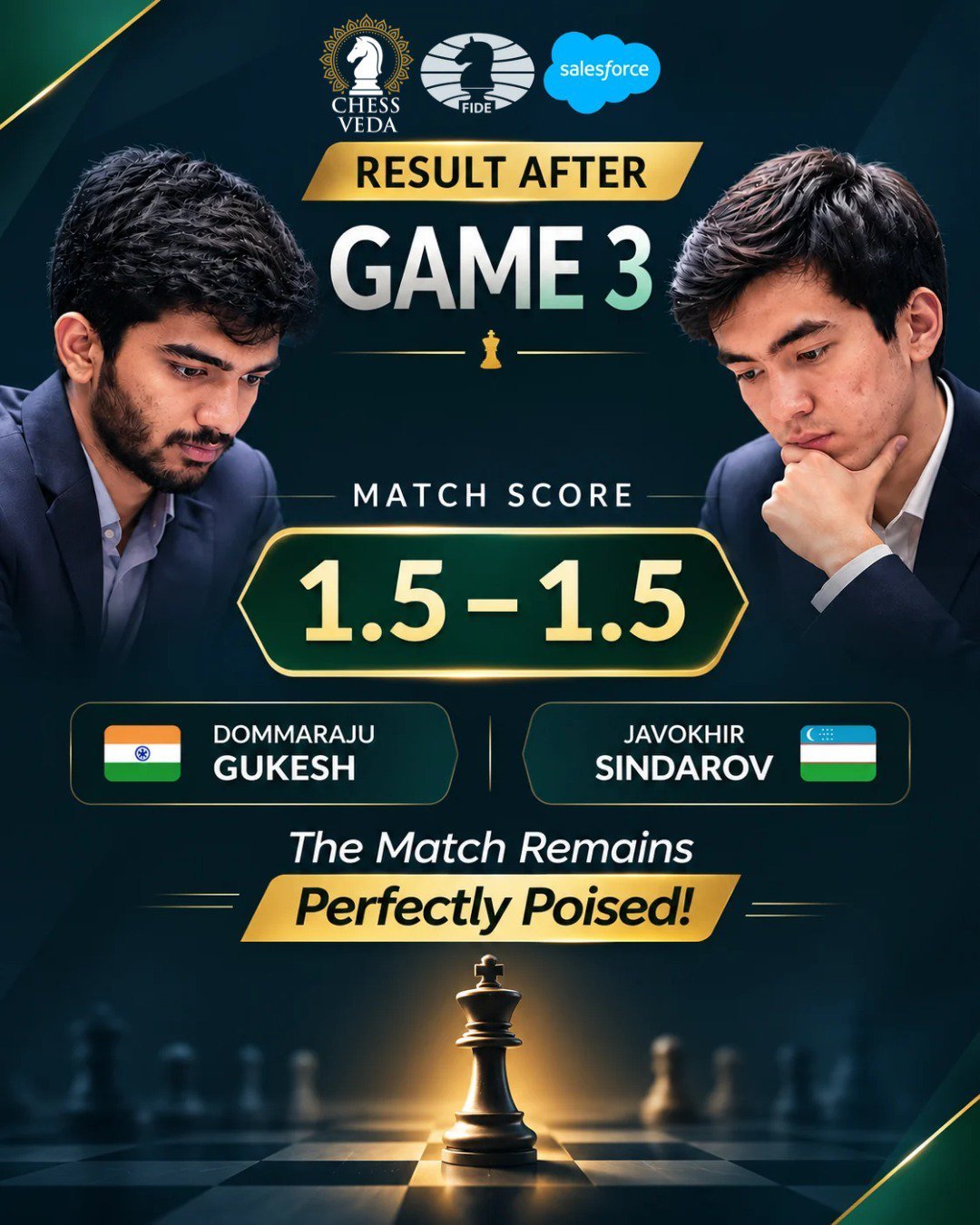
Javokhir Sindarov and defending champion D. Gukesh played out a hard-fought 60-move draw in Game 3 of the 2026 FIDE World Chess Championship in Geneva on Thursday. The result leaves the 14-game match level at 1.5–1.5.
By PC Bureau
November 27: The third game of the World Championship match offered the first sustained battle of the contest. Playing Black, Gukesh surprised Sindarov in the opening, seized a substantial advantage on the clock and kept up the pressure through a long middlegame and rook-and-bishop endgame. But the Uzbek challenger defended resourcefully, survived a tense time scramble and held the world champion to a draw after 60 moves.
The game, played at the Fondation Martin Bodmer in Geneva, lasted nearly five hours. It was a marked contrast to the first two encounters, which ended in draws after 38 and 20 moves respectively.
Gukesh’s opening surprise
Sindarov opened with 1.e4, and Gukesh responded with the Berlin Defence of the Ruy Lopez. However, after 4.O-O Nxe4 5.d4, the Indian chose 5…Be7, entering the relatively rare Rio de Janeiro Variation.
This was a departure from Game 1, when he had played 5…Nd6 and entered the Berlin Endgame. The choice appeared to catch Sindarov off guard. The challenger had to spend considerable time working out his response, while Gukesh played his first 15 moves in barely two minutes.
By move 10, Gukesh had built up a lead of around 20 minutes on the clock. It was the first time in the match that the world champion had enjoyed such a clear time advantage.
The queens were exchanged on move 16, but the resulting position offered plenty of play. Gukesh developed his kingside initiative with …h5 and …g5, while his king moved towards the centre. Sindarov, meanwhile, tried to organise counterplay on the queenside.
Sindarov under time pressure
The game entered a prolonged rook-and-bishop middlegame. Gukesh maintained the initiative and gradually advanced his central pawns. Sindarov’s 29.f4 was an attempt to challenge Black’s kingside pawns, but after 29…gxf4, Gukesh was able to push his d-pawn forward and create a dangerous passed pawn.
The pressure was compounded by Sindarov’s dwindling time. The challenger approached the first time control with only seconds to spare and had to make his 40th move under extreme pressure. He survived the scramble and received the additional 30 minutes, while Gukesh retained a more comfortable position on the clock.
Despite the time advantage, Gukesh could not convert his pressure into a decisive breakthrough. Sindarov’s defensive resources kept the position within drawing limits.
READ: Bomb Threats to Bachchan’s “Jalsa’, Diljit Dosanjh Concert
A long endgame, but no breakthrough
The rooks were eventually exchanged, leaving the players with bishops and pawns. Gukesh continued to test Sindarov’s defence, but the latter’s king and bishop held the position together.
The players reached a bishop endgame with bishops operating on the same-coloured squares. Gukesh tried to make progress with his king and pawns, but Sindarov found the necessary defensive moves. With no realistic route to a win, the game ended in a draw by repetition after 60 moves.
The result reflected the balance of the game. Gukesh had won the opening battle and enjoyed a significant clock advantage, but Sindarov’s resilience prevented him from turning those advantages into a win.
Gukesh gains confidence, Sindarov shows resilience
The draw should nevertheless provide Gukesh with some encouragement. His choice of the Rio de Janeiro Variation was a successful practical surprise, and he managed to put Sindarov under sustained pressure with the black pieces. After being on the back foot in the clock department in the first two games, the champion controlled the pace for much of this encounter.
For Sindarov, the game was a test of defensive technique and nerves. He was forced to think deeply in the opening, spent much of the game short of time and came close to running out of it before the first time control. Yet he found a way to hold the position.
Both players will now have a rest day on Friday before returning to the board on Saturday. Gukesh will have White in Game 4, with the match still evenly poised at 1.5–1.5.
After three draws, neither player has established a lead. But Game 3 showed that the contest is beginning to open up, with both preparation and the ability to withstand prolonged pressure likely to play a decisive role in the remaining games.
Result: ½–½ after 60 moves.
Opening: Ruy Lopez, Berlin Defence (Rio de Janeiro Variation)
Match score: 1.5–1.5
The game ended with Gukesh repeating the king moves in the opposite-coloured bishops endgame.









Comments 1