BY PC Bureau
February 10, 2026
Even after three days of sustained ethnic violence, the Manipur Police has failed to contain clashes between the Tangkhul Naga and Kuki-Zo communities, forcing the state government to extend internet bans to two more districts as gunfire, arson, and displacement continue to destabilise large swathes of Ukhrul, Kangpokpi, and Kamjong.
Despite the deployment of central security forces, including the Assam Rifles, the situation remains highly volatile, with both communities accusing the police and security agencies of partisan conduct — further eroding trust and severely complicating peace efforts. Multiple videos circulating on social media show gunfire and arson continuing in the presence of security personnel. While the forces exercised restraint to avoid escalation, they have so far failed to effectively contain the violence or restore normalcy.
Three Days of Violence, No Containment
The violence erupted on February 8 in the Litan Sareikhong area of Ukhrul, allegedly triggered by an assault on a Tangkhul Naga man during a drunken altercation in Sirarakhong village. What began as a localised incident quickly spiralled into coordinated arson and armed clashes, exposing the inability of the Manipur Police to prevent escalation.
Manipur : 10/2/2026 Shocking visuals have surfaced showing Tangkhul pastor (Phungyar) encouraging and praying for Tangkhul armed youths and militants ahead of the attack on Litan Kuki village.@Spearcorps @PIBHomeAffairs @MIB_India @PIB_India @official_dgar @SpokespersonMoD @ANI https://t.co/icNzxvpKbH pic.twitter.com/sPXIdl09ov
— Neng Khongsai KUKI (@KhongsaiChanu) February 10, 2026
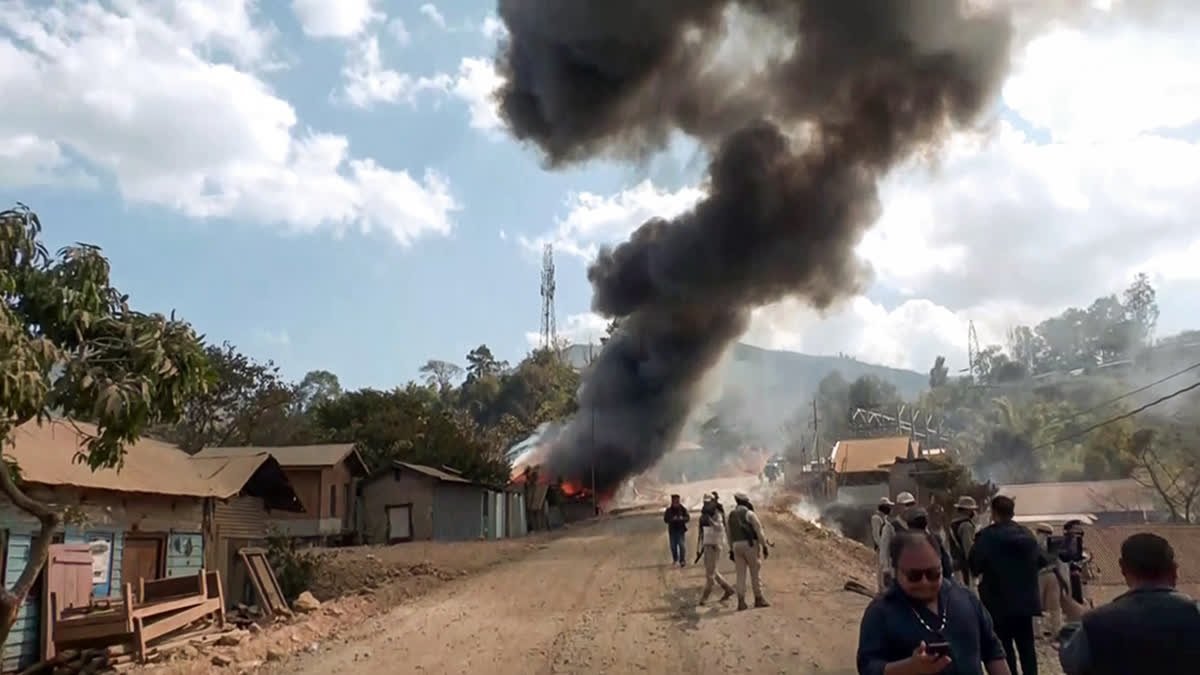
By the night of February 8, over 25 houses and four government quarters were torched in Litan Bazaar and surrounding villages. Videos circulating on social media showed thick smoke rising from the hills, accompanied by sustained automatic gunfire, painting a grim picture of lawlessness.
Instead of stabilising, the violence intensified over the next two days, with cross-firing reported along the Mangkot–Chefu hill range, and fresh arson attacks pushing the number of damaged properties to over 30. Entire villages emptied as women, children, and elderly residents fled en masse toward Motbung, Saikul, and safer areas in Ukhrul.
READ: Trump’s Indo-US Trade Fact Sheet Reveals What Modi Govt Won’t Say
Central Forces Step In, But Volatility Persists
With the state police struggling to regain control, additional companies of the Assam Rifles were rushed into the conflict zones on instructions from the Ministry of Home Affairs. However, the deployment has failed to restore calm, with sporadic gunfire and fresh arson continuing to be reported even on February 10.
Meanwhile, posts circulating on X have accused the Manipur Police of favouring Tangkhul Naga groups, while several others accounts have alleged that the Assam Rifles are backing their rivals. Though these claims remain unverified, they have deepened mistrust, inflamed communal anger, and further complicated counter-insurgency operations.
Security officials privately concede that restoring confidence among rival groups has become as critical as restoring order on the ground.
Internet Ban Expanded Amid Policing Failure
In what officials describe as a last-resort containment strategy, the Manipur government on February 10 extended internet suspension to Kangpokpi and Kamjong, in addition to the existing shutdown in Ukhrul.
The order, issued by Home Commissioner N. Ashok Kumar, suspended mobile data, broadband, VPN, and VSAT services for five days, citing intelligence inputs that inflammatory online content and misinformation were fuelling violence.
Major telecom operators — Airtel, Jio, Vodafone Idea, and BSNL — have been directed to ensure strict compliance, with penalties threatened for violations.
Critics, however, argue that internet bans cannot substitute for decisive policing and political engagement, especially when violence has already spiralled beyond initial control.
A Familiar Pattern of Crisis Management
This latest breakdown underscores Manipur’s chronic policing and governance challenges, especially in handling ethnic flashpoints. Since the 2023 unrest, which claimed over 260 lives and displaced tens of thousands, authorities have repeatedly relied on internet shutdowns, curfews, and troop deployments — measures that contain symptoms but not root causes.
The BJP-led government under Chief Minister Yumnam Khemchand Singh, despite projecting ethnic balance by appointing Kuki-Zo MLA Nemcha Kipgen as Deputy CM, has failed to establish a credible conflict-prevention framework, analysts say.
With inter-ethnic suspicion deepening, security forces facing credibility deficits, and violence refusing to subside, Manipur once again stands perilously close to sliding back into large-scale conflict.
Unless firm, impartial enforcement of law and immediate political dialogue follow, experts warn the current unrest could snowball into a far wider and deadlier confrontation.