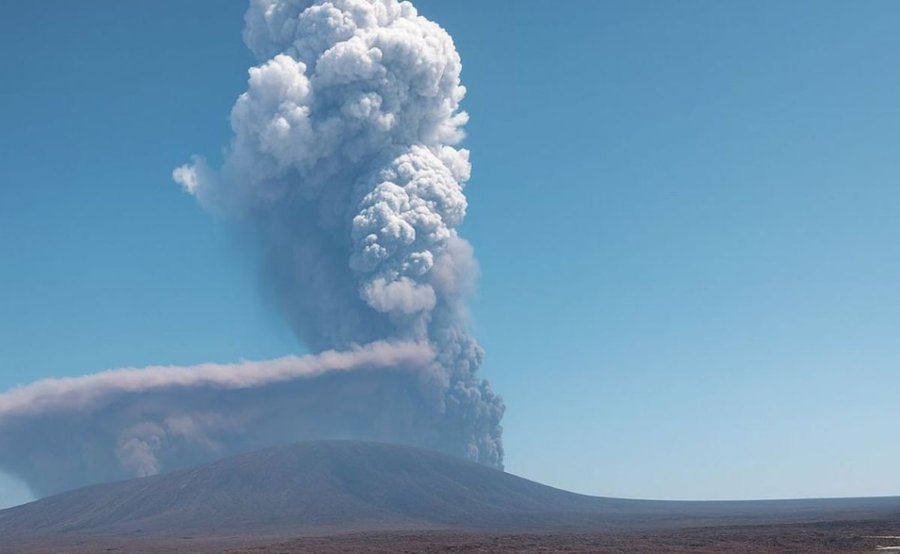
The eruption, among the most powerful in decades in the Afar Rift, forced Indian aviation authorities to divert Europe- and Gulf-bound flights and issue emergency guidelines for all carriers.
BY PC Bureau
November25, 2025: A long-dormant volcano in northern Ethiopia roared back to life on Sunday for the first time in nearly 12 millennia, sending massive ash clouds soaring 14–15 kilometres into the sky and triggering a chain of atmospheric and aviation disruptions across continents. The eruption — among the most significant geological events in the Horn of Africa in recent decades — has already impacted India’s western and northern regions, where the upper-atmospheric ash plumes have drifted into Delhi’s skies, raising alarms for aviation authorities.
The Hayli Gubbi volcano, located in the seismically active Afar region, unleashed violent plumes early Sunday, blanketing nearby villages with ash and sending shockwaves through the East African Rift Valley — a geological hotspot where the African tectonic plate is slowly splitting into two.
The eruption’s timing and intensity caught local communities, meteorologists and international aviation bodies off-guard, prompting rapid advisories, flight diversions and emergency airspace warnings.
A Massive Plume Travels Across Continents
Meteorological models show that the ash plume — propelled by upper-level winds moving at 100–120 km/h — travelled east-northeast across the Arabian Peninsula before entering Gujarat’s airspace late Sunday. It continued drifting over Rajasthan, Haryana, Punjab and Delhi, reaching the national capital’s upper-atmosphere layer just as the city was battling hazardous smog.
Although the plume is thousands of feet above ground level and not expected to worsen Delhi’s AQI, its presence has forced several airlines to adjust routes. A number of Europe-bound flights from India were reported delayed, diverted or rescheduled.
Videos circulating on social media showed the ash column rising sharply into the atmosphere, resembling a colossal white-grey pillar. While many videos could not be immediately authenticated, satellite imagery confirmed the presence of a dense plume stretching hundreds of kilometres.
READ: Dharmendra (1935–2025): The Last of the Gentle Giants
Flights Hit Across India and Middle East
The unexpected drift of volcanic ash across high-altitude travel corridors prompted India’s aviation regulator, the Directorate General of Civil Aviation (DGCA), to issue an urgent advisory.
Airlines were instructed to avoid all published volcanic-ash-affected areas, revise routing, carry additional fuel for longer detours, and report any suspected ash encounters immediately.
Ash poses severe hazards to aircraft:
It can stall engines mid-air,
Sandblast cockpit windows,
Damage control surfaces,
And contaminate ventilation systems.
In its public message, IndiGo reassured passengers that safety protocols were fully activated.
“Your safety remains our highest priority… we are closely tracking international advisories and taking all precautions,” the airline posted on X.
Air India and SpiceJet also reported disruptions. Several flights headed to the Middle East, Africa and Europe were re-routed to avoid dangerous air corridors.
A number of flights from Dubai, Abu Dhabi and Doha to Indian cities experienced delays, as Middle Eastern aviation hubs lie directly in the path of the ash plume’s trajectory.
Will India’s Air Quality Worsen?
According to atmospheric scientists, the plume consists mostly of sulphur dioxide (SO₂) and fine ash particles. While SO₂ can be harmful at ground level, experts say it is unlikely to descend into India’s lower atmosphere in concentrations that would worsen the AQI.
However, some impact is expected elsewhere.
A weather expert posted on X: “The plume will likely raise SO₂ levels in the hills of Nepal, the Himalayas and parts of the Terai belt of Uttar Pradesh… some material will later drift toward China.”
The hills and mountain regions may experience a temporary spike in SO₂, which can irritate the respiratory system, especially for vulnerable populations.
Volcanic ash from Ethiopia’s Hayli Gubbi volcano — erupting after nearly 12,000 years — is now drifting towards India.
Dense parts of the plume may pass over Delhi, Haryana & UP.
DGCA issues alerts as flights face delays, cancellations & rerouting.As if the AQI crisis wasn’t… pic.twitter.com/KCwfp0EKxx
— Megh Updates 🚨™ (@MeghUpdates) November 24, 2025
A Geological Awakening After 12,000 Years
The Hayli Gubbi volcano, standing roughly 500 metres high, is part of the Afar Triangle, one of the most geologically active regions on Earth. The Rift Valley is a zone where the African tectonic plate is slowly tearing apart, forming new crust and deepening chasms — a process that has been ongoing for millions of years.
According to the Smithsonian Institution’s Global Volcanism Program, Hayli Gubbi has had no known eruptions in the Holocene epoch, which spans the last 12,000 years.
This makes Sunday’s eruption a rare and significant geological event.
Residents in surrounding towns described the blast as terrifying.
“It felt like a sudden bomb had exploded — ash and smoke everywhere,”
said one resident interviewed by AP.
Cracks appeared in some structures, and several villages were quickly coated in ash. Emergency teams from Ethiopia’s meteorological and geological departments were deployed to assess damage, though communication lines remain patchy.
Impact Across East Africa
Thick layers of ash fell across parts of the Afar region, blanketing homes, farmland and grazing areas. Local water sources are at risk of contamination — a major concern in an area already struggling with drought.
Volcanic ash can:
Pollute water supplies,
Damage crops,
Poison livestock,
And cause long-term soil degradation.
The Afar region is also home to nomadic pastoralist communities who rely heavily on livestock for survival. Humanitarian agencies are assessing whether emergency relief is required.
Tremors continued in the area for several hours after the eruption, raising fears of additional activity. While major aftershocks have not been reported, scientists say the region will remain seismically unsettled for days.
Global Scientists Tracking the Plume’s Spread
Volcanologists worldwide are closely monitoring the plume’s movement and composition. The unusually long dormancy of Hayli Gubbi makes this eruption scientifically significant.
Satellite data from NASA, ESA and the African Union’s EARTH observation centre is tracking:
Ash height,
SO₂ concentration,
Speed and direction of the drift,
And temperature anomalies.
Experts are also examining whether this eruption could influence regional climate patterns. Large volcanic eruptions can temporarily cool global temperatures if sufficient sulphur dioxide reaches the stratosphere and forms reflective aerosols.
At present, scientists believe the Hayli Gubbi eruption is not large enough to have a global climate impact, though more data is needed.
India Preparing for Continued Disruptions
The DGCA said it will issue updated airspace advisories as global aviation bodies release fresh modelling. The next 48–72 hours will be critical in determining whether:
The ash disperses,
Or if new eruptions intensify the plume.
If the plume thickens, airlines may need to reroute additional long-haul flights, particularly those using the northern Arabian Sea and Western Asia corridors.
Meteorological agencies in Gujarat, Rajasthan and Delhi continue to track upper-atmosphere movements. While no significant ground-level effects are expected in India, experts warn that the situation remains dynamic.
A Reminder of the Planet’s Unpredictability
The sudden awakening of a dormant volcano underscores the volatile nature of the Earth’s crust, especially in tectonically active areas like the East African Rift. As climate patterns change and geological activity becomes more unpredictable, scientists say global monitoring systems must be strengthened — particularly in vulnerable regions with limited resources.
For now, the world watches as East Africa grapples with a rare natural event, and airlines adjust their routes to avoid a danger that begins thousands of kilometres away but travels swiftly across continents.