Notably absent were the armed SoO groups that have historically steered the movement — underscoring the emergence of a decentralised people’s revolt driven by survival instincts rather than organised leadership.
BY PC Bureau
February 6, 2026: For the first time since the ethnic conflict erupted on May 3, 2023, the Kuki-Zo hills of Manipur witnessed a mass political uprising of similar scale and emotional intensity, as tens of thousands of ordinary people poured into the streets across multiple districts on Friday, reigniting memories of the early days of the conflict.
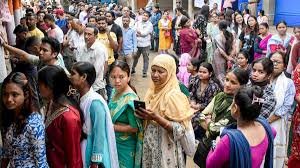
From Churachandpur to Saikul, Moreh, Tengnoupal, Pherzawl, and parts of Chandel, public life ground to a halt as women, schoolchildren, college students, elderly men and women, and entire families emerged spontaneously in protest, enforcing near-total shutdowns and staging massive rallies.
What made the day extraordinary was not merely the scale — but the organic nature of the mobilisation.
There were no mass mobilisation for weeks or days, no central leadership instructions, no role played by armed groups under the Suspension of Operations (SoO) framework, which have traditionally dominated Kuki-Zo movements.
Yet, the streets overflowed.
READ: Fear Over Fury: Why Nemcha Kipgen’s Hometown Defied Manipur’s Protest Wave
A People’s Uprising, Not an Organised Protest
In town after town, crowds assembled before dawn, blocking highways, raising barricades, and filling market squares with slogans rejecting the newly formed Manipur government.
Observers described the mobilisation as instinctive and emotional, driven by collective rage, exhaustion, and accumulated trauma.
“This is not a protest organised by leaders. This is a protest of survival. It has now become a people’s movement that can no longer be controlled,” said Dr Chinkholal Thansingh, a prominent Churachandpur-based physician and president of Lamka City of Hope. “People walked out of their homes because they could no longer remain silent.”
VIDEO | Manipur: The Kuki Women Organisation for Human Rights held a protest rally in Churachandpur to oppose the participation of Kuki-Zo MLAs in the formation of the government.
Earlier, Kuki-Zo tribal groups declared a social boycott of Kuki-Zo legislators who have joined… pic.twitter.com/ek2DzHoHcM
— Press Trust of India (@PTI_News) February 6, 2026
Women led the frontlines — carrying infants, holding their daughters’ hands, guiding elderly parents, while students marched in school uniforms, some clutching handwritten placards.
In Churachandpur, the epicentre of mobilisation, streets were flooded by massive processions chanting:
Markets, schools, government offices, banks, and transport services shut completely. Major highways connecting hill districts to Imphal and Myanmar were blocked.
In Moreh, the strategic border town, thousands marched through bazaars and residential localities, forcing a complete shutdown of cross-border trade.
READ:
VIDEO | Manipur: The Kuki Women Organisation for Human Rights held a protest rally in Churachandpur to oppose the participation of Kuki-Zo MLAs in the formation of the government.
Earlier, Kuki-Zo tribal groups declared a social boycott of Kuki-Zo legislators who have joined… pic.twitter.com/ek2DzHoHcM
— Press Trust of India (@PTI_News) February 6, 2026
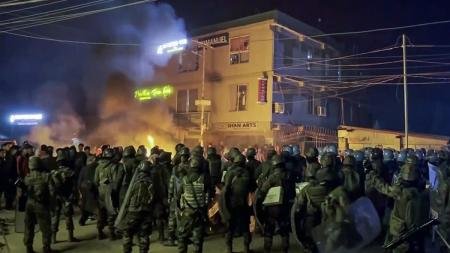
In Saikul , protesters erected burning barricades, triggering confrontations with security forces.
In Pherzawl and Chandel, villagers walked for kilometres to reach district headquarters, swelling protest sites into seas of humanity.
Return of May 3 — Without Guns
For many, Friday’s uprising recalled the emotional intensity of May 3, 2023, when violence first erupted.
But there was one striking difference.
VIDEO | Manipur: The Kuki Women Organisation for Human Rights held a protest rally in Churachandpur to oppose the participation of Kuki-Zo MLAs in the formation of the government.
Earlier, Kuki-Zo tribal groups declared a social boycott of Kuki-Zo legislators who have joined… pic.twitter.com/ek2DzHoHcM
— Press Trust of India (@PTI_News) February 6, 2026
The armed groups that once stood at the forefront of the Kuki-Zo movement were conspicuously absent.
Not a single major SoO group issued a public statement.
No militant leaders addressed gatherings.
No armed presence was visible.
The protest belonged entirely to civilians.
The silence of the SoO groups — including those under the UPF and KNO umbrellas — was widely interpreted as politically significant.
Many see it as an implicit acknowledgment that public anger has reached a level that cannot be controlled, managed, or channelled through militant authority.
Why the Hills Exploded
The protests were triggered by the participation of three Kuki-Zo MLAs — including Kangpokpi MLA Nemcha Kipgen, now Deputy Chief Minister — in the newly sworn-in BJP-led Manipur government, which ended nearly a year of President’s Rule.
For most Kuki-Zo groups, joining a Meitei-dominated government in Imphal represents a fundamental betrayal of their political demand for:
- A separate administration, or
- A Union Territory with legislative safeguards.
Kuki-Zo Council had issued explicit resolutions barring any Kuki-Zo MLA from joining the government without written constitutional guarantees.
The decision to ignore these mandates shattered fragile trust.
“This is not about politics anymore. This is about dignity and survival,” said a student protester in Saikul. “Our people are still in relief camps. Our villages are destroyed. And they are sharing power in Imphal as if nothing happened.”
Women and Children at the Heart of the Protest
Across protest zones, women formed the backbone of mobilisation.
In Churachandpur, women’s groups blocked highways, confronted security forces, and physically prevented traffic movement.
Security deployments were intensified across sensitive zones, with paramilitary reinforcements rushed into Kangpokpi, Moreh, and Churachandpur.
The Silence of the Armed Groups
Perhaps the most politically revealing aspect of the day was the complete absence of SoO militant leadership from public discourse.
For decades, armed groups have shaped political narratives, enforced shutdowns, and controlled mobilisation.
On Friday, they were spectators — not drivers.
“This signals a dangerous moment for militant authority,” said a senior security official. “When masses move independently, guns lose relevance.”
Civil society leaders openly described the protests as a rejection of both Imphal’s political authority and militant shadow governance.
A Defining Moment for Kuki-Zo Politics
As night fell, hill districts remained under heavy security deployment, but public anger showed no sign of dissipating.
Civil society groups announced more protests in the coming days, while student and women’s organisations vowed to sustain agitation until political demands are addressed.
For Manipur, Friday marked a turning point.
Not merely a protest.
But a people’s uprising — organic, emotional, civilian-led — that reopened the unresolved wounds of May 3, 2023 and cast a long shadow over the legitimacy of the newly formed state government.
As one elderly protester in Churachandpur said:
“This is not politics. This is our cry for existence.”