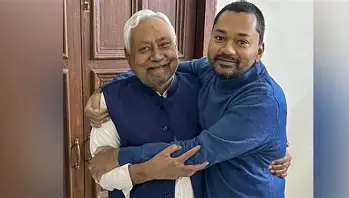
The move has sparked speculation about a leadership transition in Bihar, with political observers suggesting Nishant Kumar could eventually take on a significant role within the ruling coalition government.
BY PC Bureau
March 8: In a development that could reshape Bihar’s political landscape, Nishant Kumar — the son of long-serving Chief Minister Nitish Kumar — formally joined the Janata Dal (United) (JDU) on Sunday, signalling a potential generational transition within the party even as the veteran leader prepares to move to the Rajya Sabha.
The 50-year-old, who has largely stayed away from public life despite years of speculation about his political future, took his first formal step into electoral politics at a time when Nitish Kumar is preparing to exit the Chief Minister’s office after dominating Bihar’s politics for more than two decades.
READ: End of an Era: Nitish Files Nomination for Rajya Sabha
Nitish Kumar’s Parliamentary Move
The 75-year-old JDU president has filed his nomination to contest the March 16 Rajya Sabha election and is widely expected to step down as Chief Minister once elected. The move marks a significant shift for a leader who has served multiple terms as Bihar’s chief minister and built his political identity around governance reforms, infrastructure expansion and welfare schemes.
Often referred to as “sushashan babu” for his emphasis on administrative order and development, Nitish Kumar has already served in several legislative roles — including as a member of the Lok Sabha, the Bihar Legislative Assembly, and the Legislative Council. A Rajya Sabha tenure would allow him to complete the rare distinction of serving in all four legislative chambers at both the state and national levels.
Only a handful of Bihar’s most influential leaders have matched that record, including former Chief Minister Lalu Prasad Yadav and the late Sushil Kumar Modi, both contemporaries of Nitish Kumar during the anti-Emergency movement of the 1970s.
Patna, Bihar: On CM Nitish Kumar’s son Nishant Kumar formally joining JD(U), JD(U) MLA Hari Narayan Singh says, “CM’s son Nishant Kumar is going to take membership of the JDU today, and this is a matter of happiness” pic.twitter.com/mQyCQFlQ1e
— IANS (@ians_india) March 8, 2026
What Nishant Kumar’s Entry Signals
Nishant Kumar’s induction into the party has immediately triggered speculation about the future leadership structure of the JDU and the ruling coalition in Bihar.
For years, Nishant remained an intensely private figure, occasionally appearing at public events but avoiding political roles. His sudden entry into the party suggests that the JDU leadership may be preparing for a carefully managed transition at a time when the party faces increasing competition from both the Bharatiya Janata Party (BJP) and the opposition Rashtriya Janata Dal (RJD).
Within political circles, there is growing speculation that Nishant could eventually be accommodated in the state government — possibly even as Deputy Chief Minister — once Nitish Kumar moves to Parliament. Such a move could allow the JDU to retain influence in the state administration even if the BJP claims the Chief Minister’s post.
If that scenario plays out, it would mark a significant recalibration in the BJP-JDU power balance in Bihar. Despite being the junior partner in several governments led by Nitish Kumar, the BJP has long aspired to install a chief minister from its own ranks in the state.
Dynastic Politics Debate
Nishant Kumar’s political debut also raises broader questions about dynastic politics — an issue frequently debated in Indian politics.
While the JDU has traditionally projected itself as a party rooted in socialist and anti-dynastic politics, the entry of the chief minister’s son could reshape that narrative. Political analysts note that Nitish Kumar had for years resisted suggestions that Nishant should enter politics, which made Sunday’s announcement particularly significant.
Whether Nishant will emerge as a long-term political figure or remain a symbolic presence in the party remains uncertain. Much will depend on how the JDU reorganises itself after Nitish Kumar’s transition to national politics.
Opposition Attacks
The opposition Rashtriya Janata Dal has reacted sharply to the developments, accusing the BJP of engineering a political rearrangement in the state.
RJD Rajya Sabha MP Manoj Kumar Jha said the party’s leader Tejashwi Yadav had repeatedly warned during last year’s Assembly election campaign that Nitish Kumar would serve only as a “temporary Chief Minister.”
“A man who served as Chief Minister for 21 years now wants to move to the Rajya Sabha. This is childish. At least make a convincing argument,” Jha said.
RJD leaders have also argued that JDU’s core voter base — which once rallied behind Nitish Kumar’s governance credentials — may feel uneasy about both the shift in leadership and the possibility of dynastic succession within the party.
A Political Transition in Bihar
Taken together, Nitish Kumar’s move to the Rajya Sabha and Nishant Kumar’s entry into the JDU signal the beginning of what could be one of the most consequential political transitions in Bihar in decades.
For over twenty years, Bihar’s politics has revolved around the rivalry and shifting alliances between Nitish Kumar and Lalu Prasad Yadav’s political camp. With Nitish gradually stepping away from the state leadership, the next phase of that political contest may be defined by a new generation of leaders — and a very different balance of power within the ruling coalition.