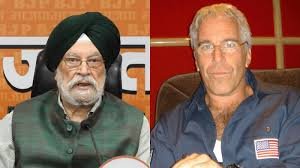
The Congress has demanded clarity on whether the Indian government was aware of these communications between Hardeep Puri and Epstein and whether the digraced offender functioned as an adviser, intermediary, or facilitator in diplomatic and business interactions.
BY PC Bureau
New Delhi | February 12, 2026: The Congress on Wednesday raised serious questions after party spokesperson Pawan Khera claimed that a fresh set of emails shows convicted sex offender Jeffrey Epstein had detailed foreknowledge of, and follow-up involvement in, meetings held by Union Minister Hardeep Singh Puri with US tech entrepreneur Reid Hoffman in October 2014.
In a post on X (formerly Twitter), Khera alleged that the email exchanges suggest that Epstein was not merely aware of the meeting but was also consulted both before and after it, pointing to what he described as a “deeply troubling” pattern of engagement.
Emails Show Pre- and Post-Meeting Communication
According to Khera, emails indicate that Epstein knew in advance about Puri’s October 4, 2014 meeting with LinkedIn co-founder Reid Hoffman and that Puri had sought Epstein’s advice before the meeting took place.
The following day, on October 5, Epstein reportedly followed up, asking whether the meeting had been productive. Khera quoted Puri’s reply in detail:
“Very useful and productive from my point of view… Week of September 14, 2015 pencilled in for visit to India… Would like to come across on 8th or 10th to brief you in fuller detail… I am here till 14 October… Just landed back…”
Subsequent emails, according to Khera, show further coordination over scheduling, culminating in Puri confirming: “Will be there at 1030 on the 10th.”
Yesterday we highlighted emails showing that Jeffrey Epstein knew in advance about @HardeepSPuri’s meeting with Reid Hoffman on 4 October 2014 and that Hardeep was seeking Epstein’s advice before that meeting even took place.
But the story doesn’t end there.
On 5 October 2014,… https://t.co/oaOpEatZg1 pic.twitter.com/AQmHeGIIsI
— Pawan Khera 🇮🇳 (@Pawankhera) February 12, 2026
‘Not a Casual Interaction,’ Says Congress
Citing the exchanges, Khera argued that the correspondence reflects sustained engagement, including:
Pre-meeting consultation
Post-meeting reporting
A planned in-person briefing
“This was not a passing interaction,” Khera said, asserting that the nature of the communication raises “serious and unavoidable questions” about Epstein’s role in the discussions.
READ: Epstein Link: Cong Confrotns Hardeep Puri with Six Questions
Key Questions Raised
The Congress spokesperson listed several questions, including:
Why was a serving Indian official reporting the outcome of a high-level meeting to Jeffrey Epstein?
In what professional or institutional capacity was Epstein involved?
Was Epstein acting as an intermediary, adviser, facilitator, or gatekeeper, and under whose authority?
Was the Indian government aware of such communications?
Were other meetings, delegations, or briefings similarly routed through Epstein?
Did these interactions have any bearing on policy, investment decisions, or diplomatic engagements?
The revelations come amid renewed political scrutiny of Epstein’s global network of contacts, following the public release of court documents and communication records in the United States that have triggered political and institutional fallout in several countries.