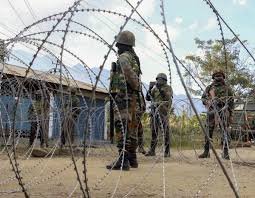
The ethnic-geographic pattern of the buffer zones underscores the continuing divide between the Imphal Valley and surrounding hill districts.
BY Navin Upadhyay
March 23, 2026: In a state already fractured by ethnic violence, denial has become a favorite political strategy in Manipur. Fresh from a meeting with the Kuki-Zo Council in Guwahati, the Chief Minister rushed to the cameras to declare, with a straight face, that there are no buffer zones in the state — only certain “sensitive areas” that the government has “identified.” Sorry, Chief Minister — the rest of Manipur, and the armed security forces standing guard, didn’t get the memo.
While the state may not formally recognise “buffer zones,” security forces have long operated de facto separation lines between areas dominated by different ethnic communities, particularly along the valley-hill transition zones. Media reports often describe these as buffer zones, but technically, they are security deployment areas rather than official zonal designations.
The Facts the CM Ignores:
In his speech in the Lok Sabha on August 9, 2023 (during the no-confidence motion debate amid the ongoing Manipur ethnic violence), Home Minister Amit Shah stated:
“Over 36,000 security personnel have been stationed between Kukis and Meiteis as a buffer zone.”
A day later, India Today reported that, during Amit Shah’s meetings with Kuki leaders around the same period, assurances were given for additional central armed forces to defend “buffer zones,” aligning with his parliamentary remarks on the security setup.
On the same day, Millennium Post reported, “Amit Shah condemns Manipur violence in Parliament” — directly quoting the line about security personnel stationed “as a buffer zone.”
September 2025: The Kuki-Zo Council signed a high-profile agreement with the Ministry of Home Affairs (MHA) to reopen National Highway-2. Within hours, the Council clarified: no one from either community should cross the “buffer zones,” which must remain inviolate until a political settlement is reached.
• If the buffer zones didn’t exist, why was the Kuki-Zo Council negotiating their maintenance with the Centre?
The CM’s wordplay — “sensitive areas, not buffer zones” — fell apart when Congress MP Dr. Angomcha Bimol Akoijam attempted to visit Saiton Nganukon (Bishnupur district) in early January 2026. He was stopped by central security forces. The widely circulated video shows the MP literally standing at the line that the Chief Minister insists does not exist. Akoijam called it an “imaginary and unconstitutional buffer zone” functioning like an “India-Kuki border.”
READ: Asian Equity Markets Plunge Amid Oil Price Surge
READ: Brent Hits $112 Amid Trump-Iran Strait of Hormuz Standoff
He later filed an RTI seeking the legal basis for these restrictions. The visuals, checkpoints, and armed personnel all confirm that the zones exist in practice, enforced by central forces (Army, Assam Rifles, CRPF, BSF) under unified command since 2023. Even the Union Home Minister has referenced these arrangements in Parliament.
Yet here we are in 2026: a new Chief Minister harping on the old line of denial. Kuki-Zo groups demand their maintenance. Security forces enforce them. An MP is stopped at one. And the CM insists, “What buffer zone?”
This isn’t governance; it’s gaslighting. The barbed wire, armed sentries, and checkpoints are all very real. Manipur doesn’t need more wordplay — it needs honesty.
Major Identified Buffer Zone Locations
These zones are concentrated along transition points between the Imphal Valley and surrounding hill districts:
• Bishnupur–Churachandpur border: Heavily checkpointed; includes Phougakchao Ikhai and Saiton Nganukon, where MP Akoijam was stopped.
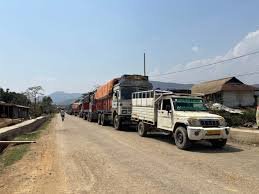
• Along National Highway-2 (Imphal–Dimapur): Checkpoints restrict movement into Kangpokpi district; includes the Kangpokpi “district gate” area.
• Along National Highway-37: Foothill sections connecting the valley to the hills have restrictions.
• Foothills around Imphal Valley edges: Imphal West/East interfacing with Kangpokpi (northern/western edges), preventing valley residents from entering Kuki-Zo-majority hills.
• Villages: Torbung, Sabungkhok Khunou, Chingphei, and Litan — flashpoint areas now under restriction.
• Leitanpokpi (Imphal East): Meitei-owned farmlands now inaccessible.
• Khamenlok river valley (Saikul subdivision, Kangpokpi) and peripheral areas in Imphal East/Bishnupur follow ethnic-geographic lines.
These zones impact agriculture, highways, and the return of internally displaced persons (IDPs). They affect Bishnupur, Churachandpur, Kangpokpi, Imphal West/East, and parts of Kakching/Thoubal indirectly.
HARD FACT:
Assam Rifles-Related Mentions and Actions
• In August 2023, the Assam Rifles defended their role in a high-profile incident where Manipur Police filed an FIR against them for allegedly obstructing search operations. The Army (overseeing Assam Rifles) responded that the unit was “keeping buffer zone sanctity,” explicitly using the term to justify their deployment and restrictions at a key checkpoint (The Print, August 8, 2023).
• In August 2025, Assam Rifles (under Spear Corps) publicly reported rescuing a civilian who “inadvertently entered a restricted buffer zone” between communities, directly referring to it as a “restricted buffer zone” in their official statement (e-pao.net, August 6, 2025).
• Multiple reports from 2024 highlight protests and demands from Kuki-Zo groups and MLAs when the Centre planned to relocate two Assam Rifles battalions (9th and 22nd) from sensitive areas like Kangvai (Churachandpur-Bishnupur border) and Kangchup (Kangpokpi-Imphal East border). These groups described the Assam Rifles as “indispensable for the maintenance of the current status quo in buffer zones,” with the Army recommending incoming CRPF units remain under Assam Rifles’ command for continuity (The Wire, August 6, 2024; Times of India, August 7, 2024).
• In 2025, Kuki-Zo women protesters thanked the Centre and the MHA for ensuring the continued presence of Assam Rifles in buffer zones after rumors of withdrawal, with Army sources confirming the forces’ role in these areas (Northeast Live YouTube report).
• March 16, 2026: Fresh tensions have surfaced in strife-hit Manipur after the Indigenous Tribal Leaders’ Forum (ITLF), a key body representing Kuki-Zo tribal groups, warned a Meitei cyclist against entering Churachandpur district, citing the sensitive buffer zones currently separating Meitei and Kuki-Zo areas (Power Corridors, March 16, 2026).
BSF-Related Mentions
• In Bishnupur district’s buffer zone areas (e.g., near Khoirentak Khuman village), BSF personnel are stationed along the edges of the buffer strip, with watch points spaced along irrigation channels and high canals to enforce separation. Reports describe layered deployments: Army/Assam Rifles at initial lines, followed by BSF and CRPF further out, treating these as operational buffer zones (The Hindu, August 3, 2025).
• Along NH-2 and inter-district borders (e.g., Bishnupur-Churachandpur), BSF is part of multi-layered checkpoints (often 3–7 posts manned by Army, Assam Rifles, BSF, CRPF, etc.) that function as buffer enforcement points, as noted in ground reports on restricted movement (Tribune India, October 4, 2023).
These cases illustrate that while the Manipur state government, Governor, and police officially deny formal buffer zones (e.g., Manipur Police clarification in May 2024; Governor’s January 2026 statement), central forces like Assam Rifles and BSF — under MHA oversight — have used the term in operational statements, justified actions by it, and enforced demarcations on the ground. This creates a de facto reality acknowledged in practice by the central security apparatus, even if not formally notified as a “declared” zone.
As of March 2026, the zones remain in place amid ongoing tensions. Kuki-Zo groups view them as essential for protection, while many in the valley see them as unconstitutional divisions hindering free movement and unity. No full public map is available, but the pattern follows ethnic-geographic lines along the valley-hill divide.