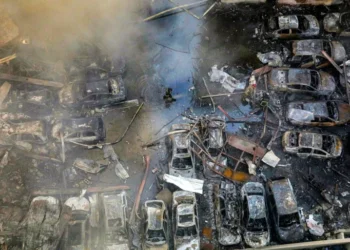
Ukraine reports a sharp rise in Russian troop movements, artillery fire, tactical aviation and drone activity across the front.
BY PC Bureau
March 22, 2026: Russian forces have begun a renewed spring offensive in eastern Ukraine, deploying dozens of tanks and armored vehicles as part of a broader escalation, CNN reported citing cording to the Ukrainian military, analysts,
The assault appears to be accelerating at a time of growing concern in Kyiv that the Middle East conflict could further weaken Ukraine’s position internationally. Ukrainian President Volodymyr Zelensky told the BBC on Sunday that he has a “very bad feeling” about the fallout of the Iran war for Ukraine.
“You see that our diplomatic meetings, trilateral meetings, are constantly postponed. There is one reason: war in Iran,” Zelensky said, according to CNN. He added that Russian President Vladimir Putin would benefit from a prolonged conflict in Iran, saying, “Putin will want a long war. For Putin, a long war in Iran is a plus,” pointing to higher oil prices and the easing of some U.S. sanctions on Russian crude as factors helping the Russian economy.
Russian forces are regrouping and continuing preparations for renewed offensive operations on the Kharkiv front after unsuccessful assaults in recent days, Viktor Trehubov, spokesperson for Ukraine’s Joint Forces grouping, said on air with the We Are Ukraine TV channel…
— The New Voice of Ukraine (@NewVoiceUkraine) March 22, 2026
Against that backdrop, Russia has intensified attacks across eastern Ukraine. CNN cited Ukrainian military chief Oleksandr Syrskyi as saying Friday that “with changing weather conditions, the Russian aggressor has stepped up pressure across several sections of the front.” Syrskyi added that combat engagements had exceeded 200 for several consecutive days and claimed Russian losses were running at more than 1,000 troops a day.
READ: No ‘Buffer Zones’ in Manipur, Says CM After Kuki-Zo Talks
Dmytro Zaporozhets of Ukraine’s 11th Corps told Ukrainian broadcaster Suspilne, as cited by CNN, that active troop movements, reinforced artillery, tactical aviation, and the widespread use of drones suggest Russian forces are preparing for a broader offensive.
One major focus of the attacks is the town of Lyman in Donetsk region, located on the edge of Ukraine’s so-called fortress belt and serving as an important defensive position protecting the larger city of Sloviansk. According to CNN, Ukraine’s Third Corps said Saturday that Russian troops used nearly 30 armored vehicles and more than 500 infantry in the area. Brig. Gen. Andriy Biletsky, the corps commander, said the assaults were repelled on all fronts.
CNN noted that the scale of the attack marks a tactical shift for Russia, which for much of last year relied more heavily on small infantry units to infiltrate Ukrainian lines. The Washington-based Institute for the Study of War said the battalion-sized assault was significantly larger than most recent Russian mechanized attacks.
There are also signs that Moscow may be preparing intensified operations against other parts of the fortress belt farther south, including Kramatorsk and Kostantynivka, two of Ukraine’s key defensive hubs in Donetsk, according to the Institute for the Study of War, as reported by CNN.
Ukraine’s 11th Corps said Russian forces have reinforced the Kramatorsk direction with armored vehicles and motorized units, while also doubling their use of artillery and tactical aviation. Even so, CNN reported that the Institute for the Study of War believes Russia may achieve only limited tactical gains in Donetsk this year and is unlikely to capture the fortress belt, describing Russian troops in the area as exhausted, overstretched, and poorly trained.
Maksym Bilousov, spokesperson for a Ukrainian unit in the east, told Ukrainian media that Russia has cut basic training for assault troops from one month to just one week, likely because of heavy casualties. At the same time, Ukrainian forces still hold high ground east of Sloviansk. Zaporozhets said that for Russian troops, stopping in the lowlands would be disastrous because Ukrainian defenders could destroy them there.
CNN also highlighted how the war, now in its fifth year, is increasingly defined by the dominance of surveillance and strike drones, which have made resupply in some frontline areas nearly impossible. Bilousov said Russian reconnaissance drones are constantly overhead, searching for targets, while strike drones such as the Molniya and Lancet are used continuously. One Ukrainian soldier in the south told CNN that the gray zone between the two sides is expanding because of the scale of drone activity.
Despite only marginal gains in recent months, the Kremlin continues to insist that capturing the remainder of four eastern Ukrainian regions remains a core objective of what it calls its “special military operation.” Ukrainian forces still control around 20 percent of Donetsk, as well as larger parts of Kherson and Zaporizhzhia, and reportedly made gains in the south last month.