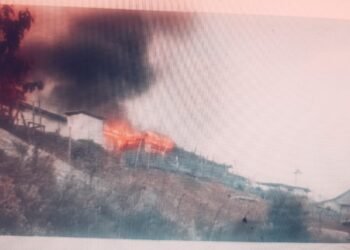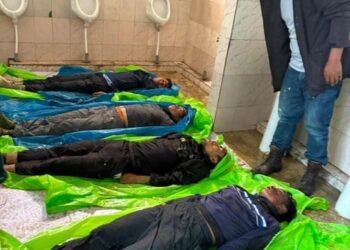
The Internally Displaced Persons Welfare Committee Churachandpur has rejected the claim, calling it disconnected from the lived realities of thousands still in camps.
BY PC Bureau
March 30, 2026: Nearly three years after the eruption of ethnic violence in May 2023 between Meitei and Kuki-Zo communities, the prospect of a large-scale, safe, and dignified return of Internally Displaced Persons (IDPs) in Manipur remains deeply uncertain—if not outright unrealistic. Official optimism continues to surface in periodic statements, most recently from state Home minister Govindas Konthoujam, who suggested that “many families are now in a position to return.”
READ: Trump Floats Seizing Iran’s Oil, Hints at Taking Kharg Island
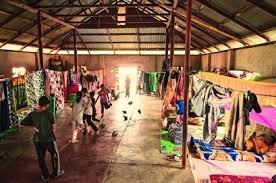
Yet, on the ground, this narrative finds little resonance. For thousands still living in relief camps or scattered informal settlements, such claims appear detached from lived realities. The Internally Displaced Persons Welfare Committee Churachandpur (IDPWCC), representing displaced families in one of the worst-affected districts, has categorically rejected the government’s position.
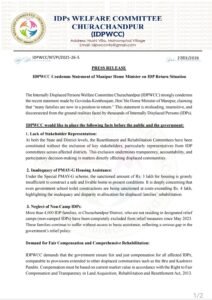
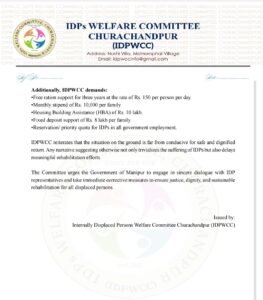
In a statement issued on March 27, 2026, the committee described the minister’s remarks as “misleading, insensitive, and disconnected,” underscoring a widening credibility gap between policymakers and those displaced.
Structural Gaps and Policy Failures
At the heart of the crisis lies a persistent failure to meaningfully include IDPs in decision-making processes. Rehabilitation committees at both state and district levels have, according to IDPWCC, excluded key representatives of displaced communities. This absence of participatory governance has not only eroded trust but also led to policies that fail to reflect ground realities.
Financial assistance, too, remains a major sticking point. The ₹3 lakh housing grant under the PMAY-G scheme is widely regarded as insufficient in the current economic climate, where even modest construction costs far exceed official estimates. Displaced families argue that the assistance offered does not account for the scale of loss—homes, livelihoods, and community networks destroyed in the violence.
Even more concerning is the near-total neglect of those outside formal relief camps. In districts like Churachandpur, over 4,000 families living in rented accommodations or with relatives reportedly remain excluded from structured relief mechanisms. Their invisibility within official frameworks highlights a critical blind spot in the state’s rehabilitation approach.
Rising Demands, Deepening Frustration
Faced with prolonged uncertainty, IDP groups have begun articulating more comprehensive demands. These include ₹10 lakh housing assistance, long-term financial security through fixed deposits, monthly stipends, extended food support, and preferential access to government employment. Their argument is rooted in precedent: other displaced groups in India have received significantly more robust rehabilitation packages.
At its core, the demand is not merely for compensation but for dignity and parity—an acknowledgment that displacement is not a temporary inconvenience but a life-altering rupture requiring sustained state support.
Security and the Geography of Fear
Beyond economics, the biggest barrier to return remains security. The violence of 2023 has hardened ethnic divisions, effectively redrawing the social geography of the state. The Imphal Valley and the surrounding hill districts now function as segregated spaces, with buffer zones, restricted movement, and lingering hostilities making return to mixed or contested areas fraught with risk.
Trust between communities has not just eroded—it has, in many cases, collapsed. Even sporadic incidents of tension reinforce fears among displaced families that returning prematurely could expose them to renewed violence. Without credible security guarantees, calls for return risk being perceived as coercive rather than constructive.
Implementation Deficit and Policy Drift
While the government has announced housing projects and allocated funds, implementation on the ground remains uneven. Delays, bureaucratic inefficiencies, and allegations of inadequate planning have slowed progress. Timelines for closing relief camps have repeatedly been pushed back, revealing a gap between policy intent and administrative capacity.
For many IDPs, the assistance received so far is seen as symbolic rather than substantive—a gesture that falls short of enabling real recovery. The longer displacement continues, the more entrenched the crisis becomes, with second-order effects on education, employment, and mental health compounding the original trauma.
A Crisis of Trust
Perhaps the most intangible yet critical challenge is the crisis of trust. Among large sections of displaced communities—particularly in Kuki-Zo dominated areas—there is a growing belief that official narratives are driven more by political optics than by genuine reconciliation efforts.
After nearly three years in limbo, patience is wearing thin. For many, the idea of return is no longer just about rebuilding homes—it is about rebuilding a sense of safety, belonging, and justice, all of which remain elusive.
The Manipur government faces a complex and deeply layered challenge. Declarations of progress may signal intent, but without tangible breakthroughs in security, inclusive dialogue, and meaningful compensation, they risk further alienating those they seek to reassure.
Sustainable rehabilitation will require more than financial packages. It demands a comprehensive approach—one that addresses ethnic polarisation, ensures equitable governance, and prioritises long-term reconciliation over short-term political messaging.
Until then, the large-scale return of IDPs in Manipur will remain what it is today: not an imminent reality, but a distant and fragile hope—one that continues to drift further out of reach for thousands still waiting to go home.