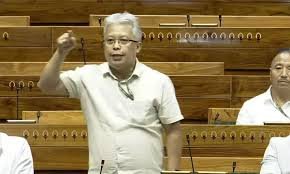
In a powerful intervention, Akoijam questioned how Parliament could spend ten hours on a ceremonial debate on Vande Matram while 65,000 displaced people in Manipur remain homeless.
BY PC Bureau
December 9, 2025: Congress MP from Inner Manipur, Dr. Angomcha Bimol Akoijam, delivered one of the most forceful interventions during the Lok Sabha’s December 9 discussion marking the 150th anniversary of Vande Mataram. His sharp remarks cut through the largely ceremonial debate, turning it into a blunt indictment of the government’s priorities amid the ongoing humanitarian crisis in Manipur.
Akoijam urged the House to confront the contrast between symbolic national celebrations and the “ignored realities” facing citizens—most urgently, the continuing ethnic violence that has displaced more than 65,000 people in his home state.
The motion to commemorate Vande Mataram was introduced by Union Minister for Parliamentary Affairs Kiren Rijiju, who recalled its historic role as a rallying cry against British rule. BJP speakers celebrated its unifying spirit while acknowledging historical sensitivities, including Tagore’s past objection to certain verses.
Opposition members, however, accused the government of diverting attention from crises such as unemployment, inflation, and internal security lapses. Congress leader Priyanka Gandhi Vadra alleged that the ruling party was “using patriotism as a smokescreen.” The context—amid frequent disruptions and stalled legislative business—amplified suspicions of political intent.
The Vande Mataram you are celebrating today and debating for 10 hours – I challenge the patriot within you to hold a three-hour discussion on Manipur. – @Bimol_Akoijam #manipur pic.twitter.com/wkXqsjvNKI
— Raza Ahmad 🇮🇳 (@RazaAhmadDL) December 8, 2025
A 59-year-old academic-turned-politician and former JNU professor, Akoijam has represented Inner Manipur since 2024 as the first Congress MP from the constituency in over a decade. Known for his outspoken advocacy, he has repeatedly submitted adjournment motions seeking parliamentary debate on the Manipur crisis.
READ: Insurgent Outfit Call for Boycott of Prez’s Visit to Manipur
Key Takeaways from Akoijam’s Speech
- Neglect of National Priorities
Akoijam criticized Parliament’s reluctance to allocate time for substantive discussions on issues like Manipur’s humanitarian disaster. “We have been demanding at least a three-to-five-hour discussion on Manipur, but nobody cares,” he said, contrasting this neglect with the ten-hour session devoted to Vande Mataram.
He further underscored the crisis’s magnitude: more than 65,000 citizens remain displaced as the state government fails to restore constitutional order. Expanding his critique, Akoijam cited unemployment, air pollution, and civic distress as signs of misplaced priorities.
- Alleged Political Motivations
According to Akoijam, the debate “had little to do with the national song and more with the BJP’s electoral ambitions in West Bengal.” His remarks framed the commemoration as part of a pattern of cultural nationalism aimed at consolidating ideological narratives in electorally sensitive states.
- Reclaiming the Spirit of Vande Mataram
In a conciliatory but forceful turn, Akoijam reinterpreted Vande Mataram as a call to constitutional responsibility rather than religious symbolism. “The true meaning of celebrating Vande Mataram,” he argued, “is to uphold what we have promised to ourselves in our Constitution.” He connected the song’s universalist ideals—unity, justice, and equality—with the need for moral governance.
Reactions and Broader Implications
Akoijam’s address drew applause from opposition benches and significant public attention online. Clips of his speech garnered more than 44,000 views within hours on the Congress-Manipur social media pages, with many hailing it as “a voice of conscience.” BJP leaders offered no immediate response.
The speech revitalized demands for a special parliamentary session on Manipur, where displacement and sporadic violence continue. It also reinforced the Congress’s broader narrative of governmental failure under the NDA, potentially influencing political alignments across the Northeast. However, given the Winter Session’s congestion—accentuated by disruptions over unrelated controversies such as the Adani bribery allegations—the likelihood of a dedicated Manipur debate remains uncertain.
Dr. Akoijam’s intervention transformed a ceremonial commemoration into a profound moral commentary. His fusion of cultural homage and political critique captured the central tension in Indian parliamentary life—the gulf between symbolic patriotism and substantive governance.
As the Manipur conflict persists into its third year, his words serve as both indictment and reminder: the truest tribute to the motherland lies not in reciting her praise, but in safeguarding her people.