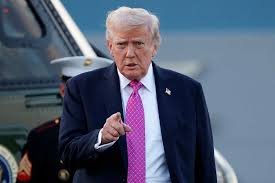
Internal discussions reportedly highlighted fears that a military strike could drag the U.S. into a prolonged and costly conflict, exposing troops and regional allies to retaliation.
By PC Bureau | February 24, 2025
New Delhi: President Donald Trump took to his Truth Social platform Monday to push back forcefully against a flurry of news reports suggesting that the nation’s top military officer had privately urged caution about launching a military strike against Iran — framing the coverage as a deliberate disinformation campaign and insisting his general remains fully prepared to execute any order given to him.
The pushback came after both The Washington Post and Axios published detailed accounts indicating that General Daniel “Razin” Caine, chairman of the Joint Chiefs of Staff, had raised serious operational concerns during a high-level meeting with Trump last week. According to those reports, Caine flagged critical shortfalls in U.S. munitions stockpiles — particularly in missile defense systems — that have been stretched thin supporting allies such as Israel and Ukraine. He also cautioned that a lack of cooperation from key regional allies could hinder American efforts to contain any potential Iranian retaliation, and he warned of a heightened risk of U.S. casualties in what analysts describe as a far more complex theater than recent American military engagements.
Axios, citing two sources with access to senior administration discussions, described Caine as a “reluctant warrior” on Iran, noting that while he was said to be fully on board with a reported January operation targeting Venezuelan President Nicolás Maduro, he has taken a more measured posture when it comes to Tehran. The outlet reported that the general sees the stakes as fundamentally higher with Iran — a country with a larger military, a sophisticated missile arsenal, and an entrenched network of regional proxies — warning that any conflict could rapidly spiral into a prolonged, costly entanglement.
READ: Democrats Push for $175 B Tariff Refund After Court’s Blow to Trump
Trump Fires Back: ‘He Only Knows How to WIN’
Trump wasted little time disputing the characterization. In a lengthy post Monday, the president acknowledged that Caine, like most people, would “like not to see War” — but claimed the general nevertheless believes a military campaign against Iran would be “something easily won.” Trump credited Caine with intimate knowledge of Iran, noting that the general oversaw Operation Midnight Hammer, a strike he described as having “blown to smithereens” Iran’s nuclear development infrastructure.
Trump on Iran: pic.twitter.com/0z7lwpPAwv
— Sidhant Sibal (@sidhant) February 23, 2026
“He has not spoken of not doing Iran, or even the fake limited strikes that I have been reading about. He only knows one thing: how to WIN and, if he is told to do so, he will be leading the pack,” Trump wrote, adding that “everything that has been written about a potential War with Iran has been written incorrectly, and purposefully so.”
The president also drew a sharp line on decision-making authority: “I am the one that makes the decision,” he wrote, adding that he would prefer a diplomatic deal but leaving the threat of military action unmistakably on the table. “If we don’t make a Deal, it will be a very bad day for that Country and, very sadly, its people, because they are great and wonderful, and something like this should never have happened to them.”
CENTCOM Commander Sidelined From Discussions
Adding another layer of intrigue to the story, Axios reported that Admiral Brad Cooper, the commander of U.S. Central Command who would be the operational architect of any strike on Iran, has not been invited to White House meetings on the topic and has had no direct communication with Trump since January. That unusual arrangement leaves Caine as the sole uniformed military voice in the room — a dynamic that has drawn quiet concern among senior defense officials, according to sources cited by the outlet.
Caine’s office, in a carefully worded statement, said the general’s role is to provide “a range of military options, as well as secondary considerations and associated impacts and risks, to the civilian leaders who make America’s security decisions” — language that neither confirmed nor denied the specifics reported by either outlet, but that notably did not dispute the underlying substance of those accounts.
A High-Stakes Standoff With Few Easy Options
The reports land against a backdrop of intense military buildup in the Middle East, with the Trump administration having deployed an unusually large concentration of naval and air assets to the region in recent weeks. Trump has repeatedly threatened Iran with military action if it does not comply with a sweeping set of demands, including caps on nuclear enrichment, limits on its ballistic missile program, and the severing of ties with regional proxy forces including Hezbollah in Lebanon and the Houthis in Yemen.
Iran has pushed back, signaling openness to negotiations while simultaneously rejecting what its officials call maximalist conditions designed to humiliate Tehran rather than resolve disputes. Iranian officials have stated publicly that the country is ready for talks, but will defend itself against any act of aggression. Meanwhile, Iranian students rallied on university campuses across the country as classes resumed following a wave of nationwide protests — a reminder of the simmering domestic pressure the Iranian government faces even without external military conflict.
Security analysts have noted that many of Washington’s stated demands on Iran align closely with Israeli priorities, raising questions about whether a diplomatic resolution is even the administration’s primary objective. Iran poses little discernible direct military threat to the continental United States, and an unprovoked first strike would almost certainly face legal challenges under international law.
For now, the public back-and-forth between the White House and the press leaves significant uncertainty about where U.S. policy is actually headed. The administration has not publicly provided a deadline for Iran to meet its demands, and diplomatic back-channels — reportedly including indirect Omani mediation — remain active even as the military buildup continues. Trump’s statement Monday that he would “rather have a Deal” was the clearest signal yet that the door to negotiations has not been formally closed.
But with an unpredictable president, a general described internally as “reluctant,” a sidelined theater commander, and a region already convulsed by multiple active conflicts, analysts warn that the margin for miscalculation is dangerously thin. Whether Monday’s Truth Social post represents a genuine effort to de-escalate the narrative or simply a reflexive attempt to control the story remains an open and urgent question.