BY PC Bureau
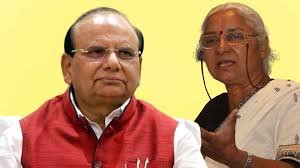
January 29, 2026: In a landmark resolution to one of India’s most protracted legal battles between a social activist and a high-profile public official, a Delhi court has acquitted Delhi Lieutenant Governor Vinai Kumar Saxena in a criminal defamation case brought by Medha Patkar.
The verdict, handed down on January 29, 2026, by Judicial Magistrate First Class (JMFC) Raghav Sharma at the Saket Court Complex in South-East Delhi, draws a definitive close to proceedings that first ignited in November 2000, marking the end of over 25 years of courtroom contention.
Verdict Highlights
The court unequivocally determined that Medha Patkar, the complainant, could not substantiate her allegations to the required legal standard. In its formal pronouncement, JMFC Raghav Sharma declared: “It is hereby held that complainant has failed to prove her case beyond reasonable doubt against the accused. Accused VK Saxena is hereby acquitted for the offense punishable under Section 500 of the Indian Penal Code (IPC).”
This ruling rested on a meticulous dissection of the prosecution’s evidence, pinpointing multiple critical weaknesses, such as glaring contradictions within Patkar’s presented testimony and supporting materials. These flaws, the judgment stressed, struck at the very foundation of her claims, casting serious doubt on the overall reliability and truthfulness of her position from the outset.
READ: Delhi HC Junks Wankhede’s Plea Against ‘Ba*ds of Bollywood’**
READ: SC Puts UGC’s Revised Rules on Hold, Seeks Centre’s Reply
Key Grounds for Acquittal
Witness testimonies unraveled under scrutiny, exposing profound inconsistencies that the court deemed irreparable. A standout example involved CW4, a pivotal witness summoned by Patkar, who categorically refuted any prior contact with her—directly clashing with her assertion of a personal confrontation over the disputed matter.
The magistrate elaborated: “The repeated denial by CW4 in his evidence that he did not contact complainant leaves no doubt that the complainant’s version of being contacted by him is false. This contradiction shows that the complainant had set up a false case of personal contact and confrontation only to bolster her claim of personal defamation.” Such discrepancies not only invalidated specific elements but permeated the entire narrative.
The absence of clear evidence showing personal imputation or malicious intent further sealed the acquittal. Judicial analysis concluded there was insufficient proof that Saxena disseminated statements aimed squarely at Patkar as an individual, with deliberate knowledge or purpose to damage her personal standing. Instead, the materials in question were characterized as a broader commentary on the organizational activities and public positions of the Narmada Bachao Andolan (NBA), rather than a pointed assault on her private character.
Compounding these issues were self-inflicted inconsistencies in Patkar’s own account during proceedings. She conceded that she had not reviewed certain key documents referenced in the controversy until sometime after their public exposure, a revelation that introduced profound logical gaps into her storyline. The court captured this succinctly: “The complainant’s own case suffers from irreconcilable contradictions… This gross inconsistency in the stand of complainant renders the credibility of her testimony diminished.” Together, these elements formed an unassailable basis for dismissal.
Roots in the 2000 Advertisement
At the dispute’s core lies a provocative full-page advertisement that appeared in The Indian Express on November 10, 2000, bearing the headline “True Face of Ms. Medha Patkar and her Narmada Bachao Andolan.” Commissioned and sponsored by the National Council for Civil Liberties (NCCL), an advocacy group under VK Saxena’s leadership at the time, the ad leveled sharp criticisms against Patkar and the NBA’s high-profile campaign opposing mega-dam projects such as the Sardar Sarovar Dam along the Narmada River. It highlighted purported irregularities, including misleading narratives about displacement impacts, the role of foreign funding sources, and the broader hindrance to developmental initiatives that promised water security for Gujarat and rehabilitation opportunities for affected communities.
Medha Patkar, as the founding figurehead of the NBA—a persistent voice for environmental protection, tribal rights, and fair resettlement—retaliated swiftly with a public press note and a formal criminal defamation complaint under IPC Section 500. She maintained that the advertisement’s contents were fabricated, actuated by malice, and meticulously crafted to tarnish her individual reputation amid a fiercely polarized national discourse on dam construction and its human costs.
Extensive Trial Timeline
This saga unfolded across an extraordinary quarter-century, marred by persistent procedural hurdles predominantly linked to the complainant’s approach. Court summons directed at Saxena emerged in 2005, but Patkar herself did not make her initial courtroom appearance until 2012—a full seven-year lapse that set the tone for prolonged inertia. Between 2005 and 2023 alone, she registered absences across more than 94 scheduled hearings, contributing to a pattern of deferral.
Patkar’s side pursued over 46 adjournments specifically to facilitate the recording of her primary evidence. Even after completing her examination-in-chief—itself delayed by 20 such requests—she evaded cross-examination proceedings, prompting an additional 24 adjournment pleas. A turning point arrived in March 2025, when JMFC Raghav Sharma rebuffed her bid to summon further witnesses, labeling it unequivocally as “a deliberate attempt to delay the trial, rather than a genuine necessity.” These accumulated obstructions extended what should have been a routine matter into an epic judicial marathon.
Reciprocal Acquittals in Parallel Cases
This outcome arrives mere days after a strikingly symmetric development: On January 24, 2026, the identical Saket Court bench—presided over by JMFC Raghav Sharma—cleared Medha Patkar in VK Saxena’s counter-filed defamation suit from 2006. That companion case centered on purportedly libelous comments Patkar made during a televised interview, where she allegedly tied Saxena to pro-dam financial backers. Acquittal stemmed from Saxena’s inability to furnish original electronic records, such as unedited footage or the source recording medium, rendering his evidence inadmissible for lack of foundational authenticity.
These back-to-back exonerations effectively bury a mutual barrage of litigation that simmered for decades, originating from acrimonious exchanges over Narmada Valley infrastructure, the ethics of mass displacement, ecological safeguards, and counter-allegations of ideological politicking from opposing camps.
Beyond the immediate parties, the judgment reaffirms the rigorous benchmarks governing criminal defamation under Indian jurisprudence—most notably, the imperative to demonstrate unambiguous personal targeting, a provable intent to inflict reputational injury, and the exclusion of any reasonable doubt whatsoever. It serves as a cautionary exposition on how evidentiary shortcomings, coupled with chronic delays through adjournments, can erode the viability of even deeply entrenched grievances.