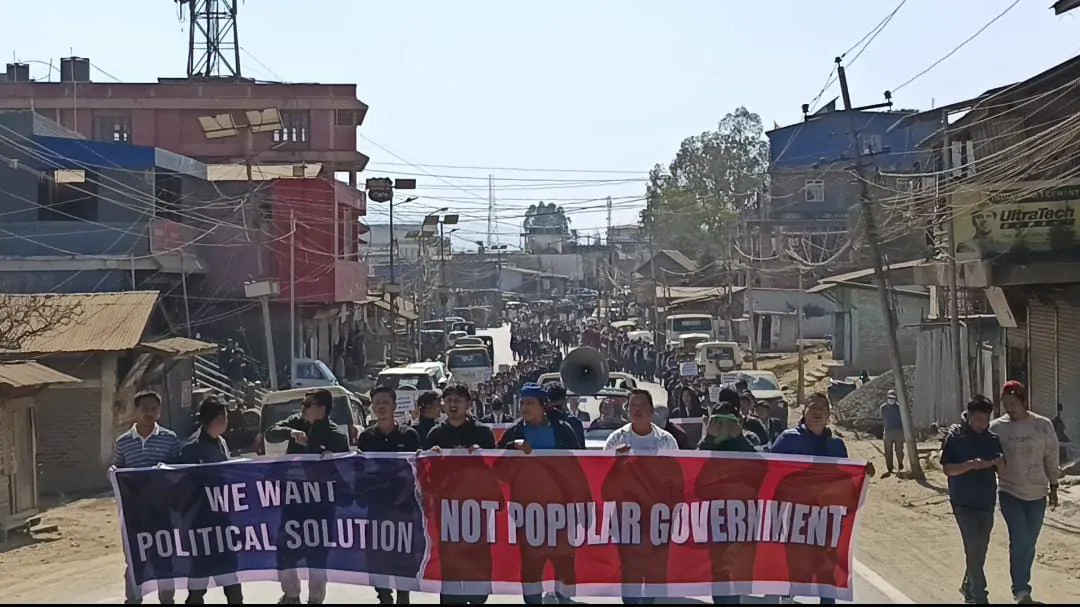
While CoTU lifted the highway bandh in Kangpokpi in the interest of inter-tribal harmony following the Republic Day arson at K. Songlung village, thousands of Kuki-Zo students in Churachandpur staged peaceful protests, underscoring unresolved grievances over governance, security, and justice.
BY PC Bureau
January 28: In a calibrated move balancing protest with restraint, the Committee on Tribal Unity (CoTU) on Wednesday suspended its 24-hour total shutdown along Asian Highway-2 (Imphal–Dimapur) and National Highway-37 (Imphal–Jiribam), citing the larger interest of peace and inter-tribal harmony. The decision came even as Kuki-Zo students in Churachandpur staged a massive rally demanding a political solution for their community and opposing any move to restore a “popular government” in Manipur.
The shutdown, which began at midnight on January 27, was called in protest against the State Government’s failure to arrest those allegedly responsible for torching K. Songlung Village (Part-II) on Republic Day. CoTU has identified the perpetrators as cadres of the ZUF-S (Kamson) group, an allegation that triggered widespread anger across Kangpokpi district.
Announcing the suspension, CoTU said the decision followed “threadbare deliberations” within its leadership and consultations with community stakeholders. Crucially, the committee cited the Joint Declaration issued by the United Naga Council (UNC) and Kuki Inpi Manipur (KIM) at Kangpokpi on January 27, which appealed for dialogue and constructive engagement between the two tribal communities.
“In recognition of the peace process initiated by UNC and KIM, the Committee has decided to suspend the 24-hour total shutdown with immediate effect,” CoTU said in a statement, adding that it would stand by the resolution adopted by the two apex tribal bodies to prevent further escalation.
The shutdown, originally scheduled to continue till midnight on January 28, was withdrawn with immediate effect. CoTU expressed gratitude to the general public, church leaders and civil society organisations for their solidarity, while reiterating that the suspension did not dilute its demand for justice and accountability in the K. Songlung arson case.
Earlier in the day, women-led volunteers were seen enforcing the shutdown across Kangpokpi town and Gamgiphai. Vehicular movement was completely restricted, business establishments and educational institutions remained shut, and even farming activities were halted. Emergency services were closely monitored.
Tensions briefly escalated later in the afternoon when the Naga People’s Organisation (NPO) announced a counter bandh, alleging that the CoTU shutdown had caused severe inconvenience to Naga commuters. The counter call was announced shortly before CoTU formally lifted its agitation.
Meanwhile, in Churachandpur, thousands of Kuki-Zo students took to the streets under the banner “We want political solution, not popular government”, signalling deepening political discontent among the community. The rally, jointly organised by multiple student bodies representing different Kuki-Zo tribes, began at Public Ground, Hiangtam Lamka, and culminated at Peace Ground, Tuibong.
Students carried placards and raised slogans such as “No solution, no popular government,” “We cannot form popular government with the Meitei,” “No more delay, political solution,” and “Justice precedes peace.” Vehicular movement along the rally route was temporarily halted, though shops and establishments elsewhere remained open. Central and State security forces were deployed at key junctions, and the rally concluded peacefully without any untoward incident.
Addressing the media, Zomi Students’ Federation General Secretary Samuel Taithul said the agitation reflected growing frustration over what he described as the Centre’s continued push to restore a popular government while ignoring the Kuki-Zo demand for a political settlement.
“What separates this conflict from others is that it is between communities themselves, not just armed groups,” Taithul said. “The hatred and communalised atmosphere has reached such a level that compromise is no longer realistic. Since we are divided geographically and physically, a political solution for the Kuki-Zo people is necessary.”
He warned that the formation of a popular government would weaken the movement for a political solution and appealed to the Centre to initiate a serious and sincere dialogue process.
Taken together, the suspension of CoTU’s shutdown and the student-led mobilisation underscore the fragile balance in Manipur—where grassroots calls for peace coexist with unresolved demands for political restructuring, justice, and long-term security