The Committee on Protection of Tribal Areas Manipur–Kuki Hills has urged the state government to clarify that existing inter-village roads in notified Hill Areas are customary routes, not new Ring Road projects requiring forest clearance.
BY PC Bureau
December 31, 2025: The Committee on Protection of Tribal Areas Manipur–Kuki Hills (COPTAM-KH) has urged the Manipur government to immediately clarify what it calls the “illegal and misleading characterisation” of long-standing inter-village roads in the state’s notified Hill Areas as new Ring Road projects, warning that such claims threaten customary tribal land rights and vital humanitarian lifelines.
In a detailed representation submitted to Chief Secretary Prashant Kumar Singh, COPTAM-KH General Secretary Lenin Haokip said the roads under dispute are “existing customary inter-village roads in continuous use for decades” and not new greenfield infrastructure requiring forest clearance.
“The road in question is not a Ring Road, nor a new project. It is an existing inter-village road in continuous customary use, serving as the only means of communication between notified Hill Area villages,” Haokip stated.
Questioning locus standi
COPTAM-KH questioned the locus standi of the applicant who moved the National Green Tribunal (NGT), identifying him as a valley-based, non-Scheduled Tribe individual with no legal or customary stake in the Hill Areas.
“He is neither a landholder, nor a customary authority, nor a stakeholder recognised under the constitutional framework governing the Hill Areas. His intervention in matters exclusively concerning customarily owned tribal land is legally untenable and administratively improper,” the representation said.
The organisation alleged that the intervention amounted to a “colourable abuse of environmental process” rather than a bona fide ecological concern.
Alleged political conflict of interest
The memorandum also pointed to the applicant’s alleged association with valley-centric organisations opposed to tribal land rights.
“The selective targeting of tribal inter-village connectivity, while comparable valley infrastructure remains unquestioned, demonstrates a clear political conflict of interest,” Haokip wrote, adding that environmental laws were being “invoked as a façade for territorial expansion”.
Challenging forest jurisdiction
COPTAM-KH strongly contested claims of Forest Department jurisdiction over the roads, asserting that land within notified Hill Area villages is held under customary ownership.
“The Forest Department possesses no inherent, presumptive, or residual jurisdiction over land situated within notified Hill Area villages in the absence of statutory notification, due process, and the free, prior, and informed consent of affected tribal communities,” the representation said.
It argued that portraying customarily owned tribal land as state-controlled forest amounted to a retrospective and unlawful assertion of authority.
READ: Kuki Group Appeals to UN Over NGT Order Halting Road Projects in Manipur Hills
Citing historical records
The organisation relied on British-era archival records to counter what it described as a “valley-centric historical narrative”.
“Authoritative Government of India records consistently describe Manipur as a valley polity enclosed by Kuki hill territory, not the converse,” Haokip stated, citing the 1925 Proceedings of the Indian Historical Records Commission.
According to the representation, these records establish that the hill territories “were never vested in valley institutions, nor subjected to valley revenue or forest settlement”.
Legal and constitutional backing
COPTAM-KH cited the Supreme Court’s judgment in Samatha v. State of Andhra Pradesh (1997), which held that tribal land in Scheduled Areas is inalienable.
“Customary ownership cannot be extinguished indirectly by re-labelling land as forest or public-purpose land. Any attempt to do so constitutes a colourable exercise of power and is constitutionally impermissible,” the memorandum said.
NGT proceedings
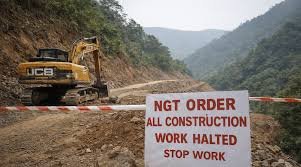
The representation comes amid proceedings before the NGT’s Eastern Zone Bench in Kolkata, where an application alleging unauthorised construction of a “Ring Road” across hill districts—including Churachandpur, Kangpokpi, Noney and Ukhrul—has resulted in an interim restraint on further construction.
Invoking the precautionary principle under Section 20 of the NGT Act, the tribunal has ordered that “no further construction by anyone be allowed to be raised in execution of the Ring Road Project till the next date”. The NGT has also sought reports from the Manipur government, though a preliminary report from the Chief Secretary is yet to be filed.
Humanitarian context
Haokip underscored the post-May 3, 2023 humanitarian situation, stating that thousands of displaced Kuki-Zo families now rely entirely on hill roads.
“For these communities, inter-village roads are not developmental luxuries. They are lifelines, integral to the right to life under Article 21 of the Constitution,” he said.
Any administrative inaction allowing obstruction of these routes, the organisation warned, would have “grave humanitarian and constitutional consequences”.
Demands to the state
COPTAM-KH has urged the Manipur government to formally clarify that existing inter-village roads in notified Hill Areas are customary roads, direct departments to refrain from asserting jurisdiction over tribal land without constitutional compliance, and prevent the misuse of environmental and forest laws to block essential connectivity.
“What is at stake is not merely a road, but the survival, dignity and constitutional rights of Scheduled Tribe communities in Manipur’s Hill Areas,” Haokip said.
The organisation said it expects the state government to act swiftly to ensure administrative clarity and protect customary tribal rights in accordance with Article 371C of the Constitution.