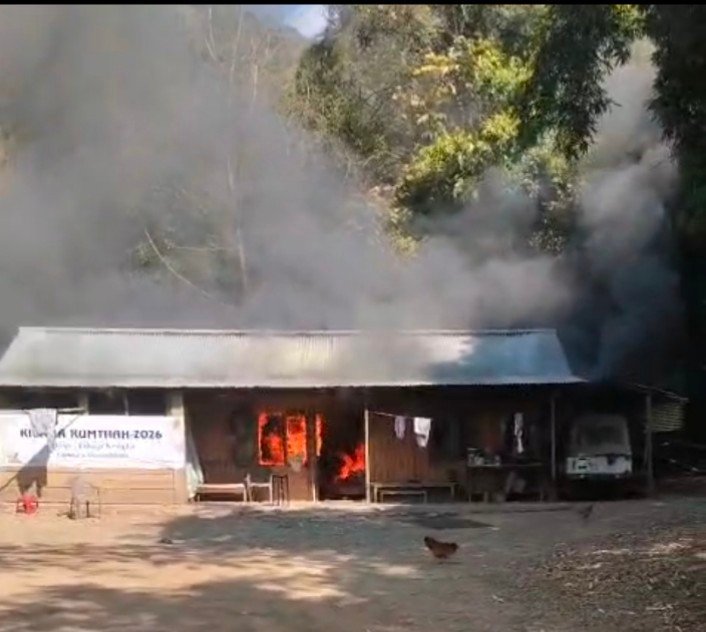
ZUF’s leadership called the suspension “false, misleading, and without any constitutional basis,” accusing GPRN/NSCN leader Kitovi of harboring prejudices against the Zeliangrong people.
BY PC Bureau
January 30, 2026 – In a move that has left Naga political watchers scratching their heads, the Zeliangrong United Front (ZUF) has issued a fiery rebuttal to what it calls its suspension from the Working Committee of Naga National Political Groups (WC-NNPGs). Observers, however, say the rebuttal is misplaced: it was not ZUF itself but the Kamson faction that GPRN/NSCN had placed under suspension.
In a press clarification released today, ZUF dismissed the affair as a fabrication concocted by N. Kitovi Zhimomi and his GPRN/NSCN team—apparently proving that nothing says “Naga unity” like inventing disciplinary actions against your supposed allies. Analysts note that ZUF has clearly seized the suspension issue to strike back at GPRN/NSCN, using it as a tool to settle old political scores.
The drama began when Kitovi’s faction announced on January 27 that it was suspending all “formal agreements” with the ZUF (Kamson) group, withdrawing its representation in the WC-NNPGs, and barring the faction from future committee meetings. The stated reasons included alleged arson attacks on a Kuki village in Kangpokpi district on Republic Day, violations of 2019 merger pacts, and behavior deemed unbecoming of a “Naga-centric” outfit. Kitovi signed the release as Convener of the WC-NNPGs, lending it an official-sounding gravitas.
READ: Breaking News: Sunetra Pawar to Be Maharashtra’s New Dy CM
READ: Silver Crashes 15%, Gold Slides 10% in One of Sharpest Sell-Offs in Years
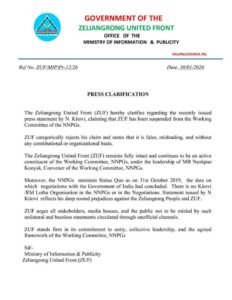
ZUF, however, rejected the claim outright, calling it “false, misleading, and without any constitutional or organizational basis.” More strikingly, the statement treated the suspension as if it were a figment of imagination. “ZUF remains fully intact and continues to be an active constituent of the Working Committee, NNPGs, under the leadership of MB Neokpao Konyak,” the statement read, sidestepping the fact that Kitovi’s suspension explicitly targeted only the Kamson faction—not the broader ZUF organization.
The rebuttal went further, claiming: “There is no Kitovi/RM Lotha Organisation in the NNPGs or in the negotiations,” effectively attempting to erase Kitovi from the political landscape. ZUF also accused Kitovi of harboring “deep-rooted prejudices” against the Zeliangrong people, pivoting from arson allegations straight to character criticism.
Observers note the deft deflection. By framing the suspension as a blanket attack on ZUF, the leadership avoided the factional nuance: this action was never about the entire organization, only the Kamson-led splinter. Yet ZUF’s statement treats factions as figments, suspensions as suggestions, and Kitovi as a rumor-spreading nuisance.
The result is a masterclass in political sleight of hand. ZUF urges the media, stakeholders, and public not to “be misled by such unilateral and baseless statements,” while issuing its own unilateral statement from its council headquarters. Meanwhile, the WC-NNPGs—or whichever body currently claims legitimacy—remains silent, possibly busy untangling internal leadership disputes.
In the end, this episode in the ongoing Naga factional saga proves one thing: when unity talks stall, the next best tactic is to rebut imaginary slights with maximum gravitas. Kitovi may have suspended a faction, but ZUF has successfully suspended reality itself—turning a procedural action into a political weapon against its rivals.
The ZUF, formed in 2011 to champion the political rights and aspirations of the Zeliangrong people, fractured in 2019 when a group led by S. Kamson (with Raitu Chawang) broke away from the main body. That splinter faction entered into a ceasefire agreement with the Government of India on October 26, 2019 and aligned itself with the National Socialist Council of Nagaland–Unification (NSCN‑U), part of the broader Naga National Political Groups (NNPGs). This breakaway grouping became widely referred to as the Kamson faction of ZUF, distinct from the original organization that continued under its existing leadership.