Not a single home was sanctioned or built in major hill districts under PMAY-U, exposing deep regional imbalance in Manipur’s housing rollout.
BY PC Bureau
New Delhi, January 9, 2026: Official data tabled in the Rajya Sabha has revealed a glaring exclusion of Manipur’s hill districts from the Centre’s flagship Pradhan Mantri Awas Yojana–Urban (PMAY-U), with nearly all housing benefits concentrated in the valley districts, leaving vast hill regions effectively untouched by the scheme.
According to the data, 56,045 houses have been sanctioned under PMAY-U and PMAY-U 2.0 in Manipur, of which 20,591 units have been completed and delivered as of late November 2025. However, not a single house has been sanctioned, grounded, or completed in most hill districts, underscoring a striking implementation gap in a state already fractured by ethnic and geographical divides.
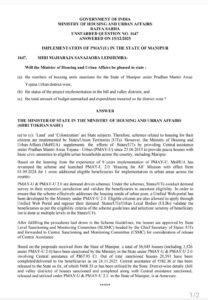
The figures, provided by Minister of State for Housing and Urban Affairs Tokhan Sahu in response to a Rajya Sabha query by Maharaja Sanajaoba Leishemba, show that every major hill district — including Chandel, Churachandpur, Kangpokpi, Senapati, Tamenglong, Tengnoupal, Ukhrul, Kamjong, Noney and Pherzawl — recorded zero progress under the urban housing scheme.
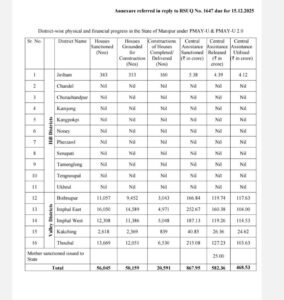
In contrast, valley districts accounted for virtually the entire allocation, with large numbers sanctioned and completed in Imphal East, Imphal West, Thoubal, Bishnupur and Kakching. Imphal East alone saw over 16,000 houses sanctioned, while Thoubal recorded more than 6,500 completions.
The only marginal exception was Jiribam, where 343 houses were sanctioned and 160 completed, a fraction of the overall numbers and insufficient to offset the broader pattern of exclusion in the hill regions.
READ: Mamata Accuses Amit Shah of Coal Scam Link Amid ED Raids
Overall, the Centre sanctioned ₹867.95 crore in assistance for Manipur, releasing ₹582.36 crore, of which ₹468.53 crore has been utilised. Yet, this funding flow has largely bypassed the hill districts, raising concerns about equitable access to welfare schemes in the state.
The Ministry maintained that PMAY-U and PMAY-U 2.0 are demand-driven, requiring states to identify beneficiaries, validate applications and forward proposals. It also noted that land availability and urban planning fall under the state’s jurisdiction. However, the data indicates that these procedural explanations have translated into complete non-coverage of hill districts, rather than delayed or limited inclusion.
The absence of PMAY-U implementation in Manipur’s hill areas has drawn scrutiny amid ongoing ethnic tensions and long-standing infrastructural neglect. The figures point to a systemic failure to extend basic housing support to urban poor households in the hills, reinforcing concerns that development schemes continue to mirror Manipur’s geographical and political fault lines.
As PMAY-U 2.0 rolls out nationwide, the data has renewed calls for targeted intervention and corrective action to ensure that Manipur’s hill districts are no longer left outside the ambit of the “Housing for All” mission.