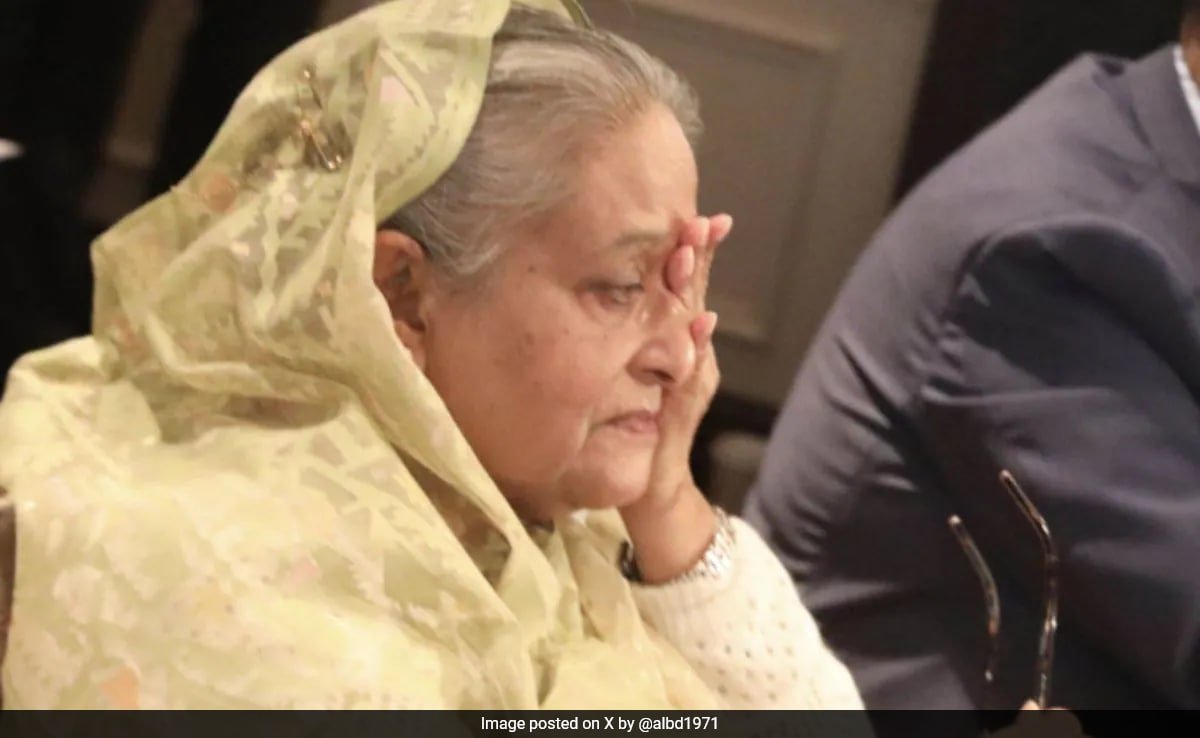
In her first public address since leaving Bangladesh, former prime minister Sheikh Hasina accused Nobel laureate Muhammad Yunus of dismantling democracy and plunging the country into fear and lawlessness.
BY PC Bureau
New Delhi
January 23, 2026: Breaking months of political silence from exile, former Bangladesh prime minister Sheikh Hasina on Thursday delivered a blistering denunciation of Nobel laureate Muhammad Yunus, accusing him of dismantling democracy and presiding over what she called an “illegal and violent” regime that has reduced Bangladesh to fear, chaos and constitutional breakdown.
Addressing a packed gathering at the Foreign Correspondents’ Club in Delhi through an audio message, Hasina portrayed the ongoing political crisis in Bangladesh as a battle for national survival, urging supporters to unite against what she described as a foreign-backed, unelected administration in Dhaka.
The event, titled ‘Save Democracy in Bangladesh’, drew senior leaders of the Awami League, former ministers, and members of the Bangladeshi diaspora based in India.
Though Hasina did not appear in person, her address was sweeping in rhetoric and uncompromising in tone. She repeatedly branded Yunus a “murderous fascist,” a “usurer,” a “money launderer,” and a “power-hungry traitor,” accusing him of betraying Bangladesh’s sovereignty and constitutional order.
BREAKING: Calling Yunus Govt a ‘puppet regime’ Sheikh Hasina through an audio message to Md Yunus asked for 5 things to make #Bangladesh credible again. It starts with Yunus’ resignation. pic.twitter.com/tdZFNUk9o7
— Anindya (@AninBanerjee) January 23, 2026
Invoking the legacy of the 1971 Liberation War and her father, Sheikh Mujibur Rahman, Hasina warned that Bangladesh stood “at the edge of an abyss.” She claimed the country had been transformed into “a vast prison, an execution ground, a valley of death,” following what she described as her forcible removal from office on August 5, 2024, through a “meticulously engineered conspiracy.”
From that day onward, she said, democracy had been driven into exile. Human rights were being systematically crushed, press freedom silenced, and violence against women and minorities allowed to flourish without restraint.
READ: Ghosts Are Back: Haunted Tourism Stages a Major Comeback in 2026
“Life and property have no security. Law and order has collapsed,” Hasina told the audience, alleging that mob violence, looting, and extortion had spread from Dhaka to villages across the country.
Her most severe allegations were directed at Yunus personally. Hasina accused him of draining the nation’s resources and pushing Bangladesh toward the “furnace of a multinational conflict” by trading away land and strategic interests to foreign powers.
“By betraying the nation, the murderous fascist Yunus is leading our beloved motherland toward disaster,” she said, warning of a “treacherous plot” that threatened Bangladesh’s sovereignty.
The speech also served as a political mobilisation call. Appealing to “all democratic, progressive, and non-communal forces of the pro-Liberation camp,” Hasina urged unity to restore the constitution, which she said was “written in the blood of martyrs.” The address concluded with chants of “Joy Bangla” and “Joy Bangabandhu,” echoing the symbolism of the independence movement.
Reasserting the Awami League’s centrality to Bangladesh’s political identity, Hasina described the party as the country’s oldest and most important political force, inseparably linked to its culture and democratic foundations. She vowed that the party would help the people reclaim the “thriving homeland that was snatched away.”
Hasina laid out five demands that she said were essential to stabilising the country: the removal of what she called the “illegal Yunus administration,” an end to street violence and lawlessness, firm guarantees for the safety of minorities and women, a halt to politically motivated legal action against journalists and opposition figures, and a fresh, impartial United Nations investigation into the events of the past year.
“The international community stands with you,” she told her supporters, insisting that the interim government had failed to listen to the people’s voice.
The address highlighted the depth of Bangladesh’s political polarisation, with Hasina framing the moment as a historic struggle between the ideals of the Liberation War and what she described as a regime of extremism, chaos, and foreign manipulation.
For the Delhi audience, the speech carried symbolic weight—marking Hasina’s first public political intervention from Indian soil and signalling her intention to continue shaping Bangladesh’s political narrative from exile.
Whether her call for mass mobilisation and international scrutiny gains momentum remains uncertain. But her message was unambiguous: “Do not give up now. Join us in the fight to reclaim our nation and rebuild democracy in Bangladesh.”