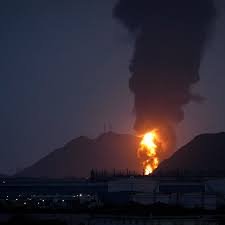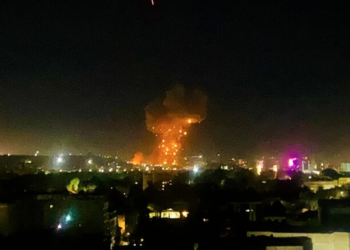
The claim was swiftly rejected by U.S. Central Command, which said the aircraft carrier remains fully operational and continues to conduct missions in the Arabian Sea.
BY PC Bureau
March 13, 2026 — Iran’s Islamic Revolutionary Guard Corps (IRGC) claimed early Friday that it carried out a missile and drone strike against the U.S. Navy aircraft carrier USS Abraham Lincoln (CVN‑72), asserting that the attack caused heavy damage and forced the carrier strike group to withdraw from regional waters.
U.S. officials quickly rejected the claim as false, with U.S. Central Command (CENTCOM) stating that the carrier remains fully operational and continues to conduct missions linked to the ongoing regional campaign known as Operation Epic Fury.
Iranian Claim of Carrier Strike
According to a statement issued by the IRGC’s Central Headquarters of the Holy Prophet, Iranian forces launched a coordinated barrage of missiles and drones targeting the Nimitz-class aircraft carrier while it was operating roughly 340 kilometers from Iran’s maritime borders in the Sea of Oman. Iranian state outlets, including Press TV, described the strike as a “precision operation” that allegedly inflicted major damage on the vessel.
The statement claimed the attack rendered the carrier temporarily non-operational and forced the strike group to retreat “at high speed” from the area. Iranian officials framed the operation as a defensive response to the U.S.-led air campaign against Iranian military infrastructure that began on February 28.
However, Iranian authorities released no imagery, satellite evidence, or independent verification to support the claim. They also did not specify whether casualties were allegedly sustained aboard the vessel.
Strike Claims in Bahrain
In a separate announcement, the IRGC said it conducted two waves of missile and drone strikes targeting a U.S. naval installation at Mina Salman Port, the main base of the United States Fifth Fleet.
Iranian sources claimed the strikes hit anti-drone defenses, drone maintenance facilities, fuel storage infrastructure, and logistical support equipment at the port. Tehran’s statement suggested the attack caused significant structural damage and disrupted operations at the installation.
U.S. officials have not confirmed these claims, and previous Iranian statements regarding attacks on Gulf bases have often been disputed or described as exaggerated by U.S. military sources.
Pentagon Denial
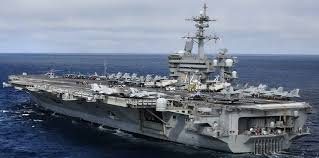
CENTCOM responded swiftly to the allegation regarding the USS Abraham Lincoln (CVN‑72), dismissing the report as unfounded and reaffirming that the carrier remains fully operational.
Recent images released by the command show the aircraft carrier conducting routine flight operations in the Arabian Sea, launching and recovering aircraft as part of ongoing strike missions tied to Operation Epic Fury.
U.S. officials say the claim follows a pattern of information warfare that has accompanied the escalating military confrontation between Iran and the United States in recent weeks. Since early March, Iranian officials have repeatedly announced missile or drone strikes against U.S. naval assets or regional bases—assertions that U.S. commanders say did not result in damage or even near misses.
Separate Naval Confrontation
Amid the escalating rhetoric, a separate maritime incident involving the carrier strike group was reported by CBS News, citing two U.S. officials who spoke on condition of anonymity.
According to the report, an Iranian vessel approached the strike group at a dangerously close distance earlier this week. A U.S. Navy escort ship—believed to be a destroyer—attempted to deter the vessel using its 5-inch Mark 45 naval gun, possibly firing warning shots.
READ: Explosions Rock Central Dubai as Drone Debris Hits Building
When the Iranian craft reportedly failed to change course, a U.S. Navy helicopter—likely an MH‑60R Seahawk—was deployed and struck the vessel with two Hellfire missiles. The condition of the Iranian vessel and the fate of its crew remain unclear.
The carrier strike group currently includes guided-missile destroyers such as USS Spruance (DDG‑111) and USS Michael Murphy (DDG‑112), along with additional U.S. naval assets operating across the Arabian Sea and Gulf region.
Regional Tensions Intensify
The competing claims come amid a surge in military incidents across the Middle East. On Thursday, a U.S. Air Force KC-135 Stratotanker refueling aircraft crashed in western Iraq while supporting operations connected to Operation Epic Fury.
CENTCOM said the crash occurred in friendly airspace and involved two tanker aircraft flying together, stressing that the incident was not the result of hostile fire or friendly fire. Search-and-rescue operations are still underway, with at least five crew members believed to have been aboard the downed aircraft.
Taken together, these developments highlight the increasingly volatile military environment in the Gulf and Arabian Sea, where U.S. forces maintain a significant presence while Iran continues to assert retaliatory capabilities.
With both sides issuing competing narratives and continuing operations, analysts say the confrontation is unfolding not only on the battlefield but also in the realm of strategic messaging and information warfare. For now, there are no visible signs of de-escalation as tensions between Washington, Tehran, and their regional allies continue to intensify.