Washington said the operation targeted violations of US sanctions linked to illicit Venezuelan oil trade. Russia condemned the seizure, citing international maritime law and demanding humane treatment of its citizens onboard
New Delhi | January 7, 2026
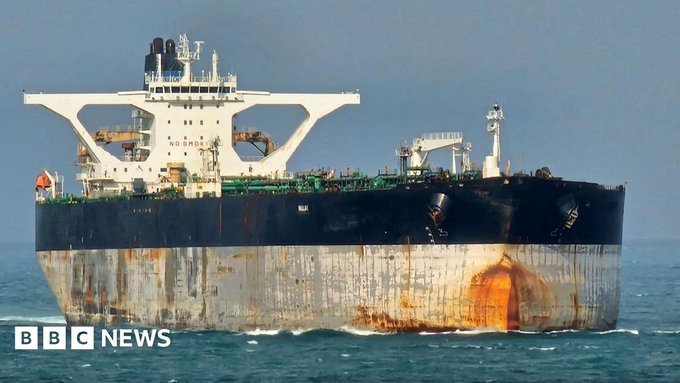
US forces have seized a Russia-flagged oil tanker, Marinera, following a dramatic pursuit in the North Atlantic, escalating tensions between Washington and Moscow amid aggressive enforcement of US sanctions on illicit oil trade.
According to US officials, the tanker was intercepted after being tracked for over two weeks. The operation was carried out by multiple American agencies, including the Department of Justice, the Department of Homeland Security, and the Department of Defense, for alleged violations of US sanctions. The US European Command confirmed the seizure in a post on X, describing it as part of a “whole-of-government” effort to protect US security interests.
Russia’s Foreign Ministry reacted sharply, urging Washington to ensure the “humane and dignified treatment” of Russian nationals aboard the vessel. Moscow’s Ministry of Transport argued that the seizure violated the 1982 UN Convention on the Law of the Sea, asserting that no state has the right to use force against vessels registered under another country’s jurisdiction. While the United States has not ratified the convention, it generally treats many of its provisions as customary international law.
Defence Secretary Pete Hegseth amplified the administration’s stance by reiterating that the blockade of sanctioned and illicit Venezuelan oil shipments “remains in full effect — anywhere in the world.” The tanker was reportedly carrying oil linked to Venezuela and had earlier sailed from Iran, before altering course to evade US enforcement near Venezuelan waters.
The New York Times reported that no Russian naval vessels were in the vicinity when the US Coast Guard boarded Marinera, averting a potential standoff between US and Russian forces. Russian state broadcaster RT released grainy images showing a helicopter approaching the tanker, while Reuters cited US officials confirming that American forces had boarded the ship.
US Coast Guard 🅱️oards Russian oil tanker Marinera in North Atlantic
Two-week pursuit ends with no resistance and no Russian vessels nearby
Russia sent naval escort but arrived too late to prevent seizure
Shadow fleet tanker now in US custody after defying Venezuela blockade pic.twitter.com/fiW924ltk4
— Boi Agent One (@boiagentone) January 7, 2026
Previously known as Bella 1, the tanker was sanctioned by the US in 2024 and later renamed Marinera. After an earlier failed boarding attempt near Venezuela in December, the vessel reportedly painted a Russian flag on its hull and was added to Russia’s official shipping registry. Moscow subsequently lodged a diplomatic protest, demanding that Washington halt its pursuit.
READ: SC Directs Centre to Submit Full Manipur Audio for Forensic Test
US surveillance of the tanker intensified in recent days, with multiple reconnaissance flights observed, including aircraft operating from US bases in Iceland. British assets were also reported to have assisted in monitoring the vessel.
No, these aren’t Somali pirates with AKs and skiffs – this is the US Coast Guard fast-roping from helos in a predawn op to seize two RUSSIAN fleet tankers
One Russian-flagged runner (Bella I/Marinera) got chased across the Atlantic by the USCGC Munro (high point for the outfit)… pic.twitter.com/UeiZn1fFc1
— Dr MJ Augustine Vinod 🇮🇳 (@mjavinod) January 7, 2026
In a related operation, the US Coast Guard intercepted another Venezuela-linked tanker in international waters near the Caribbean. US Homeland Security Secretary Kristi Noem said the Coast Guard had conducted “back-to-back, meticulously coordinated boardings” of two so-called “ghost fleet” tankers, warning that efforts to disrupt the funding of narco-terrorism would continue unabated.
The seizures signal a sharper phase in Washington’s enforcement of sanctions targeting oil shipments linked to Venezuela, Iran, and Russia, raising concerns of wider geopolitical fallout on the high seas.