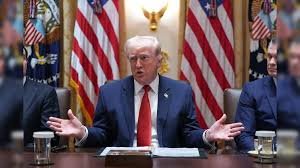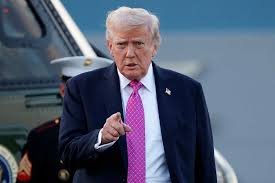
Trump warned trading partners against exploiting the decision, signaling tougher measures as global markets react with uncertainty.
BY PC Power
February 23, 2026 — Days after the U.S. Supreme Court struck down his sweeping global tariffs, President Donald Trump claimed the ruling had paradoxically expanded his authority, insisting it confirmed his ability to impose even stronger trade measures under alternative laws.
In a sharply worded post on Truth Social, Trump mocked the Court and declared that its decision had unintentionally empowered his presidency.
“The supreme court (will be using lower case letters for a while based on a complete lack of respect!) of the United States accidentally and unwittingly gave me, as President of the United States, far more powers and strength than I had prior to their ridiculous, dumb, and very internationally divisive ruling,” he wrote.
Trump argued that the judgment validated his ability to use other statutory tools more aggressively, claiming it provided legal certainty for tariffs imposed under separate authorities.
“For one thing, I can use Licenses to do absolutely ‘terrible’ things to foreign countries. The court has also approved all other Tariffs, of which there are many,” he added, while insisting he would not seek fresh approval from Congress.
The comments came after the Supreme Court ruled 6–3 on February 20 in Learning Resources, Inc. v. Trump, consolidated with Trump v. V.O.S. Selections, that Trump had exceeded his authority by imposing tariffs under the International Emergency Economic Powers Act (IEEPA), a 1977 law intended for national security emergencies rather than broad trade policy.
Writing for the majority, Chief Justice John Roberts concluded that IEEPA does not explicitly authorize the president to impose tariffs. The ruling invalidated wide-ranging “emergency” duties Trump had imposed on imports from multiple countries, citing issues such as trade deficits, drug trafficking, and national security threats.
🆘
Trade tensions resurface as Trump signals the possibility of higher retaliatory tariffs.Play games, pay higher tariffs — Trump’s message.#Tariffs#US_Tariffs#Trump_Tariffs pic.twitter.com/Iij3V7Tkl8
— $. €. Invest₹ust 🇮🇳 (@SterlingFincap) February 23, 2026
Following the decision, U.S. Customs and Border Protection confirmed it would immediately stop collecting tariffs imposed under IEEPA, marking a major legal setback for Trump’s global trade strategy.
However, Trump moved swiftly to restore his tariff framework using alternative legal authority. Within hours of the ruling, he invoked Section 122 of the Trade Act of 1974, which allows temporary tariffs to address balance-of-payments concerns. He initially imposed a 10 percent global tariff, before raising it to the statutory maximum of 15 percent, effective immediately.
The measure allows the tariffs to remain in force for up to 150 days without congressional approval, buying the administration time to reassess its broader trade strategy.
Trump also warned foreign governments against attempting to exploit the Court’s decision, signaling a willingness to escalate further if trading partners sought concessions.
“Any Country that wants to ‘play games’ with the ridiculous Supreme Court decision, especially those that have ‘Ripped Off’ the U.S.A. for years, will be met with a much higher Tariff, and worse,” he wrote in a separate post.
READ: Delhi LG Clears Reservation, Age Relaxation for ex-Agniveers
Administration officials have maintained that Trump’s core trade agenda remains unchanged despite the legal setback. His aggressive tariff strategy has been central to his economic platform, aimed at reducing trade deficits and pressuring foreign governments to renegotiate trade terms.
The Supreme Court’s ruling has introduced new uncertainty into global trade markets, raising questions about refunds for previously collected tariffs and the limits of presidential emergency powers. At the same time, Trump’s rapid pivot to alternative legal tools underscores his determination to retain leverage in international trade negotiations.
Critics warn that escalating tariffs could trigger retaliatory measures, disrupt supply chains, and fuel inflation, while supporters argue the approach fulfills long-standing promises to protect American industries.
With the temporary tariffs set to expire later this year unless extended or replaced, the confrontation between the White House, the courts, and America’s trading partners appears far from over.