A review of defence agreements and delivery timelines of Apache contradicts Trump’s claim, highlighting a familiar pattern of inflated figures in his public remarks.
BY PC Bureau
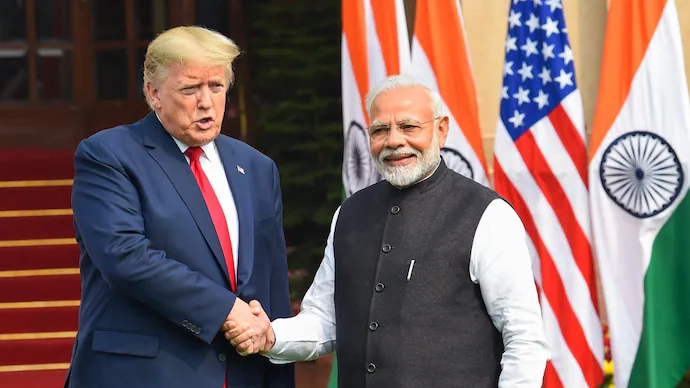
January 7, 2026: US President Donald Trump on Tuesday made another exaggerated claim, asserting that India had ordered 68 Apache attack helicopters from the United States and that delays in their delivery were so severe that Prime Minister Narendra Modi personally sought a meeting with him to complain about the issue.
A review of official contracts, delivery schedules and discussions with military and diplomatic sources, however, shows that Trump’s account does not align with the facts. India ordered a total of 28 Apache helicopters, not 68, and by December 2025, all of them had been delivered.
The discrepancy fits a pattern often highlighted by critics of Trump’s public statements, in which figures are inflated and timelines compressed to underscore US leverage or his personal role in global affairs. Similar concerns have been raised over his repeated claim that he forced India and Pakistan into a truce by threatening tariffs. In the Apache case, while delivery delays did occur and did frustrate New Delhi, the scale described by Trump was inaccurate. Nor is there evidence to support his claim that Prime Minister Modi deferentially asked, “Sir, may I see you, please?” to raise the matter.
India’s acquisition of the Boeing AH-64E Apache Guardian helicopters took place in two distinct phases, not as a single large order.
The first contract was signed in September 2015, during the final months of the Obama administration, when India agreed to buy 22 Apaches for the Indian Air Force in a deal worth around $2.2 billion. These helicopters were delivered on schedule, with the final units arriving by 2020 during Trump’s first term in office. They were inducted into two frontline squadrons and quickly became a core component of India’s attack helicopter fleet.
The second deal was signed in February 2020, during Trump’s visit to India. Valued between $600 million and $800 million, it covered six Apaches for the Indian Army Aviation Corps. This order experienced repeated delays and became a subject of discussion in both Indian and US political circles. Prime Minister Modi raised the issue during his visit to the White House in February 2025, among several other agenda items. Taken together, the two contracts total 28 helicopters—less than half the number cited by Trump.
Read: “Come Get Me, Coward”: Colombia’s Prez Gustavo Petro Dares Trump
While the Air Force’s Apaches were delivered on time, the Army’s six helicopters were significantly delayed. Deliveries were initially scheduled to begin in early 2024, but the first batch arrived only in July 2025, about 15 months late. The final three helicopters were delivered in December 2025, completing the order nearly two years behind schedule.
Multiple factors contributed to the delays. Boeing’s Apache production line in Mesa, Arizona, was hit by post-pandemic supply chain disruptions, including shortages of engines, gearboxes and specialised electronics. India also reportedly had a lower priority ranking within the US Defence Priorities and Allocations System in 2024, placing it behind other customers, including the US Army, for key components.
Technical and logistical challenges further compounded the problem. Boeing temporarily paused some Apache deliveries worldwide due to electrical and power-generation concerns that required additional safety testing. In a final setback, a shipment bound for India in November 2025 had to turn back mid-flight after Turkey denied overflight clearance to the Antonov-124 transport aircraft carrying the helicopters, adding several weeks to the delay.
These genuine frustrations likely formed the basis of Trump’s remarks, but the numerical exaggeration undermines their credibility. Some analysts suggest Trump may have conflated two separate Indian helicopter purchases from Boeing—the Apache and the CH-47F Chinook heavy-lift helicopter. India ordered 15 Chinooks, all of which were delivered between 2019 and 2020. Even combined, however, the two deals amount to only 43 helicopters. There is no record in India’s Ministry of Defence or US Foreign Military Sales notifications of any additional Apache orders beyond the 28 units, despite the Indian Army once projecting a requirement for 39.
India’s experience with delayed US deliveries and shifting strategic priorities, particularly in relation to China and Pakistan, has reinforced New Delhi’s push to reduce dependence on foreign suppliers. Under the “Make in India” initiative, India is increasingly prioritising indigenous platforms such as the HAL Prachand Light Combat Helicopter. Designed for extreme altitudes, the Prachand can operate above 20,000 feet—areas where the heavier Apache faces limitations, including regions like Siachen.
India plans to induct 156 Prachand helicopters across the Army and Air Force, gradually reducing reliance on imported attack helicopters. While Apaches are expected to remain India’s primary heavy strike platforms in plains and desert sectors, the future of the country’s rotary-wing combat capability is set to be increasingly home-grown.
Trump’s claim of a 68-helicopter order may have overstated the scale, but it has inadvertently highlighted why India is determined to limit exposure to unpredictable foreign dependencies.