With India-US tarde deal euphoria gone, Sensex fell 953 points, while Nifty slid 222 points this week, as disappointing corporate earnings and global volatility weighed on investor sentiment.
BY PC Bureau
February 13, 2026: The Indian stock market endured a bruising week as investor optimism around the India-US trade agreement gave way to a sharp selloff, particularly in IT and metal stocks, erasing massive wealth from the markets. Between Wednesday and Friday, investors lost a staggering Rs 9.5 lakh crore, with benchmark indices giving up early gains amid volatile trading sessions.
For the week, the BSE Sensex fell 953.64 points, or 1.14%, while the NSE Nifty 50 dropped 222.6 points, or 0.86%. The total market capitalization of companies listed on the BSE shrank by Rs 7,02,017.71 crore, settling at Rs 4,65,46,643.20 crore ($5.13 trillion) on Friday.
READ: Three Years On, Manipur Victims Still Wait as SC Presses CBI for Action
Why the Markets Nosedived
Friday’s trading session saw the Sensex and Nifty slide more than 1% as widespread selling pressure across metal, IT, and commodity shares mirrored weakness in global markets. Analysts pointed to subdued cues from overseas markets and heightened caution ahead of key US inflation and labour data.
Disappointing corporate earnings also weighed heavily on investor sentiment, alongside growing fears that rapid developments in artificial intelligence (AI) could upend traditional business models in the technology sector.
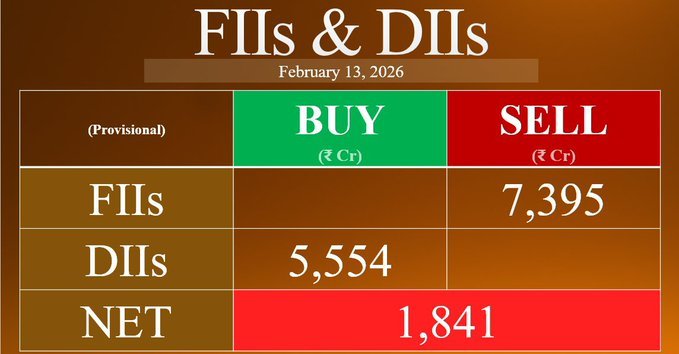
The Indian equity markets faced significant pressure today, February 13, 2026, as Foreign Institutional Investors (FIIs) offloaded shares worth a massive ₹7,395.41 crores in the cash segment. This aggressive selling triggered a sharp decline in benchmark indices, with the Nifty… pic.twitter.com/issdtoDPDa
— 𓄂Vinod Joseph (@MrVinodJoseph) February 13, 2026
“Selling pressure in IT stocks, coupled with weaker-than-expected earnings, primarily drove the decline,” said Siddhartha Khemka, Head of Research, Wealth Management at Motilal Oswal Financial Services Ltd. “The Nifty IT index hit a 10-month low, though selective buying helped contain losses slightly. Investors are increasingly concerned that AI could disrupt conventional service models and affect future revenue visibility.”
Vinod Nair, Head of Research at Geojit Investments, added that the initial optimism from the India-US trade deal had faded, and market participants grew cautious amid fears that Indian IT firms relying on labour arbitrage could lose ground to global peers listed on Nasdaq.
Sectoral Impact: IT and Metals Bear the Brunt
India’s $250 billion software services sector has been under intense pressure over the past eight trading sessions. Heavy selling erased several lakh crore in market capitalization, with TCS, Infosys, HCL Technologies, Wipro, and Tech Mahindra experiencing steep declines. TCS alone has dropped 44% from its record peak in August 2024, bringing its market capitalization below Rs 10 lakh crore—a level last seen in October 2020.
The immediate trigger has been the release of Anthropic’s Claude 4.6 and Cowork agents, sparking fears of a “SaaSpocalypse,” a potential structural shift threatening the traditional headcount-driven billing model for IT services.
Metal stocks also faced pressure as the dollar strengthened. Reports of Russia returning to US dollar settlements revived concerns about softened metal prices, prompting profit-booking in the sector.
Technical Outlook
From a technical perspective, Rupak De, Senior Technical Analyst at LKP Securities, noted that the Nifty has slipped below its 20-day moving average and breached the 38.2% Fibonacci retracement of its previous upward move from 24,571 to 26,341.
“With the index closing below the key support of 25,500, the near-term bias is weak, with potential for a further slide toward 25,000,” Rupak De said. “On the upside, immediate resistance is seen around 25,800.”
Nair observed that while tariff concerns are easing and the domestic earnings season is winding down on mixed trends, global cues—especially US labour and inflation data—will play a crucial role in shaping market direction.
Despite turbulence, analysts say selective sectors may benefit from rotation into domestically oriented industries. Banking, automobiles, and consumption-driven segments could attract investor attention as IT and metals face structural and external headwinds.
“Overall sentiment will likely remain cautious until clearer macroeconomic and policy signals emerge,” Nair said. “Improved valuations and constructive GDP forecasts may help sustain foreign portfolio inflows, but markets are expected to remain range-bound in the near term.”