BY Navin Upadhyay
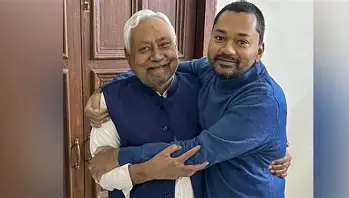
March 5, 2026: The sudden emergence of Nishant Kumar in Bihar’s political discourse marks a striking shift in the political landscape surrounding veteran leader Nitish Kumar. For decades, the chief minister carefully kept his family away from active politics, cultivating an image sharply different from many regional leaders who promoted dynastic succession. Yet today, both the Janata Dal (United) (JD(U)) and the Bharatiya Janata Party (BJP) appear to have strong political reasons to support the idea of Nishant Kumar stepping in as deputy chief minister.
At first glance, Nishant’s possible entry into government may appear surprising. Until recently, he was largely unknown in public life. For years, political workers, bureaucrats and visitors who frequented the official residence of Nitish Kumar in Patna rarely saw him involved in political meetings or organisational affairs. Unlike the children of many prominent politicians, Nishant had stayed almost entirely away from the public spotlight.
However, that began to change over the past year. A section of JD(U) leaders and supporters started quietly mounting pressure on Nitish Kumar to consider passing on his political legacy to his son. The argument was simple: the party’s long-term survival might depend on a figure who can symbolically inherit the political capital accumulated by Nitish Kumar over nearly two decades.
READ: JD(U) Cadres Up in Arms Over Reports of Nitish Kumar Quitting as CM
JD(U)’s Leadership Vacuum
The JD(U)’s biggest challenge today is the absence of a natural successor who commands broad social legitimacy within the party’s support base. Nitish Kumar’s political success has been rooted in a carefully crafted coalition of social groups, particularly the extremely backward castes (EBCs) and sections of other OBC communities.
Over the years, he painstakingly built a political narrative around governance, social justice and representation for marginalised groups. This social engineering allowed the JD(U) to consolidate support among communities that historically felt excluded from power.
But within the party, there is currently no mass leader from the broader OBC spectrum capable of holding this coalition together. Senior leaders in the JD(U) may have administrative experience or organisational influence, but few possess the social legitimacy or symbolic authority that Nitish Kumar commands among these communities.
In this context, Nishant Kumar is increasingly being viewed by some party leaders as a “continuity candidate.” Even though he lacks political experience, his biggest political asset is his surname. For many grassroots workers and supporters, especially those loyal to Nitish Kumar personally, the son could represent a way to preserve the party’s identity and keep its vote base intact.
Preventing Fragmentation
The fear within the JD(U) is that once Nitish Kumar withdraws from active politics due to age or health concerns, the party could rapidly fragment. Without a unifying figure, leaders might drift toward larger political formations or build their own regional factions.
Installing Nishant Kumar in a prominent position such as deputy chief minister could therefore serve as a symbolic anchor for party workers. Even if he initially plays a limited political role, his presence could reassure cadres that the Nitish legacy—and by extension the JD(U)’s political identity—will continue.
Why BJP Also Needs Nishant
The logic for the BJP supporting such a move is different but equally strategic. In Bihar’s complex political landscape, the saffron party has struggled historically to win power on its own. Despite being a major national force, the BJP has rarely been able to independently dominate the state’s caste-driven electoral arithmetic.
The BJP’s primary rival in the state remains the Rashtriya Janata Dal (RJD), which continues to command a formidable base among Yadavs and sections of Muslim voters.
To counter the RJD effectively, the BJP has long relied on alliances that broaden its social reach. The JD(U), under Nitish Kumar, has played a crucial role in bringing in EBCs and other non-Yadav OBC groups. These communities have been central to the electoral coalitions that helped the alliance remain competitive.
If the JD(U) were to weaken or split after Nitish Kumar’s departure, the BJP could lose access to this carefully cultivated vote base. Supporting Nishant Kumar as deputy chief minister could therefore help maintain the continuity of the JD(U) support structure within the alliance.
Stability in a Political Quagmire
Bihar’s politics has long been marked by shifting alliances, caste alignments and fragile coalitions. In such a volatile environment, both the BJP and the JD(U) have strong incentives to avoid sudden disruptions.
For the JD(U), Nishant Kumar could become a rallying point that prevents organisational collapse. For the BJP, his presence could help preserve the alliance’s social coalition and ensure that JD(U) voters continue backing the partnership in future elections.
In that sense, the emergence of Nishant Kumar is less about dynastic ambition and more about political survival. Whether he eventually evolves into an active political leader remains to be seen. But at this moment, for both the JD(U) and the BJP, his entry into government could represent a strategic attempt to stabilise an alliance navigating one of the most uncertain phases in Bihar’s recent political history.