Organised by COCOMI, the “Manipur Kanba Khongchat” rally highlighted public anger over alleged inaction by authorities, delayed rehabilitation of IDPs, and fears of external interference.
By PC Bureau
January 31, 2026 — In one of the largest public mobilisations in Manipur in recent months, tens of thousands of people poured onto the streets of Imphal on Friday in a powerful and emotionally charged demonstration demanding the protection of the state’s territorial and administrative integrity and urgent safeguards for its indigenous communities.
The massive rally, titled “Manipur Kanba Khongchat” (Save Manipur Rally), was organised by the Coordinating Committee on Manipur Integrity (COCOMI), a prominent umbrella body representing multiple Meitei civil society organisations. The march saw overwhelming participation from women, students, youth groups, elderly residents, market vendors, and large numbers of internally displaced persons (IDPs) — many of whom continue to live in relief camps nearly three years after ethnic violence first erupted in the state.
The demonstration unfolded against the backdrop of the prolonged and unresolved ethnic conflict that began in May 2023 between the valley-based Meitei community and hill-based Kuki-Zo groups. Since then, the violence has claimed more than 260 lives, displaced over 60,000 people, and fractured Manipur’s social and political fabric. Despite repeated peace initiatives, security deployments, and political interventions, tensions remain high, and trust between communities and institutions continues to erode.
READ: Adani Agrees to Accept US SEC Summons in Bribery Case
READ: Sharad Pawar Breaks Silence on NCP Merger Plan and Ajit Pawar’s Final Wish
A City in Motion
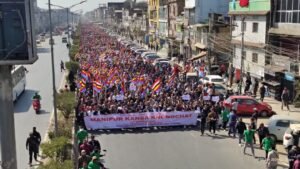
Under tight security arrangements, including heavy deployment of the Central Reserve Police Force (CRPF) and state security personnel, the rally commenced at Tiddim Ground in Kwakeithel, located along the Imphal airport road. From there, thousands of marchers proceeded along major thoroughfares, passing through Tiddim Road, Keishampat Junction, Wahengbam Leikai, Nagamapal, and Khuyathong, before culminating at THAU Ground in Thangmeiband, situated close to the Manipur Legislative Assembly complex.
The scale of participation transformed central Imphal into a sea of banners, placards, and festoons, creating a striking visual of collective resolve. Chants and slogans reverberated through the streets, with participants raising voices in unison, declaring: “Manipur gi Saktam Kaiba Yaroi” (Manipur’s territorial integrity is non-negotiable) and “Long Live Manipur.”
Placards carried pointed political messages, including “We condemn the Indian government’s double standards in peace talks,” “Public alert rally on peace negotiations,” and “Manipur Kanba Khongchat.” Many marchers also held photographs and handwritten appeals calling for justice, rehabilitation, and the safe return of displaced families to their homes.
Anger, Anxiety, and Assertion
Addressing the massive gathering, COCOMI convenor YK Dhiren delivered a sharply worded speech, accusing the central government of deliberate inaction and alleged complicity in what he described as a “proxy war” being waged through “Chin-Kuki narco-terrorist networks.” He alleged that powerful external forces were being used to destabilise Manipur, undermine indigenous communities, and threaten the state’s territorial integrity.
“This is not merely an ethnic conflict. It is an attack on Manipur’s identity, unity, and existence,” Dhiren told the crowd. “We will not remain silent spectators while our land, our people, and our future are put at risk.”
Other speakers echoed similar sentiments, demanding an immediate end to what they described as external interference, swift and dignified resettlement of IDPs, dismantling of alleged narco-terrorist networks, and the restoration of popular democratic governance in the state.
Their demands acquired added urgency as President’s Rule in Manipur nears its one-year mark on February 12, intensifying anxieties about prolonged political uncertainty and administrative paralysis.
Statewide Cease-Work, Widespread Participation
The rally coincided with a statewide cease-work call, which witnessed significant compliance across the Imphal Valley and parts of surrounding districts. Government offices saw thin attendance, while markets, educational institutions, and private establishments largely shut down in solidarity.
The protest drew participation from diverse sections of society, including Meira Paibies — Manipur’s iconic women torchbearers — student unions, local clubs, traders, transport workers, and civil society organisations. Groups arrived from districts such as Bishnupur, Thoubal, Kakching, Imphal East and West, Jiribam, and even some hill areas, highlighting the breadth of public mobilisation.
For many IDPs, the rally became a platform to express years of pent-up grief and anger. Families displaced from their homes marched with placards describing their continued suffering in overcrowded relief camps, lack of livelihood opportunities, and uncertain prospects of return.
“We have lost everything — our homes, our farms, our dignity,” said a displaced woman from Kangpokpi, now living in a camp near Imphal. “We want peace, but not at the cost of our identity and rights.”
Resolutions and Renewed Warnings
The march culminated in a mammoth public meeting at THAU Ground, where organisers read out a series of resolutions. These included strong condemnation of what participants termed the Indian government’s “proxy war alliance with illegal immigrants”, demands for decisive security operations against armed groups, accelerated rehabilitation and resettlement of IDPs, and immediate political dialogue rooted in constitutional principles and local consent.
The resolutions also reaffirmed that Manipur’s territorial unity remains non-negotiable, drawing parallels with historic mass movements that successfully resisted perceived threats to the state’s boundaries in earlier decades.
Organisers warned that continued neglect and delayed action could further radicalise public sentiment, deepening alienation and instability in a region already scarred by decades of insurgency and counter-insurgency operations.
A Peaceful Protest Amid Heavy Security
Despite the charged atmosphere and strong rhetoric, the demonstration concluded peacefully, with no major incidents reported. Security personnel maintained tight vigil throughout the route, erecting barricades, deploying rapid response teams, and monitoring crowd movement to prevent any flare-ups.
Authorities described the event as “peaceful but intense,” noting that the sheer scale of mobilisation reflected deep public frustration with the slow pace of political resolution and rehabilitation efforts.
A State at a Crossroads
Friday’s rally underscored the widening trust deficit between large sections of Manipur’s population and the political establishment, both in Imphal and New Delhi. Nearly three years into the conflict, many residents feel trapped in a cycle of uncertainty, displacement, and fear, with no clear roadmap for durable peace.
As ethnic tensions persist, buffer zones remain contested, and thousands of families continue to live in limbo, the “Manipur Kanba Khongchat” stands as a stark reminder of the urgency of meaningful dialogue, transparent governance, and inclusive peace-building.
For the people of Manipur, the message was unambiguous: peace must not come at the cost of territorial integrity, democratic rights, or historical identity. And until those assurances are secured, the streets will continue to echo with calls for justice, unity, and lasting reconciliation.