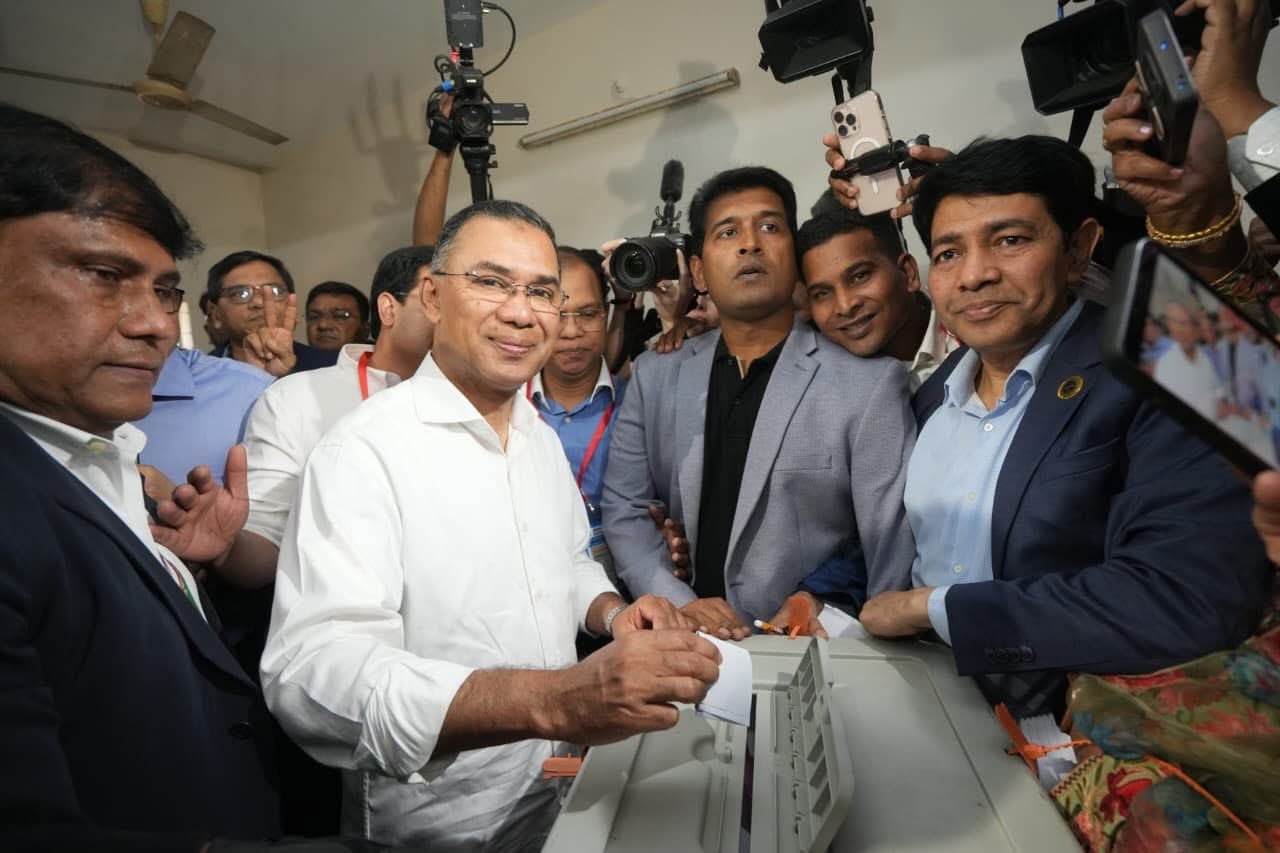
BNP leaders say the party is on track to secure over 200 of the 300 parliamentary seats, defeating an 11-party alliance led by Jamaat-e-Islami in one of the most closely watched elections in recent years.
BY PC Bureau
February 13, 2026: The Bangladesh Nationalist Party (BNP), led by Tarique Rahman, surged toward a decisive victory in Thursday’s crucial national election, paving the way for the 60-year-old leader to become Bangladesh’s next prime minister.
Rahman, who returned to Bangladesh after 17 years in exile in the United Kingdom, was elected from both Dhaka-17 and Bogura-6 constituencies, according to unofficial results from the Election Commission and party sources, The Daily Star reported.
Prime Minister Narendra Modi congratulated Tarique Rahman for BNP’s decisive victory. Ina post on X, Modi said, “India will continue to stand in support of a democratic, progressive and inclusive Bangladesh.”
I convey my warm congratulations to Mr. Tarique Rahman on leading BNP to a decisive victory in the Parliamentary elections in Bangladesh.
This victory shows the trust of the people of Bangladesh in your leadership.
India will continue to stand in support of a democratic,…
— Narendra Modi (@narendramodi) February 13, 2026
The United States congratulated Rahman on what it described as a “historic victory.” US Ambassador to Bangladesh Brent T. Christensen wrote on X: “Congratulations to the people of Bangladesh on a successful election and to the Bangladesh Nationalist Party and Tarique Rahman on your historic victory. The United States looks forward to working with you to realize shared goals of prosperity and security for both our countries.”
The BNP entered the contest as the frontrunner, fielding candidates in 292 of the 300 parliamentary seats and allocating the remaining constituencies to smaller allies. Its main challenger was an 11-party alliance led by Jamaat-e-Islami.
BNP election committee spokesman Mahdi Amin told reporters the party was on course to secure at least two-thirds of the seats, adding that Rahman had won both constituencies he contested. Senior BNP leader Ruhul Kabir Rizvi claimed a “sweeping victory” in a party statement but did not provide specific figures. He urged supporters to offer prayers of thanksgiving on Friday instead of celebrating on the streets.
Who Is Tarique Rahman?
Tarique Rahman is the eldest son of former President Ziaur Rahman and three-time Prime Minister Khaleda Zia. He returned to Bangladesh after nearly 17 years in exile, following his mother’s death, and swiftly emerged as the leading contender for the prime minister’s post. The Awami League was unable to contest the election after its registration was suspended.
READ: Congress Flags Epstein Email Trail Linking Hardeep Puri to 2014 Meetings
Rahman formally assumed leadership of the BNP in December 2025 after Khaleda Zia’s death, having previously served as the party’s acting chairman. Often referred to as the “dark prince,” he was widely regarded as the de facto power center between 2001 and 2006 during the BNP–Jamaat coalition government, while Khaleda Zia was prime minister. During that period, he operated from Hawa Bhaban, a building frequently described as a “shadow PMO.”
Between 2006 and 2008, Bangladesh witnessed intense political unrest as the BNP and Awami League clashed over delayed elections. The turmoil led to the installation of a military-backed caretaker government, which curtailed civil liberties and attempted to reshape the political landscape. Elections held in 2008 brought the Awami League back to power.
Rahman was arrested in May 2007 and detained for 17 months on multiple charges, including money laundering and involvement in an alleged assassination plot against Sheikh Hasina. He was convicted in absentia, but the verdicts were overturned after Hasina was removed from power in a student-led uprising in August 2024. Rahman later relocated to London for medical treatment, alleging torture during his detention.
What Rahman Said About India
One of the most pressing challenges for the incoming government will be recalibrating relations with India. Under Sheikh Hasina, India was Bangladesh’s closest ally, but ties deteriorated sharply after her government’s fall and have grown increasingly strained.
Rahman acknowledged existing “issues” with India, stating that he seeks a relationship based on “mutual respect” and “mutual understanding.” When asked whether ties could improve while India continues to provide refuge to Hasina and members of her party, Rahman responded, “That depends. It has to be on them too.”
Managing relations with India is expected to be one of the first major tests for a BNP-led government, as both countries navigate a period of diplomatic uncertainty.
———————————————–
BANGLADESH NATIONAL ELECTION – SEAT TALLY
(300 Total Seats | Unofficial Trends)
———————————————–
Party / Alliance Seats
Bangladesh Nationalist Party (BNP) At least 200*
Jamaat-e-Islami–led 11-party alliance Remaining seats (approx. <100)*
Others / Independents Minimal / TBD
———————————————–
*BNP leaders claim they are on track for
at least two-thirds majority (200+ seats).
*Final numbers subject to Election Commission confirmation.