The use of submissive language has raised doubts about COTU’s ability to enforce unity within the Kuki-Zo political leadership. Critics argue the statement weakens the organisation’s negotiating position on separate administration and security guarantees.
BY PC Buraeau
The Committee on Tribal Unity’s (COTU) latest appeal to the Centre against pushing Kuki-Zo legislators into Manipur’s political process has drawn attention not only to its demands but also to the unusually conciliatory tone of its statement, which critics say exposes the organisation’s limited influence over its own elected representatives.
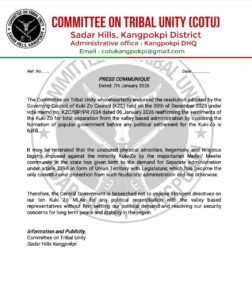
COTU has endorsed a resolution passed by the Governing Council of the Kuki Zo Council (KZC) on December 30, 2025, reiterating opposition to the formation of a popular government in Manipur before a political settlement addressing Kuki-Zo demands is reached. The resolution calls for complete separation from the valley-based administration and reiterates the demand for a Separate Administration in the form of a Union Territory with a legislature under Article 239A.
While the statement details allegations of sustained violence, domination and religious discrimination against the Kuki-Zo community by the majority Meitei population, its concluding appeal adopts a notably deferential tone toward the Centre.
In its final paragraph, COTU said the Central Government was “beseeched” not to impose directives on the ten Kuki-Zo MLAs to engage in political reconciliation with valley-based leaders until political and security concerns were resolved.
Observers note that the choice of language weakens the force of the organisation’s political stance. Rather than asserting authority over its legislators, the appeal suggests that the Centre holds greater influence over the Kuki-Zo MLAs than the community’s own representative bodies. The plea to New Delhi to “spare” the legislators from political engagement has been read as an admission that COTU lacks the ability to enforce unity or discipline within its own ranks.
READ: Trump Exaggerates Apache Deal, Facts Undercut ‘68 Helicopter’ Claim
The statement, critics argue, inadvertently undercuts COTU’s claim of representing a unified political will. By projecting dependence on the Centre’s discretion, the organisation risks diluting its bargaining position at a time when it seeks constitutional restructuring and long-term security guarantees for the Kuki-Zo people.
The episode highlights a growing perception that while tribal organisations continue to articulate strong demands on paper, their political leverage may be weakening—particularly when their own elected representatives appear to be beyond their direct control.