Brent crude jumps 10% and European gas spikes after attacks on Saudi and Qatari energy facilities, highlighting rising Gulf risks.
BY PC Bureau
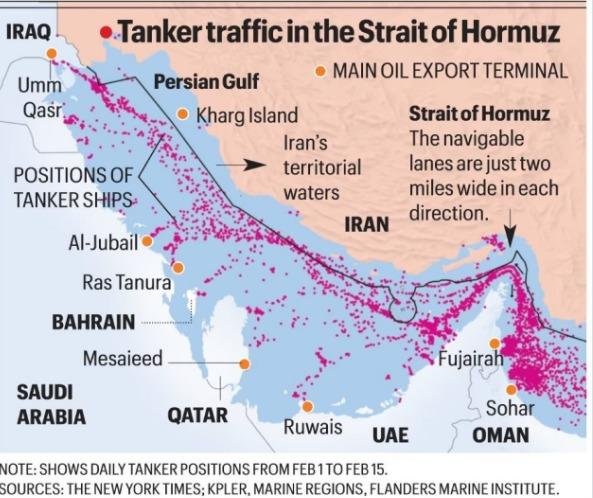
March 2: Global oil shipments through the Strait of Hormuz have all but frozen, choking nearly 86% of normal east–west crude traffic and sending energy markets into a state of high alert.
Maritime analytics firms Windward and Kpler report that, although the strait is not formally closed, the flow of vessels has collapsed. On March 1, only three tankers carrying a combined 2.8 million barrels of crude crossed the waterway — a staggering 86% drop from the 2026 daily average of 19.8 million barrels. By early March 2, the situation worsened, with just a single small tanker and a small cargo ship navigating the main lanes.
The bottleneck has created a massive backlog. Approximately 706 non‑Iranian tankers are now stranded on either side of the strait: 334 crude carriers, 109 dirty product tankers, and 263 clean product vessels. In addition, 26 tankers are drifting in the Gulf without clear destinations, while hundreds more remain idle in the Gulf of Oman, unable to proceed safely.
Global “wait and freeze” in energy markets
Markets responded immediately. Brent crude surged nearly 10% to around $80 a barrel. European gas prices jumped more than 40% after coordinated attacks targeted Saudi Arabia’s Ras Tanura refinery and a Qatari LNG facility, prompting emergency shutdowns. Analysts describe the situation as a global “wait and freeze,” as traders and refiners hesitate to commit cargoes amid extreme uncertainty.
If the standoff continues for days, tanker queues are expected to balloon further, disrupting delivery schedules across the globe. War‑risk insurance for Gulf waters has already tightened sharply, sending freight rates and premiums higher — costs that flow directly into consumer fuel prices.
If the disruption persists for weeks, the fallout could be severe. Asian and European refiners are urgently seeking alternative supplies from the US Gulf, West Africa, Brazil, and Russia. Countries like China and India, heavily reliant on Gulf crude, face immediate vulnerabilities, with potential knock-on effects for both domestic fuel availability and international markets.
READ: Sonia Gandhi Slams Centre’s Silence on Khamenei Killing
READ: Drone Strike Hits US Embassy in Riyadh Amid Escalating Conflict
India braces for possible shortages
In New Delhi, government officials are reportedly considering emergency measures to secure domestic supplies. These could include curbing petrol and diesel exports, ramping up imports of Russian crude, and introducing demand‑management measures such as LPG rationing if the crisis deepens. NDTV could not independently verify these potential actions.
The oil ministry emphasized on X that it is “continuously monitoring the evolving situation, and all necessary steps will be taken to ensure availability and affordability of major petroleum products,” following a review by Oil Minister Hardeep Puri.
India exports a significant portion of its refined fuels — roughly a third of petrol and around a quarter of diesel output. LPG is especially at risk: the country imports 80–85% of its requirements, mostly via the Strait of Hormuz. Current stocks are reportedly sufficient for less than two weeks if shipments are halted.
To mitigate risk, state refiners Indian Oil, HPCL, and BPCL have increased LPG production at select facilities. Puri noted that India’s combined crude and product reserves — across strategic caverns, refineries, ports, and floating storage — can cover about 74 days of demand. Within that, dedicated crude caverns hold roughly 17–18 days of demand, refined fuels about 20–21 days, and LNG storage around 10–12 days.
US President Donald Trump has warned that the West Asia conflict could last “weeks, not days,” underscoring the growing challenge for India and other nations to balance domestic fuel security with their roles as major exporters in a highly interconnected global energy market.