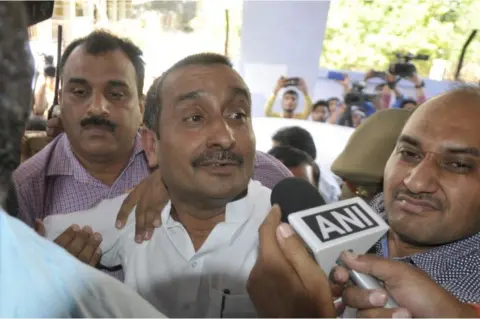
A Supreme Court bench led by CJI Surya Kant held that substantial questions of law arise from the High Court’s ruling and made an exception to the usual practice of not staying bail orders without hearing the accused in th Unnao rape case. .
BY PC Bureau
New Delhi, December 29: The Supreme Court on Monday stayed the operation of the Delhi High Court order that had granted bail to former Uttar Pradesh MLA Kuldeep Singh Sengar and suspended his life sentence in the Unnao rape case, directing that he shall not be released from prison for now.
A vacation bench comprising Chief Justice of India Surya Kant, Justice J.K. Maheshwari, and Justice Augustine George Masih issued notice to Sengar on an appeal filed by the Central Bureau of Investigation (CBI) challenging the High Court’s December 23 decision. The court stayed the High Court order and sought a counter-affidavit from Sengar within four weeks.
“We have heard the Solicitor General for the CBI and senior counsel for the convict. We find that several substantial questions of law arise for consideration,” the bench observed, while ordering that Sengar remain in custody pending further hearing.
The apex court noted that it ordinarily does not stay bail orders without hearing the accused, but said the present case warranted an exception. “Given the peculiar facts, where the respondent stands convicted for a separate offence as well, we stay the operation of the Delhi High Court order dated December 23. The respondent shall not be released pursuant to the said order,” it said.
During the hearing, the Supreme Court also expressed concern over the High Court’s interpretation of the term “public servant” under Section 5 of the Protection of Children from Sexual Offences (POCSO) Act. The bench cautioned that such an interpretation could have far-reaching consequences and potentially exclude elected representatives from the ambit of aggravated sexual offences under the law.
A decent day.
Supreme Court stays the Delhi HC order granting bail to Sengar in Unnao Rape case
Secondly, the Aravali judgement has been stayed till a committee of experts is constituted. pic.twitter.com/4eJOPQAimG
— Areeb Uddin (@legallyuddin) December 29, 2025
“The legal issue requires consideration. While the judges of the High Court are among the finest, we are all prone to committing errors. We are concerned that while a constable may be treated as a public servant under the POCSO Act, a Member of the Legislative Assembly could end up being excluded,” the court remarked.
The CBI had approached the Supreme Court against the Delhi High Court’s decision to suspend the life sentence imposed on Sengar by a trial court in December 2019. Sengar was convicted for offences under the Indian Penal Code and the POCSO Act in connection with the rape of a minor and was sentenced to imprisonment for the remainder of his natural life.
However, the High Court suspended the sentence and granted bail, holding prima facie that the offence of aggravated penetrative sexual assault under the POCSO Act was not made out against him. It ruled that Sengar did not fall within the definition of a “public servant” under Section 5(c) of the POCSO Act or Section 376(2)(b) of the IPC, and that he could also not be brought within the scope of Section 5(p) of the POCSO Act, which deals with persons in a position of trust or authority.
In its appeal, the CBI argued that the High Court had erred in law by excluding a sitting MLA from the definition of a public servant. The agency contended that an elected legislator occupies a constitutional position of trust and authority and performs public duties in which the State and the community at large have a direct interest.
The CBI also raised concerns over the safety of the survivor and her family, submitting that Sengar is an influential individual and that his release during the pendency of the appeal could jeopardise their security and undermine public confidence in the justice delivery system.
Read: Dense Fog Brings Delhi-NCR to a Standstill, Flights Hit by Major Delays
Appearing for the CBI, Solicitor General Tushar Mehta described the case as a “horrific” instance of child rape. He told the court that charges had been framed under Section 376 of the IPC and Sections 5 and 6 of the POCSO Act, and that the trial court had recorded a clear finding that the victim was below 16 years of age at the time of the offence.
One of the grounds cited by the High Court for suspending the sentence was that Sengar had already undergone the maximum punishment of seven years under the applicable provision at the time. The Solicitor General disputed this, arguing that the minimum punishment for the offence is 20 years following amendments to rape laws.
The bench, however, clarified that the amendment enhancing punishment came into force after the commission of the offence. “The amendment was not in force at the time of commission of the offence,” Justice Maheshwari noted.
The matter will now be taken up after the filing of counter-affidavits, with the Supreme Court’s stay ensuring that Sengar remains in jail in the interim.