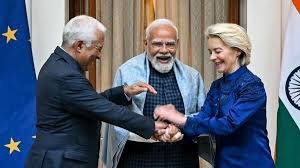
The FTA will eliminate or reduce tariffs on over 90% of EU goods, opening European markets to Indian exports like textiles, leather, and jewellery, while lowering prices on European imports such as automobiles, wine, and food products.
BY PC Bureau
New Delhi | January 27, 2026 — Prime Minister Narendra Modi on Tuesday described the conclusion of the comprehensive Free Trade Agreement (FTA) between India and the European Union as the “biggest free trade agreement in Indian history” and a milestone that could help stabilise a world facing economic and geopolitical uncertainty.
Speaking on the sidelines of the India-EU Summit in New Delhi, PM Modi called the day “historic,” saying the agreement moves India-EU relations into a new phase of co-development and shared prosperity. “Yesterday, a big agreement was signed between India and the European Union. People are calling it the mother of all deals,” he said.
The Prime Minister noted that the pact brings together two major economic blocs accounting for nearly 25% of global GDP and about one-third of world trade, underlining its scale and strategic importance. He said the agreement would significantly improve market access for Indian goods in Europe and should be seen not merely as a trade pact but as a blueprint for long-term economic partnership.
READ: India–EU Seal ‘Landmark’ FTA, Slash Tariffs on Over 90% of Goods
READ: US Slams EU-India Trade Pact, Flags Russian Oil Purchases
Prime Minister @narendramodi says India-EU ties are reaching new heights.
PM Modi calls the India EU FTA as historic, saying it will benefit farmers and MSMEs#EuropeanCommission #EUIndiaRelations #IndiaEU #EUIndiaEkSaath@MEAIndia @EU_Commission @EUCouncil… pic.twitter.com/4gISHDpopX
— All India Radio News (@airnewsalerts) January 27, 2026
The announcement coincided with high-level talks at the 16th India-EU Summit, attended by European Commission President Ursula von der Leyen and European Council President António Costa. Leaders exchanged a political declaration marking the conclusion of negotiations, with the formal signing expected later this year after approvals by EU institutions.
Negotiations on the FTA, which resumed in 2022 after a nine-year pause, spanned nearly two decades and addressed long-standing differences over tariffs, market access, intellectual property, and sustainability standards. The agreement is expected to lower prices of several European imports for Indian consumers while boosting Indian exports such as textiles, jewellery, leather, and footwear.
Beyond trade, PM Modi said India and the EU were strengthening cooperation in defence, security, supply chains, migration, and mobility, positioning the partnership as a stabilising force amid global uncertainty. He added that India-EU ties have gained momentum in recent years, anchored in shared democratic values, economic complementarity, and strong people-to-people links.
Highlighting the human dimension of the relationship, the Prime Minister noted that nearly eight lakh Indians living in Europe play a vital role in deepening bilateral ties.
Industry leaders have welcomed the deal, projecting a sharp rise in bilateral trade from the current level of around $120 billion annually, though concerns remain over implementation challenges such as non-tariff barriers and environmental regulations.
As global attention turns to the agreement’s rollout, the India-EU FTA is being seen as one of the most consequential trade pacts of the decade, with the potential to reshape global trade patterns in an increasingly multipolar world.