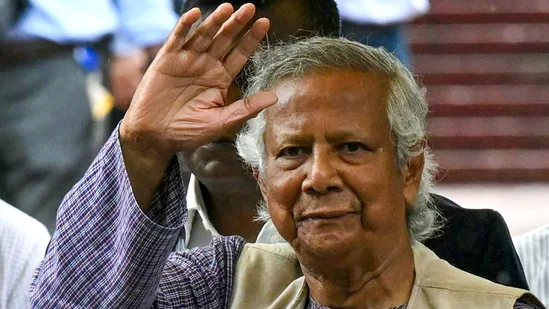
Yunus portrayed Bangladesh as a crucial maritime gateway for the landlocked northeastern region, signalling Dhaka’s intent to assert its geographic and economic importance in regional connectivity.
BY PC Bureau
February 17, 2026: India-Bangladesh relations, already strained during Muhammad Yunus’s tenure as interim chief, appeared to face one final jolt as he used his farewell address to once again reference India’s sensitive northeastern region. In a speech marked by assertive nationalism, Yunus invoked the “Seven Sisters” while declaring that Bangladesh was no longer a “submissive” nation, signalling a defiant tone toward New Delhi even as he exited office.
In his 25-minute address, Yunus emphasised Bangladesh’s geographic advantage, arguing that the country could unlock vast economic opportunities for India’s northeastern states through access to its seaports. Notably, he referred to the Seven Sisters without mentioning India, a formulation that many in New Delhi may view as an attempt to frame the region as economically dependent on Bangladesh rather than an integral part of India’s strategic landscape.
“Bangladesh can provide huge potential for economic prosperity for the seven sister states, Nepal and Bhutan. Our open seas are not just borders — they are gateways to the global economy,” Yunus said.
Bangladesh interim government chief advisor Md Yunus once again rakes up India’s “Seven Sisters” in his last address to the nation ahead of new govt formation tomorrow
“Our open sea is not only a geographical boundary, it is an open door to engage with the world economy for… pic.twitter.com/bEYQWCdVqi
— Indrajit Kundu | ইন্দ্রজিৎ (@iindrojit) February 16, 2026
READ: Rajpal Yadav Gets Interim Bail in Cheque Bounce Case
The remark is widely seen as an effort to position Bangladesh as a critical maritime outlet for the landlocked northeastern region. It also echoes Yunus’s earlier comments during his visit to China last year, when he described India’s northeast as “landlocked” and encouraged greater regional connectivity involving Beijing — statements that drew sharp criticism from Indian leaders and northeastern chief ministers.
Under Yunus’s 18-month leadership, ties between Dhaka and New Delhi deteriorated significantly, accompanied by rising anti-India sentiment within Bangladesh. His administration was also marked by closer engagement with China and Pakistan, moves that unsettled India, which has historically been one of Bangladesh’s closest partners, particularly during times of political and humanitarian crisis.
China figured prominently in Yunus’s farewell speech, with the Nobel laureate calling for a “strategic balance” in foreign relations and highlighting expanding cooperation with Beijing. He cited progress on the China-backed Teesta River project and the construction of a 1,000-bed international hospital in Nilphamari as key achievements of his administration.
The Teesta initiative, in particular, has drawn scrutiny from India due to its proximity to the Siliguri Corridor — the narrow stretch of land often referred to as the “Chicken’s Neck,” which connects mainland India to its northeastern states and is considered strategically vital.
Yunus’s final remarks reinforce the perception that his tenure marked a departure from Bangladesh’s traditionally close alignment with India, instead pursuing a more diversified foreign policy anchored in deeper ties with China. His parting message, invoking economic leverage over the northeastern region, is likely to be interpreted in New Delhi as a continuation of the diplomatic friction that defined much of his time in office.