BY PC Bureau
January 26, 2026: India’s 77th Republic Day celebrations on January 26, 2026, transformed Kartavya Path in New Delhi into a vibrant showcase of the nation’s military strength, technological self-reliance, and rich cultural tapestry. This year’s parade held special significance as it marked the 150-year legacy of the national song Vande Mataram, composed by Bankim Chandra Chatterjee in 1875 and first appearing in his novel Anandamath. The song later became a powerful rallying cry during India’s freedom struggle.
The day began on a solemn note with Prime Minister Narendra Modi laying a wreath at the National War Memorial, paying homage to the nation’s fallen heroes and setting a tone of gratitude and remembrance ahead of the grand parade.
President Droupadi Murmu, accompanied by the chief guests—European Council President Antonio Costa and European Commission President Ursula von der Leyen—arrived in the traditional horse-drawn buggy, escorted by the President’s Bodyguard, the Indian Army’s oldest regiment. Their presence underscored the strengthening ties between India and the European Union amid ongoing discussions on trade and strategic partnerships.
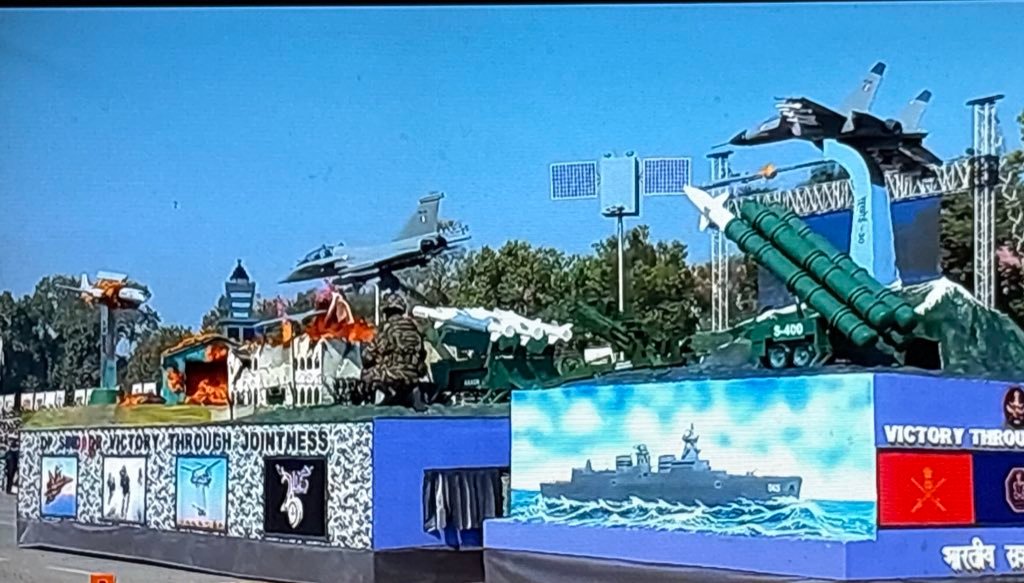
#WATCH | The Tri-Services tableau at this year’s Republic Day showcases Operation SINDOOR: Victory Through Jointness, highlighting the unity, strength, and seamless coordination of the Indian Army, Navy, and Air Force in safeguarding national sovereignty
Watch Republic Day… pic.twitter.com/iqJ9FnKwWC
— DD News (@DDNewslive) January 26, 2026
As per tradition, the national flag was unfurled at Kartavya Path, followed by the national anthem and a resounding 21-gun salute. The salute was fired using indigenously developed 105 mm light field guns by the 1721 Ceremonial Battery of the 172 Field Regiment, highlighting India’s growing capabilities in domestic defence manufacturing.
A major highlight of the parade was the Indian Army’s first-ever display of a phased battle array format, integrating ground and aerial elements to demonstrate modern operational readiness. The reconnaissance segment featured the historic 61 Cavalry in active combat uniforms, followed by high-mobility vehicles. Aerial support was provided by the indigenous Dhruv Advanced Light Helicopter and its armed variant, Rudra, which carried the flag of Operation Sindoor—a recent military operation symbolising India’s decisive response to cross-border terrorism and showcasing joint tri-services coordination, indigenous technology, and air dominance.
The Tri-Services tableau of the Indian Armed Forces prominently featured Operation Sindoor, illustrating victory through integrated operations and self-reliance in defence systems. The display included advanced platforms such as the BrahMos missile, Apache helicopters, Dhanush artillery, Bhishma and Arjun tanks, NAG missiles, among others.
The parade was commanded by Lieutenant General Bhavnish Kumar, General Officer Commanding, Delhi Area, a second-generation army officer. Major General Navraj Dhillon, Chief of Staff, HQ Delhi, and a third-generation officer, served as the Parade Second-in-Command.
READ: Horrific Murder Inside Mumbai’s Train Caught on CCTV
Recipients of India’s highest gallantry awards added inspiration to the event. These included Param Vir Chakra awardees Subedar Major (Honorary Captain) Yogendra Singh Yadav (Retd.) and Subedar Major Sanjay Kumar, along with Ashoka Chakra awardees Major General C.A. Pithawalla (Retd.) and Colonel D. Sreeram Kumar. In a special honour, Group Captain Shubhanshu Shukla, the second Indian astronaut to travel to space, was conferred the Ashoka Chakra by the President.
OPERATION SINDOOR FORMATION 🔥
Under the resolute leadership of PM Narendra Modi (@narendramodi ), India’s skies today echo confidence, capability and unchallenged national pride.
The marching contingent of the Indian Air Force participates in the #RepublicDay parade at… pic.twitter.com/0a33G4nBuq
— Pradeep Bhandari(प्रदीप भंडारी)🇮🇳 (@pradip103) January 26, 2026
A contingent from the European Union also participated in the parade, with four flag bearers on three gypsies carrying the flags of the European Union, European Union Military Staff, EU Naval Force Atalanta, and EU Naval Force Aspides, symbolising shared values and deepening cooperation.
Kartavya Path was elaborately decorated to reflect India’s national journey, seamlessly blending military spectacle with cultural reverence for Vande Mataram. More than 100 cultural artists performed on the theme ‘Vividata Mein Ekta’ (Unity in Diversity), delivering a grand musical presentation celebrating India’s pluralistic heritage and enduring national unity. Tableaux from States and Union Territories, along with those from various ministries and departments, further highlighted cultural diversity, economic progress, and the vision of Aatmanirbhar Bharat.
The 77th Republic Day Parade stood as a powerful testament to India’s evolution—a nation that honours its historical roots through the enduring spirit of Vande Mataram, projects formidable military capability shaped by real operations like Sindoor, and embraces global partnerships while steadfastly pursuing self-reliance and unity in diversity.