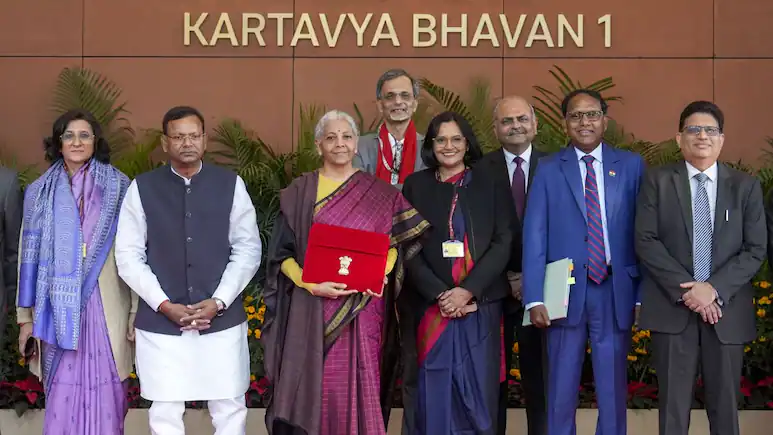
Budget 2026 is expected to prioritise structural economic reforms, customs simplification and manufacturing expansion, while maintaining fiscal discipline and avoiding sweeping tax relief measures.
BY PC Bureau
February 1, 2026: In a few hours, Finance Minister Nirmala Sitharaman will present her ninth Union Budget, traditionally one of the most anticipated political and economic events of the year. Budget mornings in India typically buzz with speculation around tax cuts, slab changes, and middle-class relief. This year, however, the atmosphere is noticeably more restrained.
Expectations are modest, wishlists are shorter, and the mood is cautious. Yet the quieter buildup does not necessarily signal a low-impact budget.
According to government sources, Budget 2026 is shaping up to be one of the most reform-driven blueprints in recent years, even as it steers clear of dramatic tax changes.
Spotlight on Structural Reforms
A key shift is already visible in the structure of the budget speech. Officials indicate that Part B — traditionally reserved for tax proposals — will take centre stage, laying out a comprehensive roadmap of India’s economic priorities.
This section is expected to detail the government’s strategy to strengthen manufacturing, expand exports, and integrate India more deeply into global value chains. In previous budgets, this narrative largely featured in Part A. The structural change signals a sharper focus on long-term economic transformation rather than short-term announcements.
Within the finance ministry, the internal theme of this year’s budget is reportedly “Reform Express,” underscoring a push toward regulatory streamlining, competitiveness, and industrial capacity-building.
The urgency stems from mounting global trade challenges, including sustained U.S. tariffs that continue to pressure Indian exporters despite progress on bilateral trade agreements. Strengthening export resilience and manufacturing competitiveness has therefore become a top policy priority.
Macroeconomic Strength, Market Caution
India enters budget day on a strong macroeconomic footing. The Economic Survey 2025–26 projects real GDP growth of 6.8% to 7.2% in FY27, following an estimated 7.4% expansion this year. Inflation has eased sharply and remains within the RBI’s comfort zone, while domestic demand has stayed resilient.
Yet financial markets remain guarded.
Vinod Nair, Head of Research at Geojit Financial Services, notes that recent sessions have reflected a mix of optimism and volatility. Concerns over global liquidity, tariff pressures, and rupee depreciation have weighed on sentiment, even as strong growth projections boosted confidence.
“Investors are looking for a budget that supports momentum while maintaining fiscal discipline,” he said.
Budget Day 2026 is here – and it’s a historic SUNDAY presentation! ⏰ 11 AM sharp.
Middle class right now: Refreshing news, praying for tax relief, higher exemptions, and NO new cess! 🙏😭💸
Key Expectations:
– Continued push: ₹11-12 lakh crore+ allocation for infrastructure… pic.twitter.com/gRmXP7ditU
— Jarnail Singh Gill (@jelly_gill) February 1, 2026
Why Major Tax Relief Is Unlikely
One major reason for subdued tax expectations is last year’s sweeping reform. Budget 2025 eliminated income tax for earnings up to roughly Rs 12.75 lakh under the revised new regime, delivering significant middle-class relief.
“Governments rarely repeat such large-scale tax changes in consecutive budgets,” analysts note, suggesting personal income tax slabs are likely to remain unchanged.
That said, modest tweaks remain possible, including a marginal increase in standard deduction, compliance easing for small businesses and professionals, and clarity on long-term capital gains taxation.
Anand K Rathi, co-founder of MIRA Money, stressed the importance of predictable taxation. “Stable capital gains and debt tax rules promote long-term wealth creation and reduce uncertainty for household investors,” he said.
Customs, Trade and Manufacturing Overhaul
One of the most closely watched announcements will be customs reform. Senior officials confirm the government is preparing a significant restructuring of tariff frameworks to simplify procedures, reduce classification disputes, and enhance predictability for businesses embedded in global supply chains.
A major policy initiative under consideration is the creation of Unified Export and Manufacturing Zones, merging Special Economic Zones (SEZs), Export Oriented Units (EOUs), and the MOOWR regime into a single integrated framework aimed at boosting exports and domestic value addition.
READ: Epstein Files Explode: Photos Show Prince Andrew on All Fours Over Woman
READ:Epstein Emails Claim PM Modi Took Advice for 2017 Israel Visit
Fiscal Discipline with Targeted Spending
Budget 2026 is expected to maintain tight fiscal discipline, with analysts projecting the fiscal deficit to move closer to 4.2% of GDP.
Gaurav Garg of Lemonn Markets Desk expects defence, renewable energy, semiconductors, and urban infrastructure to receive policy priority, even as overall expenditure growth remains measured.
Meanwhile, Arun Patel of Arunasset Investment Services pointed out that cooling inflation — with CPI dropping to 1.3% in December — provides space for calibrated growth support without destabilising fiscal balances.
A Blueprint for Long-Term Growth
In sum, Budget 2026 is unlikely to deliver headline-grabbing tax cuts, but it could introduce some of the most consequential structural reforms in recent years.
With a restructured speech, stronger emphasis on manufacturing and trade competitiveness, and a decisive tilt toward long-term economic correction, Sitharaman’s ninth budget may shape India’s growth trajectory well beyond this financial year.