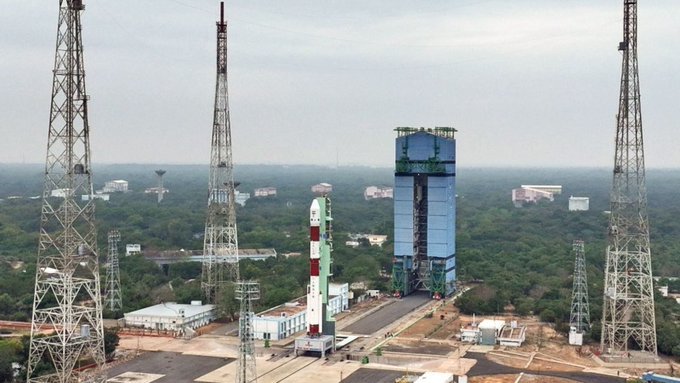
The ISRO’s launch was intended to restore confidence after a PSLV failure in 2025, but the anomaly has raised fears of back-to-back setbacks for India’s most reliable launch vehicle.
BY PC Bureau
January 12, 2026: India’s workhorse Polar Satellite Launch Vehicle (PSLV) suffered a fresh setback on Monday after its 64th mission encountered an anomaly mid-flight, raising serious concerns for the Indian Space Research Organisation (ISRO) following back-to-back failures of the trusted rocket.
The mission, designated PSLV-C62, lifted off from the Satish Dhawan Space Centre in Sriharikota at 10:18 am, carrying Earth Observation Satellite EOS-N1 along with 15 other satellites. However, minutes after launch, ISRO detected a deviation during the rocket’s third stage — a phase considered critical for placing payloads into precise orbits.
ISRO Chairman Dr V. Narayanan confirmed that while the first and second stages of the four-stage rocket performed as expected, the mission veered off its planned trajectory during the third stage. “Data is being analysed and we will share details at the earliest,” he said, stopping short of officially declaring the mission a failure.
In PSLV missions, third-stage anomalies are typically severe, often resulting in the loss of payloads. If confirmed, this would mark the second consecutive PSLV failure, following a similar third-stage malfunction during the vehicle’s only launch in 2025.
ISRO fails again & that too PSLV 💔
>back to back failure of PSLV which is workhorse of ISRO
>One after one Strategic satellites are going waste, keeping our Armed Forces & intel agencies behind>price, delay & reputation of India space sector at cost
— Vivek Singh (@VivekSi85847001) January 12, 2026
READ: Trump Likely to Visit India Soon, US Envoys Indicates
Comeback mission under cloud
PSLV-C62 was intended to restore confidence in the launch vehicle after last year’s setback. Following the 2025 failure, ISRO had constituted a failure analysis committee, though its findings were never made public. Despite the unresolved questions, ISRO cleared PSLV-C62 as the first launch of 2026 — a decision that now faces renewed scrutiny.
The rocket was carrying 16 satellites, including EOS-N1 and Anvesha, a surveillance satellite developed by the Defence Research and Development Organisation (DRDO). Anvesha is designed to deliver advanced imaging and monitoring capabilities, adding strategic significance to the mission.
Blow to commercial and global partners
The potential loss of the satellites would have implications well beyond ISRO. Payloads from international customers — including Brazil, Nepal and the United Kingdom — were aboard the rocket, underlining the global commercial stakes involved.
Indian private space companies have also been hit. Hyderabad-based Dhruva Space had seven satellites onboard, making it one of the largest commercial participants in the mission. For startups increasingly reliant on PSLV’s reputation for reliability, repeated failures pose a serious business risk.
Though five failures in 64 missions do not constitute a poor statistical record, PSLV has long been marketed as a dependable and cost-effective launch vehicle — a cornerstone of India’s commercial space ambitions.
Wider implications for India’s space programme
The timing of the anomaly is particularly sensitive. India is preparing to launch the first industry-manufactured PSLV under a consortium led by Hindustan Aeronautics Limited and Larsen & Toubro. Any unresolved technical issues could complicate that transition and delay commercial expansion plans.
For now, ISRO has neither confirmed success nor failure. However, Dr Narayanan’s admission that the mission could not proceed along its intended trajectory has fuelled concerns that the payloads may have been lost.
Once the full data analysis is complete, ISRO’s findings are expected to shape not only the future of PSLV launches but also confidence in India’s rapidly growing public-private space ecosystem.