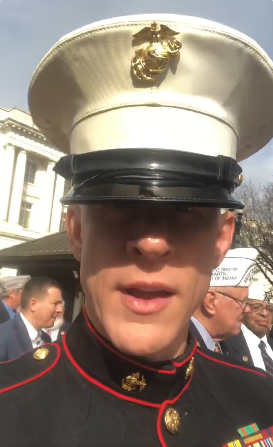
A protest by former Marine sergeant Brian McGinnis at a hearing of the United States Senate Armed Services Committee has gone viral, highlighting rising opposition to the war with Iran.
BY PC Bureau
March 5, 2026: A dramatic confrontation at a US Senate hearing has become a rallying point for anti-war activists protesting Washington’s military involvement in the escalating conflict with Iran.
A US Marine Corps veteran was forcibly removed from a hearing of the United States Senate Armed Services Committee on Wednesday after interrupting proceedings to protest the war. Video of the incident — which quickly spread across social media — shows Capitol Police officers dragging the protester out of the chamber as he shouted: “No one wants to fight for Israel!”
Bystanders in the footage can be heard claiming that the protester’s arm was broken during the struggle.
The man was identified as Brian McGinnis, a former Marine sergeant, activist with Code Pink and a Green Party candidate for the US Senate in North Carolina. McGinnis disrupted a subcommittee hearing on military readiness, shouting that “America does not want to send its sons and daughters to war for Israel” and claiming Israel was responsible for the conflict.
Former Marine Sgt. Brian McGuinness stood up in Congress to say what millions of Americans are thinking: We don’t want to fight a war with Iran for Israel.
Security dragged him out and broke his arm. Veterans are speaking out. The American people don’t want this war. pic.twitter.com/Bxjluiol5f— Medea Benjamin (@medeabenjamin) March 4, 2026
Footage shows McGinnis clinging to a doorframe as police officers tried to remove him. Tim Sheehy, a Republican senator from Montana and a former Navy SEAL, briefly stepped in to help officers escort him out.
Some recordings captured an audible snapping sound during the scuffle. McGinnis later alleged that his left arm or wrist had been broken.
The United States Capitol Police said McGinnis faces charges including assaulting officers and resisting arrest. Authorities added that both the protester and three officers received medical treatment following the incident. Sheehy said he intervened only “to help out and de-escalate the situation.”
READ: India Rejects Claim That US is Using Its Ports to Strike Iran
Dispute Over Injury
Debate over how the injury occurred quickly erupted online. Some video clips appear to show McGinnis jamming his own hand in a door while resisting removal, while critics — including fellow protesters — have accused Sheehy of causing the injury during the scuffle.
The senator has not commented further on the allegation.
The dramatic footage has circulated widely online, with many users portraying it as a symbol of rising public anger over US involvement in the Middle East conflict.
Protests Spread Across the US
McGinnis’s removal comes amid a wave of anti-war demonstrations across the United States since American and Israeli strikes on Iranian targets began on February 28.
The joint operation by the US and Israel followed the assassination of Iran’s Supreme Leader, Ali Khamenei, and has drawn Washington into direct military confrontation with Tehran.
US President Donald Trump has said the campaign could last “four weeks”.
Activist coalitions including ANSWER Coalition, Code Pink and the Democratic Socialists of America say demonstrations have taken place in more than 40 cities.
On Monday, designated a national day of action, protests were held in Washington, New York, Los Angeles, Chicago, San Francisco, Atlanta and Boston. Demonstrators carried placards reading “Stop the war on Iran” and “Not another war for Israel”, while some waved Iranian and Palestinian flags.
In Los Angeles, around 150 people gathered outside City Hall to denounce the strikes as an “illegal act of war”. Similar protests took place in New York City and near the White House.
Veterans’ groups and military families have also joined the demonstrations, arguing that Americans are weary of new Middle East conflicts after two decades of wars in Iraq and Afghanistan.
Deepening Political Divide
Supporters of the military action argue the strikes were necessary to neutralise Iranian threats and defend a key ally.
But critics say the Senate hearing confrontation reflects growing public frustration with US foreign policy in the region.
As protests continue and the conflict intensifies, the removal of a Marine veteran from a Senate hearing has become more than just a viral moment — it has emerged as a powerful symbol of the widening divide between US government policy and an anti-war movement gaining momentum across the country.