The latest climbdown follows a similar March episode when COTU dropped its demand for arrests in the Kamjong killings after government assurances, with no action taken so far.
By PC Bureau
April 10, 2026
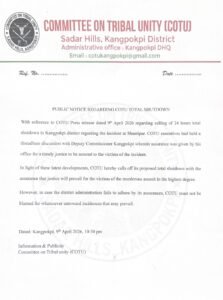
In yet another embarrassing display of hollow rhetoric followed by swift retreat, the Committee on Tribal Unity (COTU), Sadar Hills, Kangpokpi, has performed a fresh U-turn. Just a day after calling for a 24-hour total shutdown to protest the April 8 shooting of Kuki-Zo civilian Lenkhogin Tuboi near Shantipur–Kanglatongbi Bridge in a sensitive buffer zone, the organisation has quietly withdrawn the bandh.
In a public notice issued late on April 9, COTU cited a “threadbare discussion” with the Deputy Commissioner of Kangpokpi and vague “assurances” of timely justice for the victims of what it had earlier termed a “murderous assault.” It then promptly called off the shutdown, adding the now-familiar disclaimer that if the administration fails, “COTU must not be blamed for whatsoever untoward incidences that may prevail.”
This is no isolated lapse. It reflects a deeply troubling and increasingly predictable pattern—issue aggressive ultimatums, disrupt public life, raise community expectations, and then retreat at the first sign of official assurances or behind-the-scenes pressure.
Repeat Offender: The March 2026 Kamjong Killings Climbdown
On March 12, 2026, COTU’s Sadar Hills Kangpokpi unit issued a stern 48-hour ultimatum demanding immediate arrests in the killing of two Kuki-Zo villagers—Thangin Baite of Thawai Kuki village and Thangboimang Khongsai of Shankai village—in Kamjong district.
The victims were allegedly shot dead by armed Tangkhul militants linked to NSCN-IM while tending their paddy fields. Another individual was injured. The incident sparked outrage across Kuki-Zo hill districts, with COTU accusing militants of fuelling land disputes and pursuing an ethnocentric agenda, citing a pattern of intimidation including past village attacks.
Yet by March 15—barely three days later—COTU abruptly withdrew its ultimatum in what observers widely described as a face-saving exercise. The group latched onto assurances—already announced earlier by the government—that the case would be handed over to the National Investigation Agency (NIA) for investigation.
No arrests have been made to date. The hardline posture collapsed without securing any concrete accountability.
Political Compulsions and Questions of Autonomy
Critics point to deeper structural and political constraints behind these repeated retreats. Deputy Chief Minister Nemcha Kipgen, a Kuki-Zo leader aligned with the state government, hails from Kangpokpi—COTU’s stronghold. Despite the killings of members of her own community, she has never publicly condemned the incidents.
Her husband, S.T. Thangboi Kipgen, chairs the Kuki National Front (KNF), part of the United People’s Front (UPF) operating under a Suspension of Operations agreement with the Centre. He wields significant influence in the region, with local perceptions that no major protest in Kangpokpi proceeds without tacit approval.
Kuki Man Shot at in Manipur’s Buffer Zone, COTU Calls for Bandh https://t.co/CCgAUK7xz0 #Manipur #Kangpokpi #BreakingNews #IndiaNews #Security #Conflict
— POWER CORRIDORS (@power_corridors) April 9, 2026
READ: Kangpokpi Shooting: Glaring Loopholes in Manipur Police Narrative
Notably, even when Nemcha Kipgen joined the Manipur government—a move that triggered protests across other Kuki-Zo hill districts—Kangpokpi remained largely silent. Observers say this reflects the degree of political accommodation shaping local responses.
Analysts argue that such entanglements have severely undermined COTU’s autonomy. The organisation often raises its voice forcefully but appears unable—or unwilling—to sustain pressure when it matters most.
Kanglatongbi Shooting: Same Script, Same Outcome
The April 8 Kanglatongbi incident follows the same script. Manipur Police issued their version nearly 24 hours later—only after COTU announced the shutdown—claiming “controlled firing” aimed at the tyres of a fleeing vehicle during a supposed vehicle exchange.
The driver, Lenkhogin Tuboi, sustained bullet injuries, while another individual from the accompanying vehicle was briefly detained and released.
Local accounts, however, allege an unprovoked attack on Kuki-Zo civilians. Key questions remain unanswered: Why was live fire used in a notified buffer zone? How did a tyre-targeted shot hit the driver? Was there an actual threat, or merely panic-driven evasion?
Yet, instead of sustaining pressure for an independent probe, suspension of personnel, or transparent answers, COTU once again settled for assurances and withdrew its agitation.
Credibility Erodes as Pattern Repeats
This recurring cycle—loud threats, public disruption, and quiet compromise—is steadily eroding COTU’s credibility. Ordinary citizens bear the brunt of shutdowns, while core demands remain unmet.
In a state still grappling with the aftermath of the 2023 ethnic violence, where buffer zones are meant to preserve fragile peace, such inconsistency only deepens mistrust and leaves grievances unresolved.
Meanwhile, the victims—from Kamjong to Kanglatongbi—continue to wait for justice. Repeated assurances and recurring U-turns do little more than compound their suffering.