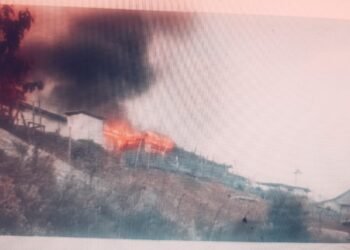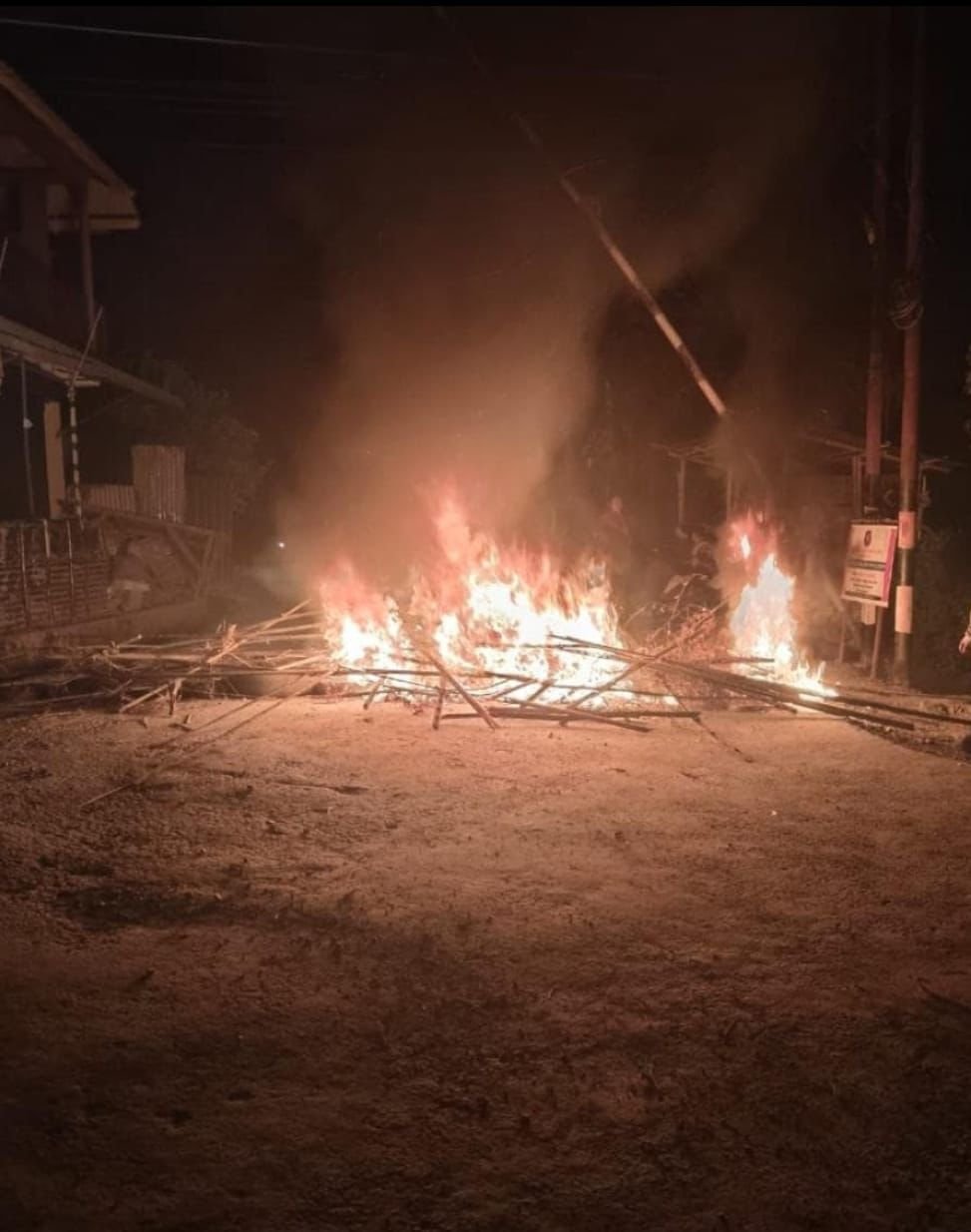
Manipur plunged into fresh turmoil after three Kuki-Zo MLAs defied a community boycott and joined the new government, triggering dire warnings, armed threats, mass protests, and gunfire in parts of Churachandpur.
BY PC Bureau
February 4, 2026: Manipur’s return to elected government after nearly a year of President’s Rule was overshadowed on day one by explosive political fallout, mass civil unrest, explicit threats from armed groups, and gunfire in a Kuki-Zo stronghold, exposing the extreme fragility of the state’s political and security landscape.
The inclusion of four Kuki-Zo legislators in the new BJP-led government, defying a near-unanimous community boycott resolution, triggered widespread protests, dire warnings, and violent signalling, raising fears of renewed escalation in a state already fractured by nearly three years of ethnic conflict.
A Chin-Kuki group identifying itself as “Village Volunteer, Eastern Zone” has issued an extreme and inflammatory statement announcing bounties targeting three Kuki-Zo legislators, including newly sworn-in Deputy Chief Minister Nemcha Kipgen, and MLAs L M Khaute and Ngursanglur Sanate.
The purported threat was circulated through Kukiland India, a widely followed Chin-Kuki social media channel that security agencies have previously flagged for carrying propaganda and extremist content.
READ: Manipur Swears in New Govt as Three Kuki-Zo MLAs Defy Boycott, Trigger Unrest
In a ceremony at Lok Bhavan in Imphal, senior BJP leader Yumnam Khemchand Singh was sworn in as Chief Minister by Governor Ajay Kumar Bhalla. He was joined by Nemcha Kipgen (BJP, Kangpokpi) and Losii Dikho (Naga People’s Front) as Deputy Chief Ministers, along with cabinet ministers Govindas Konthoujam (BJP) and Khuraijam Loken Singh (National People’s Party).
Prime Minister Narendra Modi congratulated the new government, expressing hope for development and reconciliation. However, those optics collapsed within hours as Kuki-Zo civil bodies and armed groups denounced the defections as betrayal, setting off protests and security alerts across the hill districts.
Nemcha Kipgen’s Virtual Oath: A Stark Symbol of Fear and Political Collapse
In a powerful illustration of the crisis, Nemcha Kipgen took her oath virtually from Manipur Bhawan in New Delhi, citing serious security threats that made travel to Imphal untenable.
Sources confirmed she received explicit warnings from multiple quarters, forcing her to remain under tight security in Delhi. The extraordinary step of administering a remote oath for a Deputy Chief Minister underscores the depth of hostility and fear engulfing Kuki-Zo politics.
While Kipgen made history as Manipur’s first woman Deputy CM and the first from the Kuki-Zo community, critics argue that her inability to safely enter her own state exposes the collapse of political legitimacy and social trust.
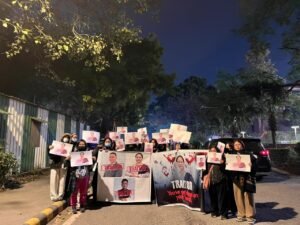
In New Delhi, Kuki women staged a late-night vigil outside Manipur Bhawan, where Kipgen was staying, holding placards stamped “TRAITOR” with images of the four MLAs.
Slogans read:
“You have blood on your hands”
“No mandate, no legitimacy”
“Power over people is betrayal”
Her elevation has further intensified anger due to her husband’s leadership role in the Kuki National Front (KNF), an armed group under the Suspension of Operations (SoO) agreement and currently in talks with the Centre for a separate Union Territory, raising serious concerns over conflict of interest and political optics.
Gunfire in Churachandpur: A Chilling Message
Late Monday night, gunshots rang out in Churachandpur, the political heartland of the Kuki-Zo movement, in what local residents and security officials described as symbolic and deliberate protest firing.
Though no casualties were reported, the incident has triggered high alert across the hill districts, with authorities fearing that political outrage could rapidly spiral into armed confrontation.
Security officials said the gunfire appeared to be a warning signal, reflecting deep rage over the political defections and escalating the atmosphere of fear and volatility.
The three MLAs Who Defied the Community Mandate
The legislators accused of violating the community’s collective resolution are:
Nemcha Kipgen — Kangpokpi (Deputy Chief Minister)
L M Khaute — Churachandpur
Ngursanglur Sanate — Tipaimukh (Pherzawl)
Their decision defied resolutions adopted on December 30, 2025, by the Kuki-Zo Council (KZC) and on January 13, 2026, at the Lungthu Political Convention in Guwahati, where civil bodies, SoO armed groups, and elected representatives collectively pledged non-participation in the Manipur government unless the Centre provided written constitutional assurances for a separate Union Territory with legislature.
READ: Manipur Swears in New Govt as Four Kuki-Zo MLAs Defy Boycott, Trigger Unrest
Kuki-Zo Council: ‘A Historic Betrayal That Risks Shattering Our Struggle’
The Kuki-Zo Council (KZC) issued a blistering, multi-page condemnation, describing the defections as a “historic betrayal” that could “irreversibly weaken the political struggle of the Kuki-Zo people.”
“After enduring unspeakable atrocities, ethnic cleansing, mass displacement, and forced segregation, the Kuki-Zo people unanimously resolved that participation in the Manipur government is politically, morally, and historically untenable,” the council said.
“Any legislator joining does so solely in personal capacity, without mandate, consent, or moral authority. Such participation amounts to a direct betrayal of our collective struggle for dignity, justice, security, and self-determination.”
Issuing a stern warning, the KZC added:
“The responsibility for any political instability, social unrest, or untoward developments shall rest squarely on those who chose power over the blood, suffering, and future of their people.”
Calling political unity “the only shield protecting our collective future,” the council warned that fragmentation at this stage could permanently damage the movement.
The KZC demanded an immediate political roadmap from the Government of India for a Union Territory under Article 239A, backed by constitutional and human rights guarantees.
Kuki Liberation Army–Letkholun: ‘Final and Unambiguous Warning’
The Kuki Liberation Army–Letkholun (KLA-L), one of the principal armed groups operating in Kuki-Zo areas, issued one of its strongest public warnings to date, calling the MLAs’ move a “direct defiance of the collective will of the Kuki-Zo nation.”
“No legislator has the political, moral, or historical mandate to join a government tied to ethnic cleansing, mass displacement, and systematic violence,” the statement said.
“This is a clear, final, and unambiguous warning. Participants shall bear full responsibility for the political, social, and security consequences.”
The group added:
“History will record whether power was chosen over people, ambition over sacrifice, and survival over conscience.”
Security analysts described the language as deeply ominous, reflecting dangerous levels of radicalisation and volatility.
Kuki Inpi Manipur: ‘Reckless and Morally Bankrupt’
The apex tribal body Kuki Inpi Manipur (KIM) condemned the government formation as “reckless, insensitive, and morally bankrupt”, warning that it lacks political legitimacy and ground authority.
“This political exercise risks plunging the state into deeper chaos. Any Kuki-Zo legislator joining will be held directly accountable for further instability, bloodshed, and fragmentation,” the KIM said.
Protests Sweep Delhi and the Hills
Across Kangpokpi, Churachandpur, Pherzawl, Tengnoupal, and Chandel, mass shutdowns, protest marches, emergency meetings, and viral social media campaigns erupted, calling for political boycott, social isolation, and sustained agitation.
The political explosion is rooted in the ethnic conflict that erupted in May 2023, killing over 200 people, destroying thousands of homes, and displacing more than 60,000 residents, effectively creating a de facto partition between the Meitei-dominated Imphal Valley and the Kuki-Zo hill districts.
Political analysts warn that while the BJP enjoys numerical majority, its moral and political legitimacy in the hills is near zero.
“This government may hold constitutional authority, but its writ does not run across half the state. That makes governance structurally fragile,” said a senior political observer.
As Manipur formally exits President’s Rule, it enters a phase of heightened danger, marked by civil resistance, armed ultimatums, street protests, and now gunfire.
The new government begins its tenure not with hope — but under siege, facing an urgent test of whether it can prevent Manipur from sliding back into full-scale instability.